
Jens Liesebach, KGI Lower North Island Representative
Game on. The first 21% of the new Ruby Red kiwifruit has been harvested in New Zealand, and harvest of Gold kiwifruit started last Friday in Hawke’s Bay. Other growers are close to starting harvest but might be delayed by the weather bomb forecasted at the time of writing. The new COVID-19 isolation rules starting from Saturday 12 March should help with picker availability. People with COVID-19 and their household contacts will only be required to isolate for seven days rather than 10. Also, those who have recovered recently from COVID-19 will not need to isolate again for three months if someone else in their household tests positive.
Growers should be aware of the potential fruit contamination risk from hand sanitisers due to a group of compounds called QACs. Commonly Didecyldimethylammonium chloride (DDAC) and Benzalkonium chloride (BAC). These can leave residues on fruit, especially if hands are still wet after applying sanitiser and then putting on gloves and picking fruit. It is advised to check hand sanitisers and avoid those containing the above compounds. Look for those which are alcohol-based, IPA (isopropyl), which are commonly used in laboratories and won’t result in any residues. Although hands should be thoroughly dry prior to putting on gloves.
The Zespri Roadshow in March was moved online due to COVID-19 escalation. One of the main subjects was the expansion potential of ZGS. Zespri has been growing kiwifruit in the Northern hemisphere for the last 20 years and forecasts a growing demand for kiwifruit in the future. New Zealand grown fruit covers a substantial amount of shelf space but would benefit from an increased supply from Europe and Asia. Zespri welcomes grower feedback and has created a webpage with further information, click here
KVH has confirmed that the new Pathway Management Plan for the kiwifruit industry has successfully been approved by the Government. Effective from 1 April 2022, the new Pathway Management Plan focuses on protection against a full range of biosecurity threats to our industry instead of just focusing on a single pest (like Psa) and provides for a consistent and more pragmatic approach to managing pathway risks such as young plants, budwood, pollen, orchard equipment and other items moved by people.
This new plan is an achievement that reflects the efforts of all who contributed to development, planning, and several consultation stages since the proposal was first announced in November 2019, click here.
Consumers are excited about the newly released Red kiwifruit, Ruby Red. Zespri is hosting an information session on Thursday 17 March at 3 pm for those interested in the RubyRed licence tender, click here for more information.
If the stresses of work or just life in general, put the jug on and watch Nigel Latter’s spin on resilience. I found it highly informative and entertaining, click here to watch the video.
Enjoy,
Jens
Dr Kathleen Kozyniak
Principal Scientist Air
Hawke’s Bay Regional Council
Summer was a bumpy ride. Rainfall was high in December (143% of the long term average), drastically below average in January (34%) and then went nuts in February (232%). Temperatures were warm throughout, thanks to very warm seas along the region’s coast.
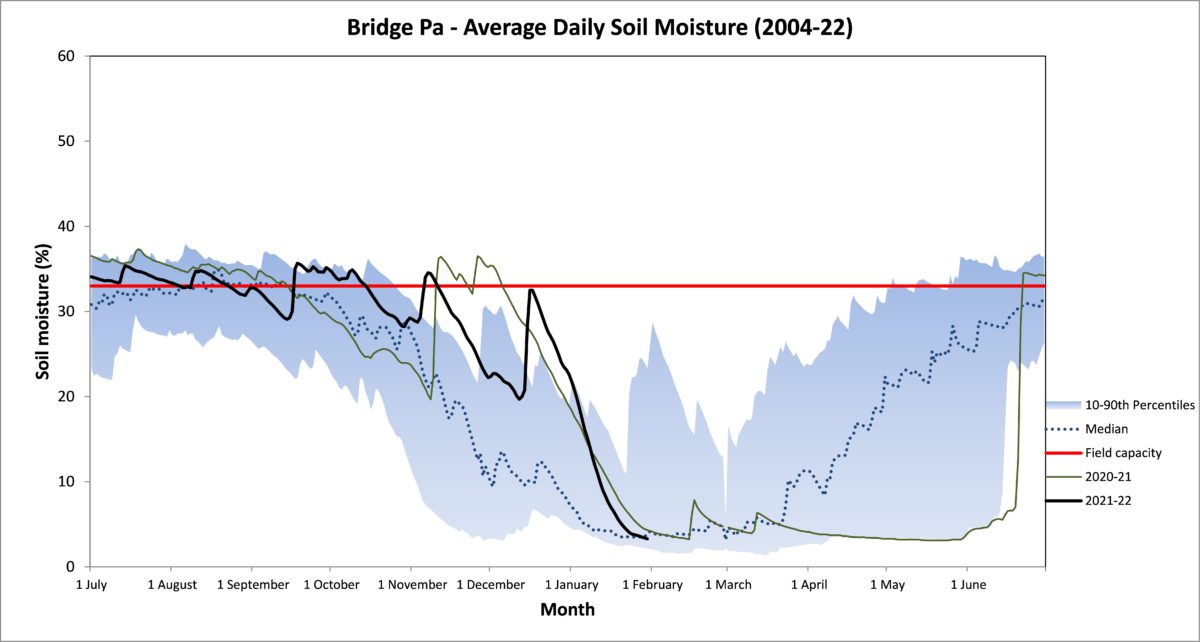
The result was soil moisture levels that ended summer looking fairly saturated, river flows that were well bolstered and groundwater levels that maintained good levels for the time of year. It’s a far cry from where we were this time last year and the year prior.
La Niña has largely met expectations but is predicted to weaken to neutral conditions during autumn. The next three months don’t look terribly different though in terms of the general pattern. Easterlies are still likely to feature regularly due to lower than usual sea level pressure to the north and northwest of New Zealand and higher to the south. Seas remain warm so air temperatures should too. Seasonal models continue to forecast either normal or above normal rainfall for the period, which doesn’t rule out a similar bumpy ride in autumn as we saw in summer. Even as I write, we have a low to the east that could either bring us phenomenal rain or simply whimper.
Percentage of Normal Rainfall
Summer Wynyard, NZAPI Student Liaison
In partnership with Plant & Food Research, Pūhoro Stem Academy and Pāhauwera Trust, NZAPI has recently congratulated three senior high school students on their participation in the Whakakotahi Cadetship Programme.
This pilot programme was introduced in 2021 with the aim of engaging secondary students in the horticulture industry. Programme goals included targeting local Māori tauira (students), making them aware of the vast career opportunities in horticulture, and overcoming the stigma of low-skilled, low-paid roles (particularly in the apples sector) by including the whānau of students on the journey.
The programme was spread over three weeks, and the three cadets were based primarily at Plant & Food Research in Havelock North, Hawke’s Bay.
The first week focused on high level overviews of different aspects of horticulture, including plant breeding, pest and disease management, FOP’s, and post-harvest quality control. In week two, visits were planned to include various sites across Hawke’s Bay, but this was unfortunately cancelled due to the national shift into the RED traffic light system. The students were adaptable and exhibited great patience as plans changed regularly. In the third week, the students split up and further engaged in their preferred areas of interest at Plant & Food.
As part of the program, NZAPI hosted a welcome and prize-giving at Plant & Food Research and invited key stakeholders, teachers from the students’ schools, and the students’ parents – to bring everyone on the learning journey and best support the students. And this also created an opportunity for the parents and teachers to learn too.
Although the COVID restrictions proved challenging, NZAPI were delighted to support the three amazing students to introduce them into the horticulture whanau, and wished them luck on their journeys as they begin tertiary studies in March.
NZAPI have exciting plans for this space in the future and are super thankful for all the work that partners have invested – Plant & Food Research, Pūhoro Stem Academy, Pāhauwera Trust and the high schools and teachers involved.
We look forward to acknowledging the following recipients at the Industry Awards Night on the 9 June at the Toitoi Arts & Events Centre:
HBFA Emerging Achiever Award: Emma Sherwood, NZAPI
Emma has been named the inaugural recipient of the HBFA Emerging Achiever Award. This award recognises an individual in the industry who has already demonstrated their ability to positively impact horticulture and shown in their own way, effective and positive leadership skills to strengthen relationships. Through Emma’s role at NZAPI, she has developed strong relationships with senior government officials and has become a trusted colleague to many within the horticulture sector and central government, her considered and enthusiastic approach has been pivotal to the successes that growers have had seen over recent times with access to RSE colleagues from the Islands.
Fourneau Trophy: Brendan Hamilton, H2Ortigator
This award recognises innovation in the fruit growing sector, that contributes to improved efficiency, sustainability or safety in the fruit growing community.
For several years, Brendan has been trialing an innovative tailored water management solution for new/establishing plants. The prototype was made last year and is currently being trialed with T & G Global, Mr Apple, Rocket, Freshco, Te Mata Estate, Craggy Range, Constellation, Villa Maria, Ngai Tukairangi Trust in Hawke’s Bay, and John O’Neil, Travelers and Southern Cross Horticulture in the Bay of Plenty for this growing season.
All scholarship and award recipients, and students receiving certificates and sashes will uplift their awards at this time. Please keep checking our Facebook and website page for updates.
The 2022 harvest is underway in Hawke’s Bay with early pear and peach varieties unfortunately bearing the brunt of the recent wet and windy conditions and growers recording some fruit loss. The first of the early variety apples were picked before the recent wet weather event and it is exciting to see some promising colour and size profiles.
Omicron is here – 981 cases today as I write this report. With harvest underway and the busiest period of the year for our industry, the Government today announced the country will enter Phase 2 – tonight. What does this mean for our industry?
Workers at registered critical services who are close contacts of a COVID-19 case will be able to continue to work as part of MBIE’s Close Contact Exemption Scheme with the use of rapid antigen testing. In addition any person who is identified as a close contact, and is vaccinated and whom can work alone, or have the capacity to do so, will be able to continue operating in a ‘bubble of one’.
To be considered in the close contact exemption scheme for critical services, your business must be registered. Please visit HortNZ’s website https://www.hortnz.co.nz/covid19/omicron/ for details.
Our Industry Awards Night was postponed in January due to the swift move into the red traffic light setting and we endeavour to hold this in June- more details are included in this newsletter along with the inaugural recipient of the Emerging Achiever Award who was presented this award due to her unavailability on the night. We also would like to congratulate Brendan Hamilton, for his H2Ortigator project, the Fourneau Trophy for outstanding innovation. We look forward to recognising these recipients at the rescheduled Awards Night on the 9 June.
The Association is excited to announce the appointment of Megan Dravitzki as the new Business and Relationship Manager. Megan will be responsible for the day-to-day operations and implementing HBFA’s strategic plan. We are fortunate that Jo will be supporting Megan in a handover period over the next couple of months. We look forward to introducing Megan in our next newsletter.
You don’t need me to tell you that this season will be challenging – we all know about the labour, COVID and logistic issues but as growers we are resilient – but resilience doesn’t mean you can’t or don’t ask for help. It doesn’t mean you don’t check up on your friends and neighbours. I’ve already heard of growers going out of their way to help other growers with labour whom they hardly know – our industry needs this we need to have a culture of sharing, caring and being willing to support one another. I encourage you to do this when you can.
All the best for the harvest.
Brydon Nisbet
HBFA President
Dr Kathleen Kozyniak
Principal Scientist Air
Hawke’s Bay Regional Council
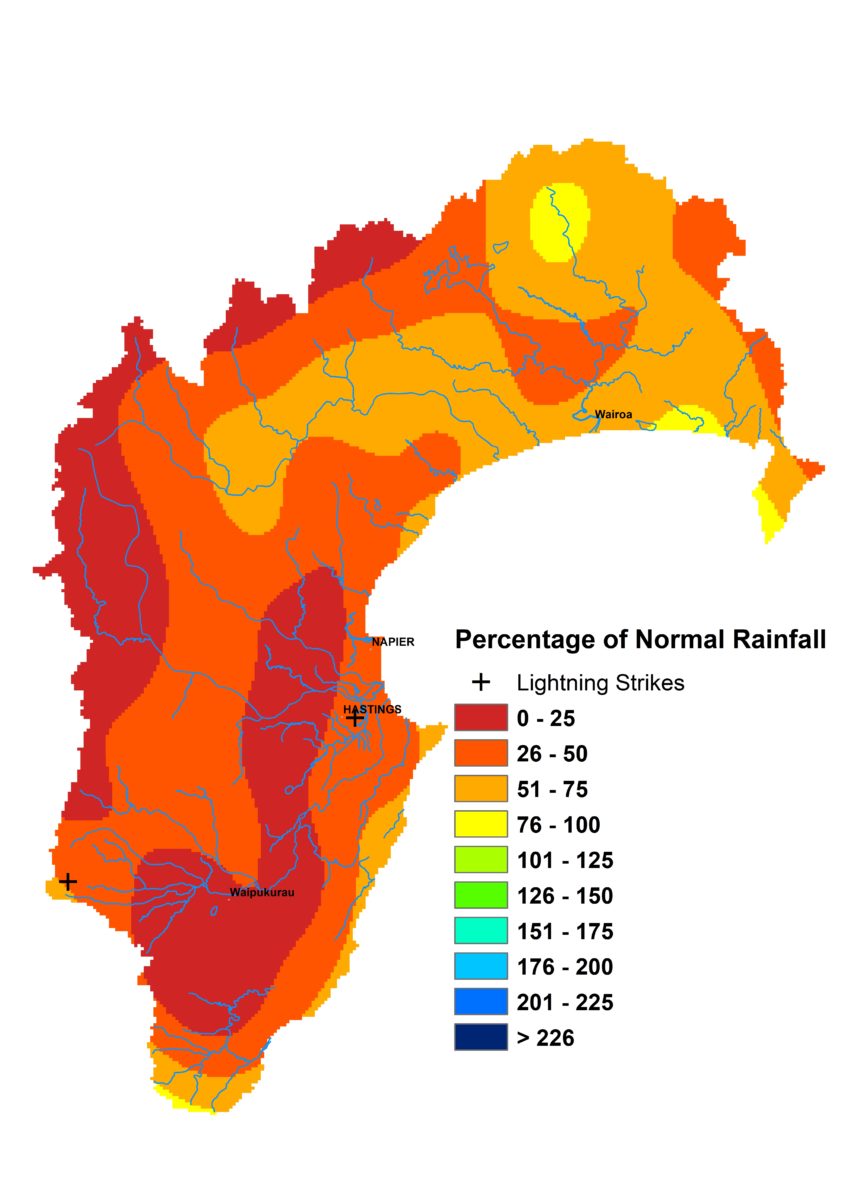
Well, after months of good rain, January decided to be contrary and barely showed up. The Plains and main ranges only got a quarter of average January rainfall and roughly 50% of normal was about the limit in other areas. Warmer than usual temperatures together with meagre rainfall can quickly turn things pear-shaped. In this case, river flows plunged and the number of water take bans at the end of January resembled the same time last year.
January groundwater levels looked positively rosy, with a healthy cluster in the normal and above normal band but they were measured early January, so the picture could easily change with our next check. Soil moisture has held above median levels in some areas but on the Heretaunga Plains they dropped below that mark as we tipped into February. Soil temperatures ended the month roughly average across the region – about 23°C on the Plains and 17°C in the ranges.
The forecasts for the months ahead still look promising so hopefully January is an aberration. La Niña continues, though should wane in autumn, while sea temperatures are still roasting around the country. An easterly flow seems likely, given we expect lower than usual sea level pressure to the north of New Zealand and the opposite to the south over the next three months. Normal or above normal rainfall is welcomely predicted along with warmer than usual temperatures, but preferably not to the point of being too clammy.
Percentage of Normal Rainfall
The harvest is upon us and the students are gearing up for a bumper harvest. In January Gordon Reid retired after 19 years of service to EIT and the fruit industry. During this time he was instrumental in developing forward thinking programs to build capability in our workforce. Most recently he developed the L5 Fruit Production Diploma that is now in its 4th year, as well as restructuring the Horticulture Trainee Program. We look forward to formally thanking him at the HBFA awards night now rescheduled to 9 June.
We are really delighted that Steven Hartley has joined the EIT team. Steven is a fruit grower with his own block, and also has current industry experience. He is especially looking forward to engaging with students and relating course content to the workplace. He will be leading the Fruit Production Diploma as well as teaching the Level 3 and Level 4 apprentices. Steven is keen to continue orchard visits and really interested in hearing about new technologies that are driving this industry’s development.
Clare Buckner steps into the apprentice program co-ordinator role, and will continue to teach on all three years.
Please contact Stacey Higgins, (ddi 06 974 8000 ext 5623) for enrolments for all courses, or feel free to call Clare or Steven.
Leander Archer
Looking on the bright side and maintaining a positive attitude is something that has always been high up on my list of values. To use a concept from a Mark Manson book, life is really a continuous series of problems, and its human nature that if we have a gap, we’ll find another problem to fill it. The choice is whether you fill it with bad problems, or good problems. And a lot of the time, we don’t get a choice on the problem, we only choose how we react.
As you progress through the harvest- mustering all your mental resources to tackle this challenge- remember that this is one of life’s good problems to have. NZ has a great crop of fruit sitting out there, that the world wants. Labour, logistics and COVID-19 are likely to throw you some curveballs, trickier than what you’ve seen before. But in my six years at AgFirst, I have met so many growers and I am continually impressed with the humour brought to the job, and their ability for calm in the face of dark and ominous clouds.
This year you’ll want to have a plan A, B and C ready to pull out as needed to help you keep your calm. Plan A will be to find the labour and with clever use of growth regulators, harvest 100% of the crop. Plan B will be to sacrifice later picks of poor paying varieties or blocks. Plan C might be to bypass complete lower value blocks. Have this plan ready and waiting to fall back on.
It’s a pleasure to work with you and be a part of this industry. Keep hold of humour, pause to breathe, and do your best.
Richard Mills, Summerfruit NZ Technical Advisor
To sum up the Summerfruit situation for the last couple of months, two ideas seem to predominate; fruit quality and fruit quantity.
I have the pleasure of talking to growers, marketers and retail once a week at this time of the year and so get a reasonable picture of what is happening in order to create the NZ Market Report. This season the amount of fruit offered for sale has been lower than the previous few across all five species; apricot, cherry, nectarine, peach and plum. Apricots have perhaps had the better volume supply in direct contrast to last season.
One of the results is that the price/kg at farm gate and at retail has been about $1/kg better, and at a level the growers tell me is more sustainable, should there be a full crop situation – which there has not been.
The other compounding factor has been the amount of rain. For an area that we consider to receive 800 mm annually, winter dominant, to get 99 mm in December in the dry end of the district is a bit excessive. So, I am not surprised that the pack outs have been lower than ideal and rots have been seen on supermarket shelves.
If we add in an OK, but just, on labour supply then the crop volume is understandable. Fruit that was picked in January benefited from the hot and dry conditions, good crop loads and stronger flavoured varieties, and be an altogether better piece of fruit. We did find some very nice stored Hawke’s Bay cherries at the Farmers Market one Sunday -well done to that grower.
Central Otago cherry supply for early-season non-export fruit was also low. Export demand was strong and the fruit of good quality so was flowing onto the domestic market. Cherries may continue to be short supplied.
Apricots from Hawke’s Bay are well finished so what we are seeing is product coming up from the South Island. Peach, nectarine and plum supply will be ramped up with the good quality mid-season varieties. Our harvest season is not due to finish until the end of February or early March so the clash with pip fruit for pickers at that stage will be interesting.
Well, that was January and it was a pearler. Then comes early February with over 120 mm of rain to date. I am hoping that the commercial growers have done better than my home, largely unsprayed orchard. There is now more fruit on the ground than in the trees without yet reaching optimum maturity. Pluots that are still on the tree are splitting. In a similar vein I have seen a Tatura Star block with 1/3 of the fruit on the ground before anything has been picked.
And yet there is still some excellent fruit on the shelves in the supermarkets, a bit of Hawke’s Bay gear, and a good proportion from Central Otago. The consumers should still get a good experience even if we growers are feeling a bit gloomy.
Changing tack – I am interested in gathering in as many residue test results as possible, even from previous seasons if you can find them. In the horticultural industries a lack of hard data is our Achilles heel and none more so than stone fruit. This data is becoming more and more necessary for submissions to government agencies and for planning processes. Should you share the information it will be kept anonymised and aggregated. And should you need some help with interpreting the data I am more than willing to try. We may even be able to use some of the data to inform which chemistry can go, stay or have a recommendation altered.
Happy harvesting.
Jens Liesebach, KGI Lower North Island Representative
Welcome to a new year. On orchard activities like male pruning and dry matter girdling are progressing, however the upcoming harvest is at the forefront of many people’s minds.
NZKGI CEO Colin Bond shared a very valuable message recently. “Collaboration will be key in order to mitigate risks surrounding the upcoming harvest. This means both collaboration between industry stakeholders, as well as with the growers around you. When we all pitch in collectively and work together as a team, we increase the chance of a successful harvest. Let’s keep working hard, check in on the people around you to make sure they’re ok and get through this safely and successfully.”
I like the idea of setting up a buddy system with your neighbours. The aim would be to help each other out if one is grounded due to Covid and if there is spare picking capacity. Who is your buddy? I am happy to help to find you one.
Other steps to help you navigate your way through the Covid threat are summarised below:
These times can be stressful and very demanding. NZKGI created a series of pastoral care podcasts to promote stress management and work/life balance. In the latest podcast, Apata’s managing director Stu Weston gives a very personal account of his experiences and shares some useful tips to ensure work doesn’t define who we are, plus he also gives suggestions on how to deal with life’s stressors. Listen to the podcast here.
While the fruit is growing nicely on the vines, attention should be given to pre-harvest intervals of chemicals when spraying. Zespri will conduct a mandatory residue test for every KPIN to ensure that the fruit meets market expectations. In these tests last year, kiwifruit related and non-kiwifruit related chemicals were detected. To minimise the risk check the latest crop protection standard here and talk to your neighbour about mitigating spray drift from late applications.
Zespri is going to hold its roadshow for Hawke’s Bay growers on Thursday 3 March at 8:30am at The Crown Hotel, Corner Bridge Street and Harding Road, Ahuriri, Napier. Due to Covid protocols growers must register here.
Hope to see you there.


