

Two topics are dominating the kiwifruit industry, fruit quality overseas and a series of AGMs on 24 August. The first topic impacts our premium position in the market. A position achieved through hard work and a healthy collaboration between growers, postharvest and Zespri. Our postharvest operators and their hard working staff should be congratulated for all they are doing to deliver high quality fruit to Zespri for the markets, but we need to understand why the cost of quality has been steadily increasing over the last 5 years. Is it the lack of labour? Is it that commercial incentives are weighted more towards early start than storage? Or is it something else? No doubt it will be a combination of factors. We need to learn quickly. NZKGI and I are interested in hearing your views.
The AGMs are on Wednesday, 24 August at the Trustpower Arena – Baypark, Truman Lane, Mt Maunganui. Kiwifruit Vine Health Incorporated (KVH) is first at 9am. Voting can be done electronically and AGM documentation can be viewed here.
At 11am, the New Zealand Kiwifruit Growers Incorporated (NZKGI) AGM is going to commence. If you have any queries or concerns about your voting entitlement or to RSVP for the AGM for catering purposes, please contact NZKGI toll free on 0800 232 505 or email the office on info@nzkgi.org.nz.
Zespri is the last AGM at 1pm. This is a fantastic opportunity to come together and celebrate the results from the past year, reflect on the challenges, ask questions, and participate in the voting process for director appointments. If you can’t attend in person, I encourage you to tune in online, where you will still be able to ask questions, and vote remotely. Visit the Zespri Canopy website for information on how to attend online. Registration will take place from 12pm (midday), with the AGM starting at 1pm.
The Zespri Global Supply (ZGS) strategy producer vote has been well communicated on many platforms such as Zespri webpage, NZKGI podcasts and industry meetings. Votes must be registered online or at the Zespri AGM in person on Wednesday 24 August 2022.
Zespri is preparing a 3-5 year work plan that will ensure the kiwifruit industry thrives as the climate continues to change. To make sure the work is focused on the things that matter, NZKGI and Zespri are seeking grower views on what things matter most. Growers will be able to help direct the focus of this work by participating in an online survey during August. Have your say by clicking here.
The Zespri Crop Protection Standard (CPS) has been updated in which a number of products have been removed from both the CPS and Allowed Other Compounds (AOC) lists and shelter requirements have been put in place. The most recent CPS document can be found here.
I hope to see you at the Zespri roadshow on 31 August at 9am at the Crown Hotel in Napier.
Bye for now,
Jens
Jens Liesebach
KGI Lower North Island Representative
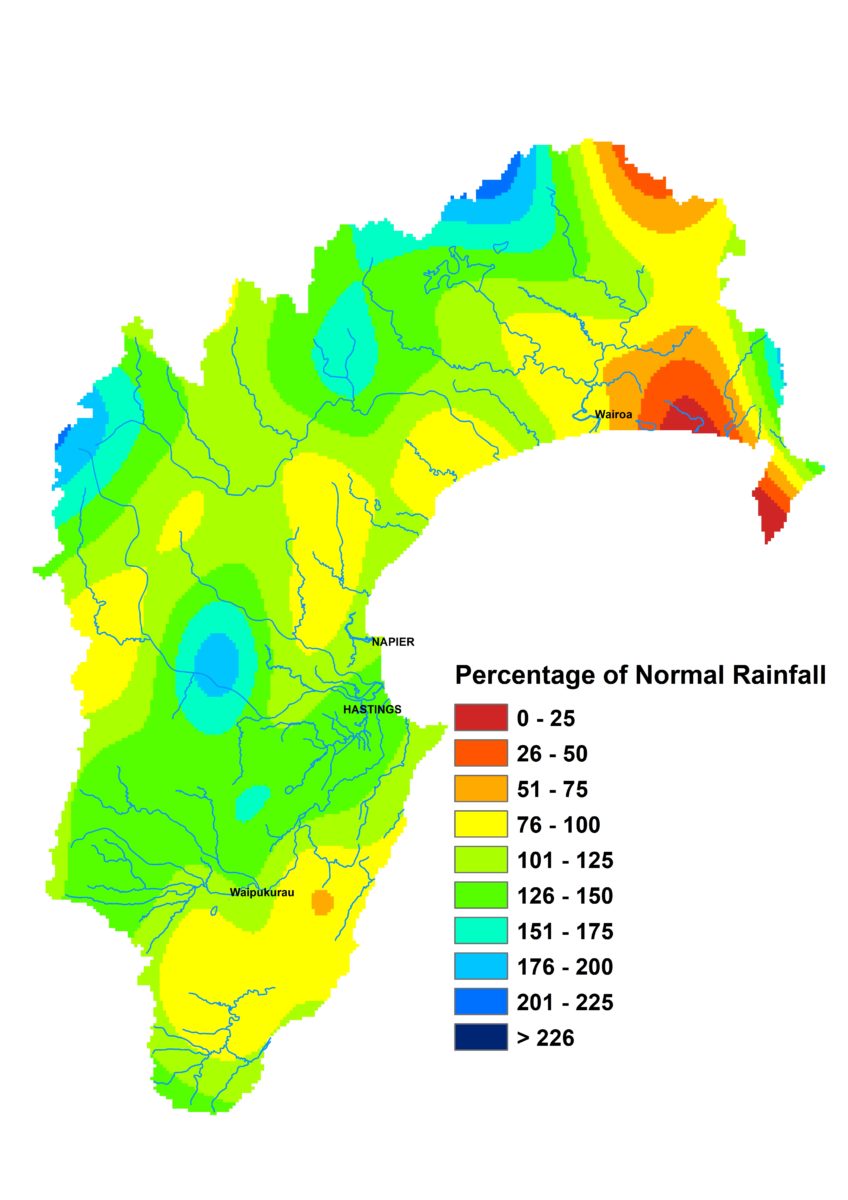
The influence of the La Niña remains with us and has helped us to have a reasonably worry free year in terms of a lack of rain. Just when we think we might be falling a little short, the following month often compensates. July’s rainfall fell within the normal range across the region but some areas got more than ample amounts. The Heretaunga Plains had 140% of average July rainfall and the Ruataniwha Plains 122%.
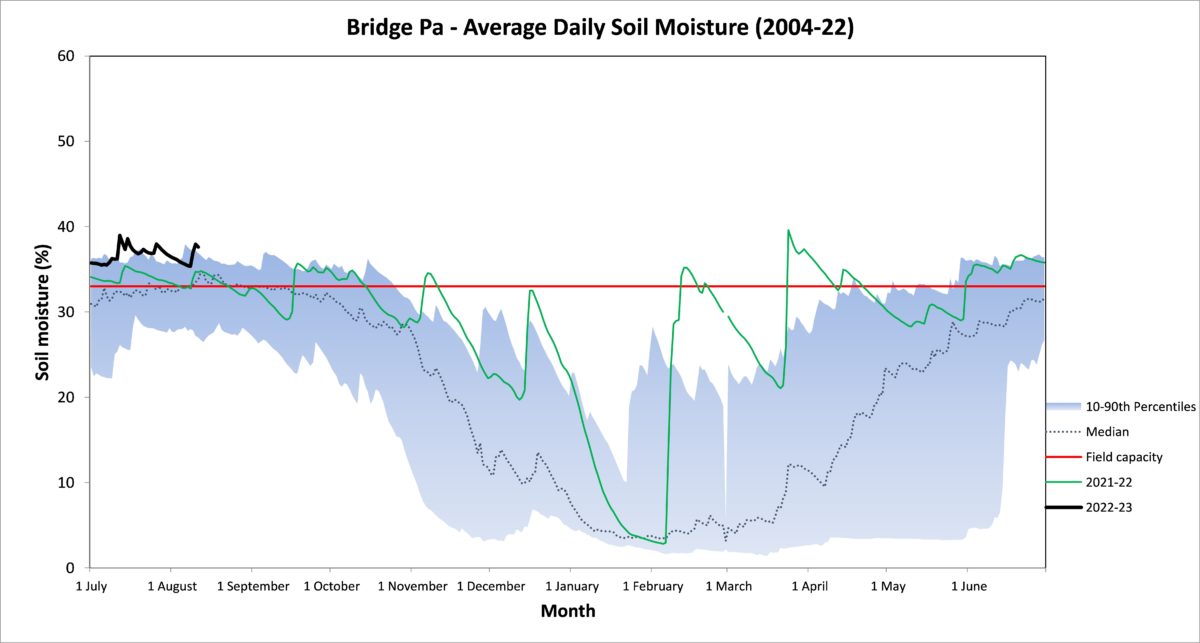
July’s river flows sat within the normal range, while soil moisture tracked above normal. A good share of our groundwater levels were still normal or above normal for the time of year, though a drier than usual June nudged upwards the number of below normal wells. Weather systems from the north stoked our temperatures, with July being a warmer than usual month and soil temperatures finishing July on about 10°C.
There is still a good chance we’ll see a La Niña this summer and a negative Indian Ocean Dipole event is currently underway. The latter enhances our chances of good spring rainfall. Seasonal weather predictions keep to a familiar story – lower than normal sea level pressures are expected to the northwest of the country and higher to the east, allowing more of those northerly and easterly flows to guide our weather. That means rainfall is expected to be in the normal range and temperatures persisting above average. We’ve had some wet spring seasons in the last few years, which hasn’t saved from punishing summer and autumn droughts. So all eyes will be on whether that “triple-dip” La Niña settles in for the summer.
Percentage of Normal Rainfall
Dr Kathleen Kozyniak
Principal Scientist Air
Hawke’s Bay Regional Council
Tēnā koutou,
I hope your winter season is progressing well. It has been a challenging time for us with ongoing issues with student attendance due to sickness. For year 2 and 3 we only teach each class once, and have very few opportunities to catch students up – that’s what our tutorials are most useful for.
Our first year class has continued to grow, and we have another cohort starting early September – if you have any students you would like to get started, get in touch with Clare. Next year quad bikes will be another vehicle option. Please give your students any opportunities to improve their chainsaw/fencing and tractor driving.
Second years have completed propagation, and have their weather assessments to work through. This subject takes a bit of learning, and your student may be after a bit more support to grasp the basics of reading a weather map.
Third years have started their bean PGR experiments, in fruit crop management. They will be reporting on this to you as a part of the assessment.
L5 post harvest classes have re-commenced, and L5 fruit production will be starting at the end of August with Labour Management.
If you have not received our monthly trainers email please inform cbuckner@eit.ac.nz .
Work continues on trying to unify a program of study for production horticulture as a part of a Te Pukenga working group. This is unlikely to affect our courses in 2023.
Best regards,
Clare Buckner – EIT
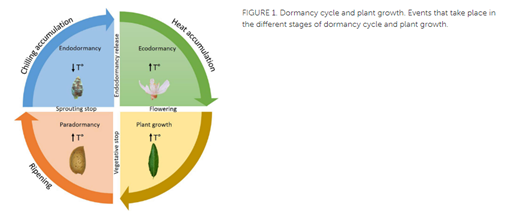
Dormancy allows apple trees to survive seasonal changes and protects the meristem (growth tissue) from unfavourable climates.
Temperature and photoperiods (day length) are the main cues that trigger the different stages in the dormancy cycle, perceived through the plant’s molecular networks and endogenous signals (eg. plant hormones). This results in the regulation of plant growth and the tree’s dormancy cycle.
Bud dormancy has 3 phases: Paradormancy, Endodormancy and Ecodormancy.
Paradormancy is induced by factors such as the tree’s apical dominance and auxins. This dormancy period is defined by the inhibition of plant growth, and setting up buds for the next season.
Endodormancy is induced by cold temperatures and short photoperiods. Once the trees enter endodormancy they are required to meet a specific number of chilling units before they can move to the next phase of dormancy. This means they must go through a period of prolonged exposure to cold temperatures (above freezing). Chilling requirements for dormant buds determine the timing of budbreak, these chilling requirements vary between varieties but are mostly between 400 and 1000 hours. If warm weather or favourable growing conditions occur before winter chilling requirements are met (the plant is still in the phase of endodormancy), growth cannot resume.
Ecodormancy is when the meristems fully develop, and the bud regains its ability to respond to environmental factors. The buds remain in the Ecodormancy phase until the heating requirements are met through extended periods of warm weather, which in turn triggers budbreak. Budbreak is influenced by external signals from the plant, the bud itself and the external environment.
Meg Becker
Horticultural Consultant
027 213 2272
Last month I reported that the retailers and wholesalers were overall, happy enough with the 2021-22 Summerfruit season. There was enough fruit but not an oversupply and prices at retail and farmgate were higher than the previous two seasons. Off course averages hide the top and bottom, the best bits and the not so good bits.
A couple of the factors that may have contributed to the smaller fruit volumes, were lower winter chill and poor pollination – the pollination being the luck of the draw, open flowers and poor weather at the same time.
As we move into spring there is enough soil moisture – good. Do we need any more, probably not, but the numbers tell us that we are about normal compared to the long-term average for winter.
Winter chill was not great last year, but ok I thought. This year the total accumulation is lower than last and the lowest of the last 5 years. Probably adequate for most of our peaches, nectarines and plums. The higher chill requiring apricots may have benefited from a dormancy enhancer (breaker) and we will see what happens with cherries in three weeks’ time. The few growers that I have talked to are saying that bud break timing this year is very close to what it was last season. The earliest of these is at shuck fall – we are under way.
Have a look at flower quality as we go through bloom, are they small or misshapen or of poor quality. If the timing is similar and flower quality looks ok then we are getting enough chilling. Another indicator of insufficient chill is a spread-out bloom. Is this good or bad? Good if the pollination weather is poor, not so good if fewer picks are desired. Tuck away these observations as a changing climate may necessitate a change in some of the growing methods.
Forecasters are suggesting that we may get another La Nina growing season – which would be the third in a row or a so-called triple-dip. For me that is the lasting impression of the 2021-22 season was easterlies and overcast skies with significant rain periods. Should that we the scenario at least we have some recent experience of how to cope as orchardists. More time on the sprayer.
I trust that we have learned some coping strategies from these last two seasons. Doing something off orchard on a regular basis. A game of golf, a bike ride, swimming, dancing or whatever spins your wheels. Take the time to look after yourselves and the staff and do me a favour; ask if I’m doing what I preach, because its really easy to just keep working. We know how to cope with weather, perhaps with a lack of staff but I come across growers and managers who are truly mentally exhausted.
Richard Mills
Summerfruit Technical Advisor
021 632559
The Hawke’s Bay Future Farming Trust will be hosting a public dialogue with Minister Damien O’Connor, who holds the Agriculture, Trade, Biosecurity, and Rural Communities portfolios, and Rod Oram, business journalist for Newsroom and Newstalk ZB.
The Forum will be held on August 11, 6:30pm at Toitoi: The HB Arts and Events Centre. Admission is free.
HBFFT chair Liz Krawczyk says, “Our speakers will discuss the future direction of agriculture in the context of climate change. They’ll be taking questions from the audience which should make for a lively dialogue.”
“Resilience in the face of climate change and reducing GHG footprints are challenges the entire primary sector must address, and with the Government about to set climate policy for agriculture, these issues are top of mind with our region’s farmers and growers.”
Local winemaker Steve Smith will moderate the dialogue. Steve has served as Chancellor of Lincoln University, chaired the Sustainable Food and Fibres Future Fund, and was Ministerial appointee to the Primary Sector Council.
The Forum, 6:30pm on 11 August, is free, but the Trust asks attendees to register here for planning purposes. www.hbfuturefarming.org/contact-us.
Sponsored by the Hastings District Council, Napier Port and Bayleys Country.
For further details, contact HBFFT’s Dave France: 021 929 895, david@franceandco.nz
FMG, Federated Farmers and NZ Police are holding a workshop focused on preventing rural crime Hawke’s Bay. This will be followed by a panel discussion where you can get your questions answered. For more information click the following link: Napier Rural Crime Invite (003)
Reducing injuries and preventing deaths in our industry is the objective of an ACC-funded project that HortNZ is leading.
For this project to be successful, we need to better understand how and why harm occurs in the sector, what people see as critical issues, and how people collect information about harm. By gaining this fuller picture, we can begin creating practical tools for the industry, with the industry.
We are gaining a better understanding through workshops, site visits, conversations and a survey, which we would like as many of you to complete as possible.
The survey will take 10 minutes to complete and please share it amongst your team and networks. The more people who complete it, the better our understanding will be of the issues you are facing. As an added bonus, there is the chance to win one of four $250 Prezzy cards by completing the survey.
If you would prefer to complete the survey on paper, or you have any further questions please contact Emily Lake – emily.lake@hortnz.co.nz or 027 582 6655.
While HortNZ is leading this project, collaboration across the horticulture industry is key to ensuring success so we thank you for taking the time to share your thoughts.
I’m currently in the States for a well-earned break away. I recently visited Hudson River Fruit Distributors (HRFD), a vertically integrated orchard company located near the Hudson River in the New York State, currently producing approximately 162 hectares of apples. This area still has a significant number of small family orchard growers and 99% of their apples are grown for local consumption.
HRFD do import some apples from NZ (Freshco), I saw a pallet of RG (Tenroy) in their cool store. Labour supply is not a problem for them, they have been sourcing their workforce from Jamaica for the last 30 years – this is how long their labour scheme has been in place, so way before our own RSE scheme. They are now employing the children of their first employees. HRFD are slowly re-developing their orchards into high density planting (3.5 – 1.3 – M9’s). Density planting systems such as 2D, Fops, or any other new planting systems is unknown to them. Most of the small family-owned orchard operations have multiple apple varieties planted. I encourage you to check out their website www.hudsonriverfruit.com if you’d like to learn more about their operation.
I recently went to see National MP for Taranaki, Barbara Kruiger speak in Hastings to hear about their policy on the issues our industry is facing. As you will be aware, our current govt are introducing major policy changes such as Three Waters, The Fair Pay Agreements Bill (FPA) and He Waka Eka Noa (the industry, iwi & govt Partnership to address climate change), our labour issues and RSE programme. It was good to hear that National would repeal Three Waters and the FPA (or at least as the bill stands now), and are totally understanding of the industry’s labour plights and would make sure we have enough RSE to harvest our fruit.
I would like to introduce Dean Smith, who has recently been appointed HBFA’s Business & Grower Engagement Manager. This is a diverse role which involves both the day-to-day management of the association and the coordination of a soon-to-commence pan-sector grower engagement project with cornerstone funding from MPI. We look forward to sharing more information about this project over the coming weeks/months.
Dean comes to us with senior leadership and broad commercial and business development experience. He has held management roles at both ends of the value chain with extensive export experience coupled with three years spent in mainland China where he managed procurement for a Chinese owned importer/distributor/retailer. He has worked in a variety of business models from family-owned start-ups to established private, public and listed companies. Since leaving university in the 2001, he’s worked across a range of industries including financial services, wine, wool, and aviation.
Dean holds a bachelor’s degrees in Commerce & Science from the University of Auckland and a Post Graduate Diploma in Viticulture and Oenology from Lincoln. Alongside his role with HBFA, he is currently completing a Masters in Sustainable Business through Otago University. Dean is a proud Hawke’s Bay local with strong connections to fruit growing in the region. His father was a third-generation orchardist, who was born and raised in Twyford before developing his own orchards and vineyards in Puketapu. Dean was raised on the family orchard and spent the bulk of his school and university holidays driving tractors, thinning apples, and pruning grapes.
In Deans words – “I’m excited about the scope of my role with HBFA and look forward to engaging with our growers to learn more about how the association can add value and build positively on its 123-year history”
Finally, please put aside Thursday 15th September in your diaries as this is our 123rd AGM. There will be more information on this shortly.
That’s it for me – I’ll be back at the end of the month.
Happy pruning.
Brydon Nisbet
HBFA President


