

A bud to fruit ratio is the number of fruit buds in a tree relative to the target number of harvested fruit. Fruit bud numbers directly correlate to the number of floral sites expected in spring and can be used to manipulate vigour status and fruit size outcomes. If not pruning to a target bud number, an understanding of the post prune bud count can guide chemical thinning decisions (how hard they need to go, and the level of floral stress the tree may already be under at flowering).
Bud density and quality are driven by light, varietal tendencies and branch texture. It’s about having the right wood, and good light capture through the tree. Getting to this point without compromising yields may be a 3 to 5 year journey.
As a tree matures and settles, bud numbers tend to increase, particularly in spur varieties. In the spring, flowers acts as a carbohydrate sink when the plant is not photosynthesising, drawing solely on reserves. With a high bud to fruit ratio, the floral stress induces an ethylene spike, resulting in the plant prioritising ‘survival’ over fruit set and influences spring carbohydrate efficiencies. This can help with vigour reduction strategies.
Running a low bud to fruit ratio is a well-utilised strategy in young canopies prioritising growth, or when trying to get a jump on fruit size in spring, particularly in a settled canopy.
There is no hard and fast rule, and not all fruit buds are equal.
Best practice winter bud monitoring includes:
Fruit bud counts: Count all fruit buds regardless of size and shape, including spurs and terminal buds on darts and bourse shoots. For tip-bearing varieties, don’t be tempted to count one-year buds. These are treated as ‘bonus flower’ due to their lower reliability and typically do not produce the highest quality fruit within the tree.
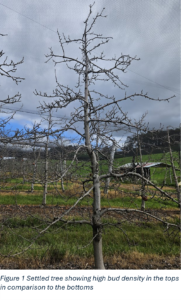
Most growers count buds as a tree average to understand the overall floral load, however splitting the tree into zones allows growers to target buds in specific parts of the tree. Where are the quality buds located and where can we target detail pruning? In a 2D system this could be the target number of buds per wire; in a spindle tree, this could be splitting the tree into bottom, middle and tops. When quantified, this helps refine pruning instructions with confidence that the target cropload will still be achieved.
The budload in the attached photo shows a settled tree with a very high bud density in the tops.
Fruit bud floral capacity assessments: Fruit buds are sampled pre-pruning and assessed under the microscope to determine their floral potential. This is a best-practice winter pruning
metric, helpful on blocks where floral capacity is unknown or on biennial varieties, particularly in an off year. This allows growers to dial their bud to fruit ratio up or down.
Used well, bud to fruit ratios help growers align pruning, thinning and crop load decisions early, giving blocks the best chance of achieving the desired vigour status, target fruit numbers, fruit size and quality.
Meg Becker


