
Sarah de Bruin
May 2024
Winter stocktake of costs:
Do you know what you have spent this season? Cost awareness is vital to grower success at a time when input costs are high, and market conditions continue to fluctuate.
Use this post harvest and winter period, to sit down and cast your eye over your orchard’s numbers. Be sure to compare how they are stacking up against previous years and industry resources such as the MPI Pipfruit Orchard Monitoring programme.
Identifying the strengths and weaknesses of your own orchard business will help refocus for the new season and show areas or categories where you might be blowing out costs and others where you might be running well and efficiently. This then provides the background to enable good decision making and planning through the winter and into the next season.
Growers need to target quality fruit production, high yields of market targeted size, colour and high grade, in order to maximise available returns. Being cost efficient doesn’t necessarily mean cost cutting. For example, increasing productivity may sometimes involve increasing expenditure, however, ultimately this will provide you with more cartons to spread those costs over.
Some blocks warrant extra effort and potential cost, but in doing so can reward with a more profitable outcome. However, some do not. Understanding where your spending is going means you can make sure you are getting the most bang for your buck.
A chance to indulge the inner orcharding nerd
LandWise held its annual conference in Havelock North last week. Sally Anderson, Summerfruit NZ’s research manager, and I attended. The focus was primarily on cropping (tomatoes, peas, beans etc) but the ideas and technology available cross over to tree crops, more often than not. While the toys and techniques have cross over, the recognition that we are all playing in the same environment, be that physical, legislative or consumer spaces, is just as important.
One of the free tools that was discussed is called Environmental Impact Quotient (EIQ), developed by Cornell University. This is a grower support tool for measuring the overall impact of the sprays that are applied. It does this by assessing and giving a value to the potential effects on people and the food we eat, as well as on animals and the general environment.
The last A-Lighter-Touch (ALT) gaps meeting highlighted the huge amount of copper that stonefruit growers apply annually, in comparison to other product groups. As a result, this type of tool will help in understanding where we are at, and what then might be changed to help meet consumer expectations.
Other presenters spoke of the increasing global interest in products that induce, or up-regulate, plants’ own natural defence systems. We see this reflected in the global agchem companies buying biotechnology companies, thus integrating the knowledge of the smaller innovators and giving the innovators global reach.
A reflection of an integrated approach for bacterial control might look something like Actigard, followed by copper, followed by a bactericide, followed by AureoGold. During the LandWise presentations, we were told of the commercially available predators that are now available. To be fair, most of the progress has been made in the greenhouse industry but I suspect that it won’t stay there for too much longer. One of the lessons that’s been learned is that releasing two or tree species at once gives better control – much like using two fungicides to protect the efficacy of both.
The theme of the LandWise conference was Rebuilding Our Soils, a reference to Cyclone Gabrielle and the regenerative ag movement. Regen ag falls to some extent into the what the consumer wants type thinking. Regan ag has been in the pastoral/broadacre space for a while, with process crops now thinking about how the philosophies might be adopted. For permanent tree crops, we’ll need to think even harder about what changes could be beneficial. Of interest, McCains is now trialling paying growers a bonus for product that meets a number of biodiversity and environment markers. This circles us back to the EIQ tool, I talked about above.
Cyclone Gabrielle soil recovery work was reported on and a series of stonefruit orchards were presented as case studies. Much of this work is yet to finally tidied up, with one of the big questions being where to store the lessons learned so that they are readily available for the next time a storm of that nature comes visiting.
For the outside demonstration part of the conference, there were drones spraying crops, robots pulling weeders and sprayers, fancy lawnmowers, nozzle technology for travelling irrigators, and crimping rollers that might be used instead of mowers.
So as an industry, how are we fairing? Probably not to badly compared to some but we have a few areas that need attention. Many of these are being picked up by the ALT-Summerfruit NZ collaboration looking at softer chemistry, sorting out which bio stimulants might be efficacious, the understory plantings, and keeping a weather eye on market requirements. Keeping a weather eye on other product groups seems like an easy way to get some wins too.
In the vein of sharing ideas, we have a visiting expert in Hawkes Bay on Tuesday 2 July and an industry get together that same evening at Black Barn. Please see Prunings for more information. We look forward to seeing as many of you as possible there.
Richard Mills
Level three fruit production students are back in class with Steven studying soil, and moving on to botany. This class has been split into two groups to ensure we can run effective practical sessions. The level 4s have completed their first of six courses, and will be starting Crop Protection with Chris Thorman in next few weeks.
You should be receiving a monthly Trainer Update that lists exactly what assessments they have, and what support they may require from the workplace.
We have a small group of first years, who will be working on fruit support structures here at EIT, as we are putting in a micro-orchard in the front paddock, with a small range of trees and structures. This will give us a space for tractor and hydro practicals, as well as some trees to play with. Much appreciation to Goldpine for donating the posts, and Genesis nursery for plants to fill the trellis.
EIT professional development Level 5 Management Programs
A reminder that the level 5 programs are made up of individual courses and anyone can join the classes for a single course at any time. Contact nhartley@eit.ac.nz for delivery schedules.
The level 5 Fruit Production students are working through the research topic module with Steven where they are carrying out a small trial and will report on their findings as part of their assessment. Their managers will be invited to hear the report.
The Leadership Qualities Module starts on Wednesday 22nd of May. Students will be discussing what makes a good leader, reflecting on their leadership styles and working through the components that help make good leaders. Anyone interested in joining us should speak to their managers or get in touch with Chris EIT now.
The 2024-2025 Level 5 Post Harvest year begins in July, anyone interested in joining this program should contact nhartley@eit.ac.nz
Finally the Post Harvest 2023 – 2024 students need to be getting any outstanding assessments in by the end of June.
Chris, Steven and Natalie
Commodity Levy Order: Thank You!
A huge thank you from NZAPI for all the interest, input, feedback, and votes. During the consultation and referendum process it was gratifying to receive lots of positive feedback about the excellent service and support we provide – thank you.
The referendum closed on Friday 3 May and NZAPI received 98% support for a compulsory levy on apples and pears.
An application has been submitted to MPI, which will be reviewed as per the Ministerial timetable (Minister to consider, a new levy order drafted, then approved by cabinet).
Growers will be notified in the NZAPI Weekly Update, and on the NZAPI website, when the new order comes into force (approximately January 2025).
CONFERENCE
Only ten days left to book at early bird rates for the NZAPI annual conference (special rates end Friday 31 May).
This year the conference is right in our backyard! From 29 – 31 July, at Toitoi Hawke’s Bay Arts and Events Centre, Hastings.
The theme – Reset, Growth, Ambition – reflects the challenges and opportunities facing the apples and pears industry, and the sector’s ongoing commitment to building a more sustainable, productive, and inclusive food sector.
Don’t miss the valuable networking and opportunities to share information with industry colleagues, friends, and suppliers.
Check out the NZAPI website for more information – we look forward to seeing you there.
Commodity Levy Order Referendum: Have you voted?
New Zealand Apples and Pears’ referendum is underway and closes on Friday 3rd of May, so make sure you have your say.
EVERY VOTE COUNTS! We need to show maximum participation in the vote, so whether you’re a big or small grower, your input is vital.
More information on the Commodity Levy Order is available on the NZAPI website. If you have any questions about the Commodity Levy Order, please email Karen Morrish, NZAPI CEO.
New Zealand Apples and Pears Conference 2024
This year’s apples and pears AGM and Conference will be held from Monday 29 to Wednesday 31 July, 2024 at Toitoi Hawke’s Bay Arts and Events Centre, Hastings
The conference will focus on a range of important themes:
The content will reflect the challenges and opportunities facing our industry, and our ongoing commitment to building a more sustainable, productive, and inclusive food sector.
The annual conference provides valuable networking and information sharing opportunities with industry colleagues and friends, as well as suppliers and government representatives. Register before Friday 31 May to secure special early-bird rates.
The harvest season for summerfruit is now well finished with the final plums being managed through stores. There were also some peaches and nectarines that had been on display for a good while, which on sampling, all had internal breakdown. This fruit is doing the reputation of the industry no good.
The A Lighter Touch programme continues to bring the various product groups together. Recently, at the Plant & Food Research fresh vegetable demonstration farm in Pukekohe, participants looked at a variety of approaches. We heard from Dr Charles Merfield on the importance of a biodiverse landscape, Dr Brad Howlett on native plantings to support beneficial insects, and Mike Arnold with the LeaderBrand story to date, with their native plantings. The visit to the field highlighted some of the differences between field and permanent crops, not that there are many, and the similarity of how weather can mess up trials.
PDFs from the workshop can be found at Biodiverse planting on vegetable farms – A Lighter Touch (a-lighter-touch.co.nz) with videos of the presentations available shortly. These are well worth a look if you are at all interested in this space.
Charles Merfield again presented, this time at the SummerGreen meetings. Charles told us that weed control is an evolving space that we need to be aware of, as there is increased resistance and no new active ingredients available, but there is new technology to help. This ties in very nicely with our own understory management projects that are getting under way in Hawke’s Bay. These projects will compliment those already growing in Central Otago.
One of the other key presentations was from the Plant & Food Research pollination team at Ruakura. Some of the past work for summerfruit was reviewed. We then looked forward to some ideas to make pollination a more resilient process for our early flowering crops. The review of artificial pollination on stonefruit in the USA suggested that it’s all possible and useful, as a back up to insect pollination.
These presentations, as well as the other presentations, will be available on the Summerfruit NZ portal soon.
As has been a recent trend, product groups are working together where this makes sense. The sharing of ideas and trial work means we don’t all need to reinvent the wheel, which is the most efficient use of grower levy money
Richard Mills
Summerfruit Technical Advisor
021 632559
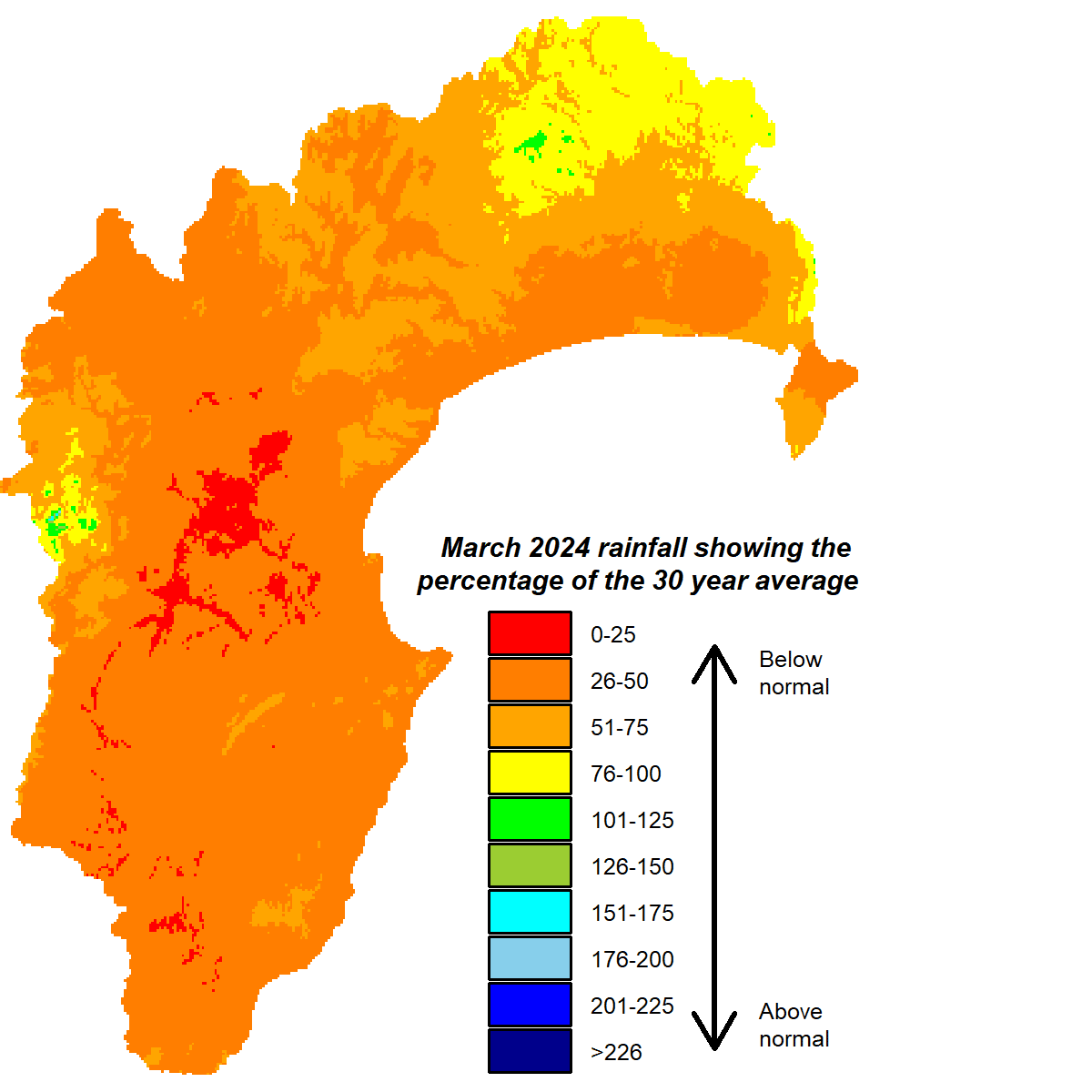
We’ve had dry run lately with two consecutive months – February and March – recording below normal rainfall and both months managing just half of their average rainfall. It looks like April could follow suit. At the time of writing, with only a week left, we’ve had 40% of April’s average.
The lack of rain has seen river flows track below normal and groundwater levels head that way too. Soil moisture has taken a dive over the past couple of months, especially sites on the Heretaunga and Ruataniwha Plains and adjacent hill country. Soil moisture at Bridge Pa has fallen into the lowest 10th percentile of readings recorded at the site for the time of year. Likewise Waipukurau and Porangahau. A month of cooler than usual temperatures seems increasingly rare, but March threw that in the mix, which at least will have stemmed the rate of moisture loss.
The El Niño event is largely over but may have a lingering effect on our weather patterns for a little while yet. A predominantly westerly flow is expected to prevail over the next few months on the back of expected higher than normal pressure across northern New Zealand and lower pressure south of the country. That, along with sea temperatures in our region lying near normal levels, makes for a forecast that isn’t full of abundant rain. The subdued sea temperatures will influence air temperatures, which could lie near normal as we flip between warm northwesterlies and brisk southwesterlies. Potential remains for La Niña conditions to emerge later in the year but it’s still early days on that call
March 2024 rainfall
Dr Kathleen Kozyniak
Principal Scientist Air
Hawke’s Bay Regional Council
Elevating the Fruit Growing Industry with Skilled Workforce Development
Announced by the Minister of Education in 2020 and launched in March 2021, Food and Fibre Centre of Vocational Excellence (CoVE) is an initiative of the Food and Fibre Centre of Vocational Excellence Society Incorporated. Members of the Society include key industry organisations (often referred to as peak bodies), employers and training providers from the food and fibre sector. Food and Fibre CoVE invests, through research and innovation projects, in the transformation of vocational education and training for our talent pool, to enable Aotearoa New Zealand’s food and fibre sector to thrive.
Creating and retaining a capable workforce is no easy task. It requires resourcefulness, some courageous and innovative thinking along with targeted funding, but that’s where Food and Fibre CoVE shines. Not only do they identify opportunities within the food and fibre sector, but through research, insights, and continuous workplace learning, they, along with their partners, seek out and successfully craft solutions.
Food and Fibre CoVE have a game plan that includes a number of key moves:
This game plan will ensure that industries, like horticulture, keep attracting and retaining skilled workers, helping organisations to evolve, grow and gain a competitive advantage.
New Training and Pathway Initiative for Fruit Growers
Like various other industries in New Zealand, fruit growing is facing difficulties in attracting and retaining talent. Often, the challenge goes beyond finding the right employees and lies with the employer’s reluctance to invest in new hires and training, due to the inherent risks and costs. The reasons are not always as straightforward as they first appear. This is where there is an opportunity to consider a new approach.
Food and Fibre CoVE are about to undertake a pilot programme where a Group Training Organisation (GTO) oversees the recruitment and employment of the apprentice or trainee for the length of their apprenticeship or training programme. This apprentice or trainee is then contracted to host businesses that cover their wages.
This innovative approach aids the employer in multiple ways. The GTO manages all recruitment operations – including screening, interviewing, reference checking and drug testing. It also oversees human resource management, dealing with payroll activities, training bookings, and handling legal and employment issues.
The best part of this arrangement is the flexibility it provides to employers; they can return the trainee under certain circumstances, if conditions are met, like a downturn in work, unsuitability, or a change in business conditions. This strategic approach effectively removes the associated hurdles of managing an apprentice or trainee, letting the host business instead focus on their operations. In a nutshell, the group training model de-risks the taking on and training of new talent in the workplace.
The first pilot is due to start mid-year and is expected to run through to early 2025. The pilot will also be informed by other key projects that Food and Fibre CoVE are currently working on, including:
Stay updated on all projects by following Food and Fibre CoVE on LinkedIn, or visit www.foodandfibrecove.nz for more information.
If you want to know more about Food and Fibre Cove, please email Chief Executive, Paul Hollings, or if you want more information on the new training and pathway project, please email Portfolio Manager, Viv Bruin.
Level 3 & 4 Fruit Production Apprenticeship
We are slap bang in the middle of Autumn and we hope you all had a good harvest and see the end in sight.
As the harvest rumbles to a close the EIT timetable starts up again to welcome back the EIT students.
We start the 2024 apprenticeship programme in May with year 1 operation skills such as; tractors, chainsaws and fruit support structure development. The soil classes for 2nd year students and the final “complying with market needs” class for the 3rd year students.
It’s going to be great to show the properties of soils and how they help us produce a quality crop; have a good debrief on the challenges of harvest and how important it is to understand the market needs.
We have student groups ready to go, but are more than happy to welcome individuals that want to extend their learning to help or progress their career. If you would like to start or want to put any individuals forward for study the Apprenticeship this year; please contact Clare Buckner on 021986396 or cbuckner@eit.ac.nz.
Level 5 Fruit Production & Post Harvest Diploma
We will welcome back the Fruit Production Diploma students and work through the data that has been collected for their research project. It will be really interesting to see the direction the projects will take.
These programmes are flexible, so we welcome any new students who want to gain a professional development qualification and develop their skills and critical thinking to enable them to move into management roles.
Managers of blocks who recognise individuals who they want to see progress in the industry should encourage these wee stars to talk to EIT about the program.
The next subject starts in May, so please contact Chris Thorman on 021468802 or cthorman@eit.ac.nz for further information.
The industry backed Post Harvest Diploma kicks off again in July.
Yesterday I visited one of our current students who has recently been promoted to the production manager role. He said he would never have had the confidence to tackle such a role if he had not signed up for the Post Harvest program. It was great to hear the hard work he has put in to his own professional development had increased his confidence and all round knowledge of the industry and help him full fill his dreams and aspirations.
So often I hear; “we just cannot get the people we need”. This program develops your junior managers. It is up to the industry leaders to shoulder tap your potential future leaders and encourage and support them to engage with personal development and support and grow your own talent.
The next Cohort starts in July so please contact Chris Thorman on 021468802 or cthorman@eit.ac.nz for further information.
This season has brought up some challenges from last year’s events, but we are moving forward in the right direction. We hope to help in continuing to support the industry in this progress.
All the Best
Steven, Clare and Chris
Sean Gresham, Ph.D.
Now that the end is in sight for harvest 2024, everyone deserves a rest, some care and attention – the trees included. The next month or so is the prime time to ensure next year’s crop is set up nicely before the trees go into dormancy. The primordial cells that will become fruit in 2025 are already on the tree as differentiated buds. From now until leaf fall, the trees accumulate nutrients and carbohydrates that they use next spring to push out new growth and help set fruit. A bit of post-harvest care can help to get a running-start next season.


