
Hawke’s Bay Fruitgrowers Association Newsletter
Carl O’Brien
August 2024
Water water everywhere, but not enough in the TANK
As everyone is no doubt aware, water allocation on the Heretaunga Plains is being reassessed during the replacement of resource consents and many growers are facing significant reductions in their previous allocations. If you’re in that boat, a reminder that Hawke’s Bay Regional Council has requested further information response be submitted by 01 September 2024. Note they have extended the timeframe until 30 December 2024 (you should have received an email from waterpermits@hbrc.govt.nz late last week telling you this). This extension will allow more mediation to occur, and it is likely to continue for the rest of this year. . Hawke’s Bay Regional Council have released guidance on situations where additional allocation may be justified within the policy framework, and these should form the base of response. Specifically, growers should be looking at:
The assessment process looks to bring a significant reduction in available allocation across the plains and with it potential for significant economic impacts, so AgFirst recommends putting your best foot forward in determining an appropriate allocation need for your enterprise. August has rolled around quickly and with the high degree of winter chill, comes the risk of an early season so be sure to budget the time to address Hawke’s Bay Regional Council prior to the season kicking off. If you’re unsure on what’s next or need some help, contact your rural professional for assistance.
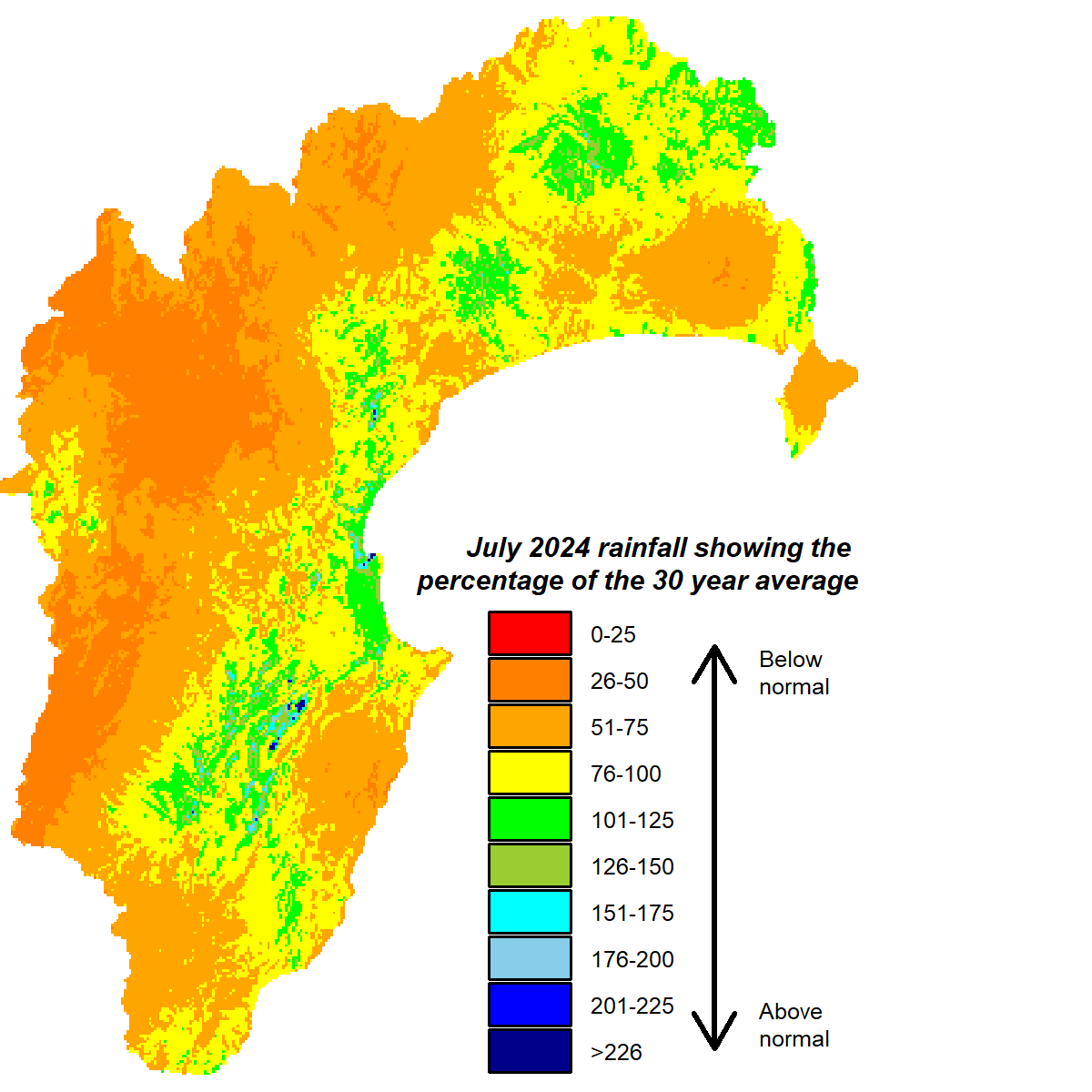
A two-month run of wet weather came to an end in July. Most of the region received below normal July rainfall, apart from the Ruataniwha Plains and Northern Hawke’s Bay where totals fell within the normal range. The western ranges received only half the month’s average, while the Heretaunga Plains fared better with about three quarters.
The shortfall in rain didn’t trouble soil moisture, which remained above median levels for the time year and, for most sites, at or near field capacity. July’s river flows tracked a little below normal but groundwater levels were solidly near or above average. Daytime air temperatures were a balmy 1.5°C above average. Nights were warm too but only by an extra 0.5°C.
We remain in neutral ENSO conditions. A La Niña emerging in spring is favoured by forecast models but it isn’t a totally done deal. They’ve been gradually nudging development a bit later and notching down their certainty a peg or two.
For the time being though, the main influence on our weather appears to be the sudden stratospheric warming event that occurred over Antarctica. It disrupts the wintertime polar vortex, puts New Zealand firmly in the firing line of the westerly wind belt and results in the occasional blast of polar air. Sea surface temperatures are above average around New Zealand though, which should help to moderate the air temperatures. Recognising a westerly bias, the seasonal forecast for spring leans toward rainfall being near or below average and temperatures near or above average. Temperatures may end up near normal, but expect a wild ride between real highs and lows.
All the best,
Kathleen
New Zealand Apples and Pears is very grateful to Boston Consulting Group (BCG) for conducting a new report into the needs of the Hawke’s Bay horticultural sector a year after Cyclone Gabrielle.
The report found that at least $410 million in additional funding was required to recover the wider Horticulture sector to its pre-cyclone state by 2030.
This pro bono work and the support of BCG, at a time when horticulture is facing a multitude of challenges, is invaluable.
BCG’s report, Hawke’s Bay Horticultural Sector: Economic recovery update: a year after Cyclone Gabrielle, found that while the short-term, critical response to the cyclone was a success, thanks to a timely, joint response between the public and private sectors, at least $345 million more was needed for replanting and reinstatement and $65 million more was needed for on-orchard clean up.
NZAPI has already used this report and the resulting information in our ongoing advocacy work for the sector and have shared the report with multiple ministries as well as Minister Nicola Griggs who has recently returned from maternity leave. She read the report with interest.
The report was valuable as it confirms that growers in Hawke’s Bay continue to struggle in the wake of Cyclone Gabrielle. We know that the cyclone hit at a time when the industry was already facing pressure on profitability due to inflation, and replanting orchard blocks requires significant time and money.
We also know that growers are critical to the Hawke’s Bay community. They are deeply enmeshed, with their lives and families here, however for them to reestablish what was lost, they must be provided the right environment to work within and currently, this is not the case.
The full report can be found here:
Winter Wet and Management Considerations
After a dry start to Autumn on the back of El Nino, this last week of June has brought a significant rain maker to bed in the wet season. Traditionally Hawke’s Bay receives most of its rainfall through June, July, and August and with soils now water logged, heavier soils are expected to remain water logged through to spring. The wet season can’t be avoided; however taking a look at what measures are possible to set up for the best possible spring start should form part of the winter programme.
While growing is often at the mercy of weather conditions, careful planning across the winter season to balance each of the operational and development tasks leads to successful execution and builds a strong foundation for a successful season.
Tēnā koutou katoa,
Its great to have busy classes back at EIT – the Level 4s are suddenly half way through their study, after a busy month. We expect their first three course assessments to be completed by the end of this month – if they are not, we will be contacting managers to discuss whether students should start new courses this year.
We have a large, mixed group of Level 3s: some started in August last year and will be finished by the end of this September, others didn’t start until after harvest. They have completed the pruning and growing environment courses already, and move on to block development over the next month, with a two day workshop for propagation and block layout. Attendance and participation has been really great from this diverse group, and we hope many will continue to Level 4 next year.
Certificate in Primary Industry Operational Skills students that started in January will be completed by the end of july, and there is the option to start straight into Level 3 fruit production with propagation as mentioned above. We have two other groups starting this year for this introductory course.
The level 5 fruit production students have completed the Leadership and relationship management course and will be starting their level 5 crop protection course in July. On the 28th of August they will present their research topic and we are encouraging the students managers to come along and support their staff. We will send you details nearer the time.
The level 5 Post Harvest program starts at the end of July. Anyone interested in joining this program should contact Chris Thorman at cthorman@eit.ac.nz for more details. Chris is happy to come out to meet anyone interested to talk through the commitment and work load.
Manawatia a Matariki nā
Clare, Chris, Steven and Warren.
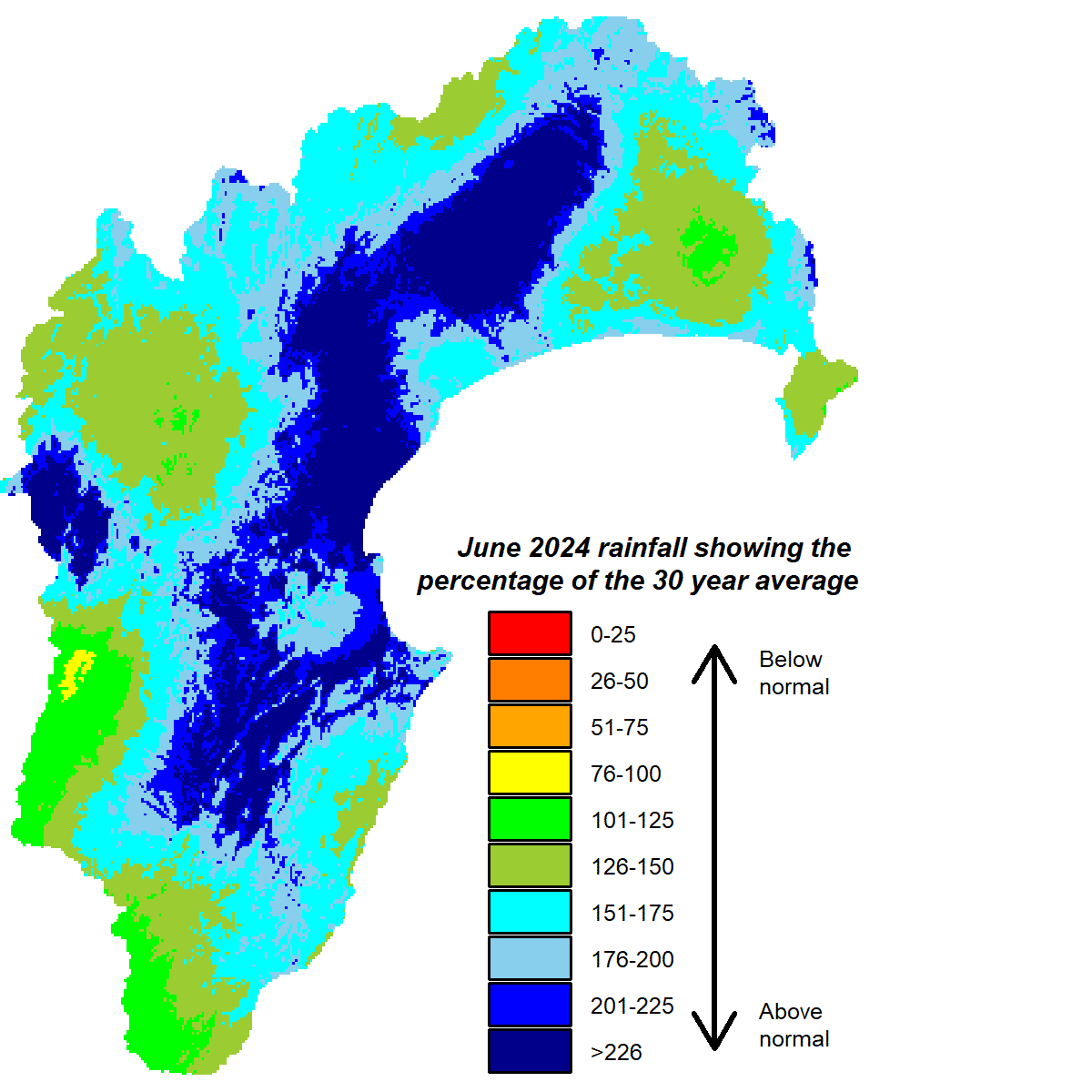
We’re struggling to find middle ground with our rainfall this year. We had three dry months near the start of the year, all receiving about half the monthly average. Now we’ve had a flurry of wet months, with each receiving one and a half times their average rainfall. Both May and June were very wet. We recorded 187% of June rainfall across the region, while some areas, such as the Heretaunga Plains, were hit by more than double their June average.
Soil moisture at most of our sites is near or above median levels for the time of year. Not a bad place to be. Groundwater levels are near average levels for mid-winter, while river flows are higher than average. June temperatures were about 1°C above average during both the day and overnight.
We are in a neutral phase of the El Niño-Southern Oscillation (ENSO) and, as a result, the seasonal forecast models are featuring bland and variable predictions of sea level pressure patterns. Near normal pressure over New Zealand seems the main outcome, while lower pressures possibly lie over the Tasman Sea. Winds could be reasonably variable on that basis.
Sea temperatures around our region are near or slightly above normal and warmer than usual through the Tasman Sea and western Pacific Ocean generally. A La Niña could yet develop in spring, but while we are in ENSO “no-man’s land”, our rainfall over the next few months might reach closer to “middle ground” and temperatures hover near or above normal.
All the best,
Kathleen
HB Fruitgrowers Association Newsletter
June 2024
The Mystery Creek Fieldays have finished for another year with Summerfruit NZ having a presence on the HortNZ stand alongside NZ Apples and Pears, Potatoes NZ and some of the team from HortNZ. NZPPI (NZ Plant Producers Incorporated) and Zespri were there as well, giving a bit of a presence for Hort in the great big Ag dominated event. This was an opportunity to chat with politicians, industry organisations and potential growers. There were discussions on how warm it has been, which gave an excuse to talk about winter chilling – it is that time of the year.
Summerfruit has eight weather stations on the Portal where winter chill information can be viewed. There is also an explanation of how three models are calculated. The model that best defines deciduous fruit crops in a temperate climate is Richardson Chill Units (RCU), with the negative checkbox turned on.
Over the past couple of weeks, we have experienced some unseasonally warm temperatures, with 26°C reported on the news, so accumulation must be poor, right? But what is the data telling us? Actually, the winter chilling is as good as it’s been for the past five years, as of 18 June.
Winter chill accumulation across Hawkes Bay from 1 May to 18 June 2024
| Station | RCU 2024 | RCU 2023 | Difference 2023 to 2024 | 5-year average |
| Bay View | 505 | 166 | 227 | 278 |
| Twyford | 501 | 311 | 156 | 345 |
| Pakowhai | 446 | 222 | 118 | 328 |
| Lawn Road | 482 | 238 | 157 | 325 |
| Ruahapia Road | 477 | 206 | 166 | 311 |
| Havelock North | 491 | 266 | 150 | 341 |
| Longlands Road | 412 | 308 | 87 | 325 |
| Te Aute | 421 | 201 | 143 | 278 |
Winter chill accumulation is way up on last season and better than any of the past five seasons. Experience has shown that the earlier winter chill arrives, the larger the total is likely to be, as July and August are cold with normal accumulation the norm. There will always be a warm spell or two during winter, so the blips are nothing to get too concerned about.
Having a look at accumulation around the country, this pattern is being replicated, especially in northern regions. After all, we live in the same weather patterns. Central Otago always accumulates sufficient chilling. For reference, most of our crops require 700-800 RCU for good breaking of dormancy, which suggests that we are two thirds of the way there already. With a bit more rain to top up soil moisture, we could be looking forward to some of the metrics being in our favour. For apricot growers who use dormancy enhancers, decisions will need to be made soon with regards to application timing. Good chill accumulation will enable an earlier bud break in Hawkes Bay, meaning an earlier application of these products.
In other Summerfruit NZ news, we have a new team member, with Edwin Spenser staring a couple of weeks ago. Ed will be in Hawkes Bay for the tech field day on Tuesday 2 July, 1pm to 3pm, at Camelot Fresh Fruit Company Ltd packhouse and orchard, 44 Thompson Road in Twyford. Ed will also be at the networking dinner later in the day. Summerfruit NZ Mid Year Function | Hawke’s Bay Tickets, Tue 2/07/2024 at 6:00 PM | Eventbrite.
For those that haven’t head, Kate Hellstrom, will finish working for Summerfruit NZ in September. The Board have started looking for her replacement. Kate will be at the field day and evening function.
Congratulations to all participants in the Hawkes Bay Young Fruitgrower Competition. Three of them have experience in stonefruit, which reflects the wide range of fruit and vegetables that are grown on the Heretaunga Plains. The quality of event reflects really well on HBFA and all those who make it happen.
By Meg Becker
Winter pruning is arguably the most important time of year on orchard as it provides the opportunity to start fresh, clean the block up and set the tree up for next season’s crop.
Manipulating the tree at pruning helps to achieve specific crop outcomes including fruit size, fruit colour and fruit quality, as well as allowing you to influence downstream costs such as thinning, summer pruning and harvest.
It is important to understand your longterm goal for each block, as well having a sound understanding of what steps you are wanting to achieve over the next 12 months.
What is your crop target? Are you trying to increase fruit size? Are you trying to reduce thinning costs? Do you need to manage vigour, or are you trying to drive canopy growth?
Understanding this prior to carrying out your pruning allows you to alter the timing of pruning, and set instruction to target specific bud numbers, wood texture, light optimisation, and vigour response. Pruning allows growers to manipulate carbohydrate partitioning in the tree to achieve a common goal.
Now the important question… what Metrics can be collected to help support educated decisions that will ensure pruning is achieving specific block targets and taking any guesswork out of growing.
The Metrics in order of importance/ease of collection:
They key to data collection is understanding within block variability and selecting trees/areas that represent it.
These metrics help growers make educated decisions giving confidence that the instruction sets the canopy up with the optimum outcome. Backing up your growing decisions with informed data helps to minimise the ‘gut feel’ mistakes, helping you to maximise your production, profit and price for the upcoming season.
Kia ora koutou,
What a great event the Young Fruitgrower of the Year was! Our congratulations to all the competitors and especially to Grace for her outstanding achievements, and Dani for the great speech.
Many heartfelt thanks and appreciation to HBFA for putting this event together – it is a huge amount of work, but hopefully you feel rewarded by the awesome turn out on Friday night as well as a great vibe on Thursday. Time and effort put into celebrating and supporting our young emerging leaders, is the very best way to show them they are in a vibrant and future focussed industry, and hopefully inspire them to forge successful careers for themselves and their whanau.
The winter is a busy time for EIT, Level 3 students have completed the growing environment course and are working their way through botany, understanding plant structures and processes underpin the pruning courses. They have soil modification practical to complete. Level 4s have completed their first course as well, and are almost through sustainable crop production with Chris Thorman, our Diploma program co-ordinator.
The government has committed to funding the Apprenticeship Boost funding, but there are several caveats. From 2025, apprentices will only be eligible for their first year (ie Level 3 fruit production), and only ‘key’ industries will be funded. That information has yet to be released, but we will be working hard to ensure horticulture remains on that list. Much like last year, we are not sure on course fees at this stage for 2025, but we will be starting a Level 3 cohort at the end of July to pick up students that have completed Certificate in Primary Industries this year, whilst we know we have reduced fees.
Steven and I are out visiting managers this month, and really enjoy the opportunity to catch up face to face to discuss your workers progress, but our doors are always open to any suggestions about training you may have, at any time.
Noho ora mai, Clare, Steven, Chris and Warren.

We were staring down the barrel of an extended dry period after April became the third successive month of below normal rainfall. The region had less than half of average April rainfall and it had been a similar story in March and February. Soil moisture levels were well below median levels for the month, particularly for areas south of Tangoio. The Bridge Pa site was particularly low and had fallen into the lowest 10th percentile of readings in the site’s record for the time of year. April’s daytime temperatures had been above average and overnight temperatures near normal. The lack of rain for three months meant that both river flows and groundwater levels were feeling the pinch.
Two-thirds through May and the picture was looking much the same. The Heretaunga Plains had received less than 10% of May’s average rainfall. How the tables turned in just a couple of days. The Plains jumped to 171% of the long-term average and the region to 154%, with a few days of May to go.
We are exiting an El Niño phase and entering neutral conditions but there’s the possibility of us later transitioning into a La Niña phase. Despite this, the seasonal forecast models still persist with a predominant westerly flow for winter, based on a prediction of higher than normal pressure across New Zealand and lower than normal south of the country. Sea temperatures along our coast are currently near normal for the time of year. All of this results in a rainfall forecast of near or below average rainfall for the winter season and temperatures that are near or above normal. The recent wet few days might be a harbinger of what we’ll get from a La Niña to come – hopefully not.
All the best,
Kathleen


