
Hawke’s Bay Fruitgrowers Newsletter
Jack Wilson
9th October 2024
Post Blossom Thinners
What keeps chemical thinning interesting is the fact it’s just as much an art than a science. A great chemical thinning result is often caused by a plan based on history, a good analysis on the seasonal conditions you have in front of you and plenty of walking blocks. This season we are going into an early compressed bloom with great spring conditions allowing the bees to go hard and therefore the probability of fruit set being high.
With a number of primary thinners been used in those early weather windows we are starting to see their effects, some better than others.
Getting out and walking blocks is critical at this time of year to ensure that any tweaks you make to your plan are based on good observation. Because of the current trend of planting large blocks of single varieties, I am seeing a fruit set gradient across blocks with headland trees and those in rows near adjacent varieties showing heavier set than trees further into the block. Blocks need to be carefully checked for fruit set gradients and the thinning programme adjusted accordingly.
The post blossom thinning window is quite wide so there is no need to panic about getting thinning sprays on if the weather doesn’t allow. Weather always trumps fruitlet stage for secondary thinners and these days we are lucky because we have chemistry for most weather conditions.
Benzyladenine (BA) thinners are not very effective on fruitlets less than 7 or 8mm diameter, irrespective of weather conditions. 10 to 12mm diameter king fruitlet size is the preferred size range and I have also seen good results out of 18 to 20mm diameter fruitlets , due to the tree being under significant stress at that time. The addition of NAA to BA will give you more effective thinning, particularly if you are going in at the smaller fruit size end of the desired range, however do not use BA with NAA on Fuji. BA and BA+NAA is temperature sensitive requiring >18oC for the next 2-3 days post application.
Metamitron is another post blossom thinner with a photosynthetic inhibitor mode of action. It has a wide window of application (6-20mm), with the best effect at 10-12mm. Metamitron has a greater thinning result under carbohydrate deficit favouring conditions, including warm nights, cloudy overcast days, high interfruit competition, shaded trees and general tree stress (waterlogging, frost etc.).
Keep walking blocks and observing, some say it’s the best chemical thinning strategy out there.
HAWKE’S BAY APPLE AND PEAR INDUSTRY INJECTS ALMOST $1 BILLION TO REGION
New research reveals pipfruit export growth is outstripping national export growth
Today, we release the results of a recent study into the economic impact of our industry.
The Economic Contribution of the New Zealand Apples and Pear Industry 2024 tells a great story.
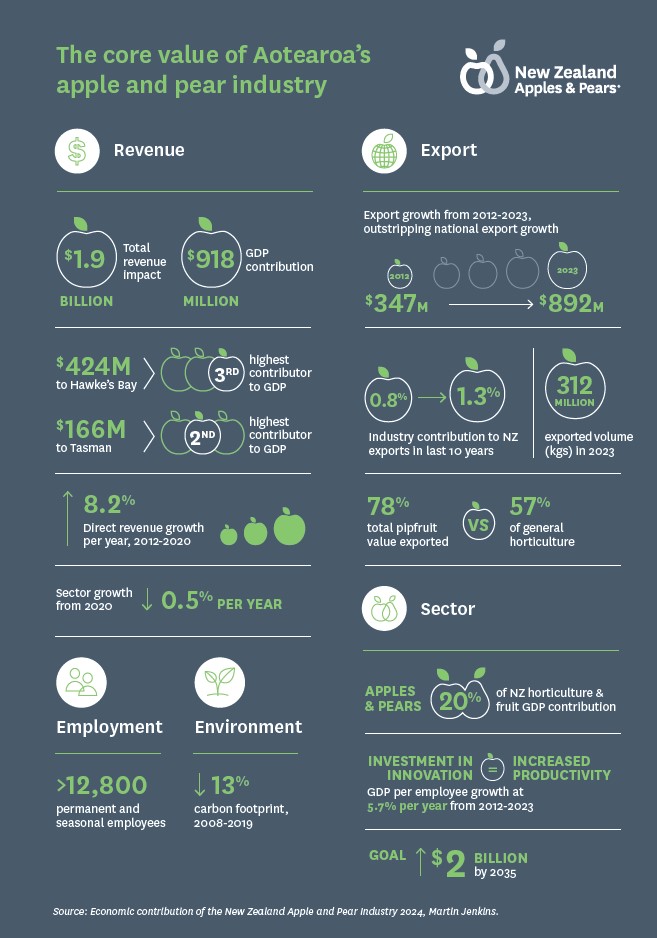
It reveals how our pipfruit industry contributes almost $2 billion of total revenue impact to the New Zealand economy, and what’s more, it shares how the value and contribution of our industry is growing.
At a regional level, this is equally true for Hawke’s Bay.
Hawke’s Bay’s apple and pear industry is the third highest contributor to the regional economy, injecting $991 million of total revenue impact into Hawke’s Bay, according to the research.
With 65 per cent of the nation’s apple and pear plantings, Hawke’s Bay’s pipfruit industry employs more than 6,000 people and makes up 77 per cent of the region’s horticulture revenue.
The report, conducted by MartinJenkins to reveal the economic contribution of the industry to national and regional economies, also found that the industry as a whole had grown its national export value from $347 million in 2012 to more than $892 million in 2023.
The growth in this export value has largely come from increased productivity, investment in high value varieties as well as the diversification of international markets, which means our sector is well placed to further align with the Government’s desire to double export value in 10 years.
However, while you might see a largely optimistic story in your local media, we know that this doesn’t reflect the difficulties the industry is facing.
We know that in the last two years, direct revenue growth has contracted to -0.5 per cent (from +8.2 percent between 2015-2020); we know that cyclone recovery is ongoing; and we know that conditions remain challenging across the board.
But this is exactly why we must use this report to showcase the value of the industry.
We are demonstrating what our industry can achieve when the conditions are.
We will use this new report to further encourage both local and central governments to recognise the value of the industry and work with us to ensure there is an operating environment that is conducive to growth.
With the right settings, the valuable role of our industry can be secured, and we can continue to produce the world’s best quality fruit right here in New Zealand.
So, while you might see a largely optimistic story in your local media, please know we see and recognise the difficulties, and will continue to advocate on your behalf to address these.
Discover key statistics here
Kia ora koutou,
Our teaching at EIT is winding down, with only one course left for the Level 4s, Human resource, which sits well at the end of their study year, looking at employment requirements and leadership skills such as conflict management. These students have completed their plant growth regulator project that they will present to you, and evidence of this is part of the assessment, so please ask some challenging questions. The fruit crop management assessment runs on through thinning time, and they will be gathering data on products used, information on pollination, and ending up with some crop estimation thoughts. Thanks to Garry Burlace from Horticentre for his lecture on chemical thinning, it would be helpful if they can now walk the blocks and listen to your opinion on how your products have performed this year.
Most level 3 students have one course to complete, with harvest and thinning classes over the next few weeks. They have plenty of assessment work to complete, with irrigation and crop health due at the end of this month.
The level 5 fruit production students are on the final stretch of this years teaching. They are completing the labour management course and now have the last of their assessments to hand in.
We had a fantastic visit to the very supportive staff at plant and food to see the root stock and apples variety breeding programs, and an informative visit the L.E.Cooke to see the commercial aspects of tree production. Thank you to all who have given their time to host us and give the students a wider understanding of the industry.
The Post Harvest students are currently working through the Plant and machinery course where they learn about efficiencies, budgeting and developing a CAPEX proposal, not forgetting the OPEX requirements of any new bit of kit may require.
We have had some fantastic industry visits, Thanks to T & G for hosting use and showing use the new pack house in full flow. The box making, delivery, collating and palliating line is truly impressive. We will be visiting Hawk packaging tomorrow to look at the efficiency gains from the tray packing robots. Again a big thank you to all those who host us and give the students the wider perspective of the industry.
The government has announced that horticulture will be supported by apprenticeship boost funding in 2025, but along with all other programs, only available for the first year of study. We are still awaiting information on what fees for 2025 will be, our application for reduced fees, to try and keep them in line with 2024, is yet to be approved.
Kia pai tō koanga
Clare, Steven, Chris and Warren.

We are seeing the influence on our weather of the “Sudden Stratospheric Warming” events that occurred over Antarctica during July and August. The phenomenon has the effect of pushing an unsettled westerly flow over New Zealand, from which Hawke’s Bay can be sheltered at times by the western ranges. The upshot so far is that July had below normal rainfall across the region, reaching 75% of the month’s long-term average. August delivered a near perfect 102% of the month’s average rainfall but the Heretaunga Plains and Northern Hawke’s Bay were two areas that missed out and were below average for the month. The end of September is almost upon us and we have received only 50% of average rainfall for the month. The Heretaunga Plains could therefore clock up three consecutive months of below normal rainfall.
Soil moisture levels are holding up quite well nonetheless, with many sites sitting near median levels for the time of year. Groundwater levels were near or above normal at the end of August and similarly river flows. Air temperatures were balmy in August, especially daytime temperatures which were 1.5°C above average.
A La Niña event is still possible but hasn’t eventuated just yet and is expected to be relatively weak if it does. The Indian Ocean Dipole is expected to remain neutral and not majorly influence our weather. Sea surface temperatures are warmer than usual around New Zealand.
The predicted sea level pressure pattern for the next three months has an area of higher than normal pressure extending over New Zealand from the east and south, which suggests a switch from the current westerly regime to a northeast wind flow. The warm sea temperatures should aid continuation of warm air temperatures, while rainfall forecasts are mixed amongst the forecast models but mostly settle on near normal rainfall over the three-month period. My bike rides in the blustery westerlies have been hard going and borderline wild at times, so I’ll be quietly thankful for a respite.
All the best,
Kathleen
Growing Future Horticulturalists Internship Programme Evaluation
By Dr Lesley Petersen
Food and Fibre Centre of Vocational Excellence (Food and Fibre CoVE) has recently completed the evaluation of the Growing Future Horticulturalists (GFH) Internship Programme, which is an initiative designed to engage Hawke’s Bay secondary school students in Years 11-13, offering them valuable exposure to the horticulture industry.
Launched in December 2023 as a pilot, the initiative is sponsored by Sow the Seed (Agricultural and Horticultural Science Advisory programme), Mr Apple, the Hawke’s Bay Fruitgrowers’ Association, and, in collaboration with the Horticulture and Agriculture Teachers Association (HATA). The programme aims to address a significant challenge facing the horticulture sector: a declining interest in horticultural careers. By providing hands-on experiences, the programme seeks to inspire young people to consider horticulture as a viable and rewarding career path whilst also helping to bridge the workforce gap within the industry.
The pilot programme allowed students to immerse themselves in various aspects of the horticultural supply chain, including orchard management, post-harvest operations, and supply logistics. Its core objectives were to give students meaningful industry exposure and to prepare them for the workforce by enhancing their technical skills, core transferable (soft) skills, and their employability. A qualitative evaluation was conducted through semi-structured interviews with key stakeholders: the intern students, parents, the programme coordinator (Sow the Seed), the co-coordinator and host organisation (Mr Apple), and industry leaders including the past CEO and programme founder, and current CEO of Hawke’s Bay Fruitgrowers’ Association. This approach provided valuable insights into the programme’s impact on students and its potential contributions to the horticulture sector.
The findings of the evaluation were highly positive. One of the most significant impacts of the programme was on students’ career aspirations. For instance, one student who began with little knowledge of the horticulture sector expressed a newfound interest in soil management and horticultural operations after participating in the internship. Students gained practical skills such as operating irrigation systems, driving forklifts, and understanding pest management, alongside core transferable (soft) skills like teamwork, problem-solving, and communication.
The hands-on learning approach, combined with opportunities to shadow department heads in areas such as marketing and quality control, offered students a broad perspective on career possibilities within the horticulture industry.
The evaluation also found that industry stakeholders, particularly Mr Apple, benefitted significantly from co-coordinating and hosting the internship programme. The company was able to showcase the diverse career opportunities available within the horticulture sector, positioning itself as a leader in workforce development and youth engagement. Hosting the programme also created opportunities for positive public relations, as seen when the programme was featured at the Hawke’s Bay Fruitgrowers’ Association Industry Awards night. However, some logistical challenges were noted, particularly in coordinating student schedules and ensuring continuous engagement throughout the internship. Improved communication between schools and industry sponsors, and a more structured approach to daily activities were recommended to enhance future iterations of the programme.
In response to the evaluation’s findings, a two-round model has been proposed for future iterations of the programme. Round 1, scheduled during the Christmas holiday period, would introduce students to core horticultural activities such as irrigation, pest management, and orchard operations. This phase would also offer elective modules aligned with students’ interests, such as marketing, project management, or quality control, culminating in a project-based assignment. Round 2, planned for mid-year school holidays, would build on the foundations established in Round 1, offering more advanced training and further immersion into the industry. This second phase would encourage students to present their project findings to their schools and the host organisation, deepening their understanding of the industry and reinforcing the skills they’ve developed.
One of the programme’s long-term goals is to create a scalable and adaptable model that can be used by other food and fibre sectors in New Zealand. For example, sectors such as dairy, viticulture, or forestry could benefit from implementing similar internship programmes to attract young talent and address workforce shortages. The inclusion of micro-credentials, such as certifications in forklift operation or food safety, has also been suggested to improve students’ employability and provide them with industry-recognised qualifications that are immediately applicable in the workforce.
To enhance the effectiveness of the programme, several recommendations have been made. Strengthening partnerships with vocational and tertiary institutions such as Primary ITO, Private Training Establishments (PTEs), and Massey University, would allow for clearer pathways from secondary education to tertiary horticulture programmes. Improving communication and outreach strategies, especially between schools and industry sponsors, would help ensure better coordination and attract a more diverse group of students. A more structured approach to daily activities, combined with weekly check-ins between mentors and students, would also ensure that students remain fully engaged and supported throughout the internship.
The pastoral care and mentorship components of the programme are also crucial for its long-term success. Mentors need to be provided with adequate resources to guide students effectively, offering support and helping them navigate any challenges. Regular feedback sessions between mentors and interns would allow for timely adjustments and help ensure a positive learning experience.
In conclusion, the GFH Internship Programme has shown great potential to address key workforce development challenges within the horticulture sector by providing students with meaningful exposure to the industry and helping them develop both technical and core transferable (soft) skills. The insights gained from this pilot programme have led to the development of a clear and scalable model that can be applied to other sectors within New Zealand’s food and fibre industries. By continuing to foster industry partnerships, improve communication, and enhance programme structure, the GFH programme can serve as a blueprint for engaging young people in horticulture and related fields. With its long-term commitment to nurturing young talent, the programme has the potential to positively shape the future of the horticulture industry, offering students a dynamic and rewarding career path.
For more information and to read the full report, visit www.foodandfibrecove.nz. Stay up-to-date on all projects by following Food and Fibre CoVE on LinkedIn.
The new season is upon us and that means there’s plenty of key dates to mark in your diary. Ensure you don’t miss a thing by registering for the below field days and events now!
NZAPI Orchard Manager/Spray Operator Field Days
Tuesday 1st October, 9:40am or 1pm, Raupare Orchard (Ngai Tukairangi), 382 Twyford Road, Hawke’s Bay
As we start our first sprays on for the new season it’s a great time to check you’re setup for success with the NZAPI Orchard Manager/Spray Operator practical
These field days are for orchard managers and sprayer operators to engage in demonstrations and discussions around sprayer set-up, and to use tasks that are important in achieving effective spray application outcomes.
This is a 2.5 hour practical session that tackles the following topics;
Further information available here
NZAPI Market Access Forum
Wednesday 30 October 2024, Havelock North Function Centre, 30 Te Mata Road, Havelock North.
The 2024 Market Access Forum will discuss industry market access performance, updates from PMAC, MPI, and the Ports, as well as market access updates for Japan, South Korea, and pears to Viet Nam.
In-person attendance is encouraged, however, a livestream will also be available (registration still required).
Postharvest 2024
November 11-15 2024, Rotorua
Three conferences will come under the banner of Postharvest 2024 in Rotorua in November this year – Postharvest Symposium, Postharvest Pathology Symposium, and Fruit and Vegetable Health.
Thursday 14 November is the industry-focused day with morning sessions covering such areas as non-destructive assessments, food waste, consumer perception, pre-postharvest interactions, preventing disorders, gene editing, phytosanitary and disease cycles. Friday 15 November will focus on Food Safety.
Discover more, including the conference programme here

Kia ora koutou, it’s wonderful to have such a cracking start to our growing season, fingers crossed it lasts.
Our Level 3 students have a lot of EIT work in progress – the final class for block development (irrigation) that goes with fruit supports, block layout and propagation, has just finished, and this assessment should be straight forward. It asks students to describe standard irrigation pre-season and maintenance checks, so please get them involved in this. Any opportunities to repair posts and wires, to be involved in grafting and tree planting will also help reinforce the class learning in these subjects. This class are also half way through crop health, and should be documenting pest, disease and weed control methods for their portfolio, and again any opportunity to be involved in these tasks will be helpful.
Level 4s have completed growing environment and have three assessments with this course around extreme weather events, block layout and soil analysis. They have just started fruit crop management which includes running a small trial at EIT observing the effects of different growth hormones on a crop. They need to present this information back to you for feedback, so get some curly questions prepared.
The level 5 fruit production students all gave their research talks last week. The students have to carry out a small scale research proposal as part of the research course and present this to an invited audience. Steven and Chris mark the delivery on a range of requirements. The students all did a great job, despite a few nerves, and the invited guests were impressed with the quality of the research questions, the way the research was carried out and the final presentations. All great skills to have as a potential leader in our industry. The students are currently working through the labour management course with Steven, where they get to discuss the law and how it works among other labour management skills. This leads on from the leadership course, bringing together two key skills required in todays orchards.
The level 5 Post Harvest students have completed their labour management courses and are now working through the leadership course where we un-pick what leadership is and what are the key elements of effective leadership. This allows the students to reflect on their own leadership style and look for ways they can develop to make them more effective in their leadership roles. This week we are delighted to welcome Clare Reid (Easton) who will be doing some leadership development exercises with them.
EIT has put in an application to Te Pūkenga for a fees discount again for next year. We hope the fees for 2025 will be similar to 2024. We will let you know when the 2025 fees are confirmed. We had good support from industry this year which enabled a discount on the planned 2024 fees and we hope to carry this over to 2025.
EIT is planning on being a regional polytechnic again with the proposed disestablishment of Te Pūkenga. We will know more about this in the new year.
Noho ora mai
Clare, Chris, Steven and Warren
Hawke’s Bay Fruitgrowers Newsletter
Dean Rainham
09 September 2024
What you do in the next couple of months will have a big impact on this year’s crop out turn, and your prospects for the following year’s crop.
Early indications are that this year’s bloom levels are going to be good. Good winter chilling and cool weather particularly over the latter half of August, all point towards heavy fruit set potential and compressed blossom period, especially if we continue to get consistently warm weather through spring.
Unless there is careful attention paid to early thinning and getting crop loads down to what the tree can handle within four to six weeks of full bloom, bloom on biennial varieties could be rather disappointing next season. There are tools available to manage the biennial bearing problems, and where these are diligently applied, it’s possible to overcome the problem.
The consumer is very decerning and places internal fruit parameters high on their priority. They are looking for firm, crunchy fruit with high brix, good acid balance to give flavour and of course colour. Over-cropped, poorly thinned trees will not deliver fruit of this premium grade. A good pruning job was the first cut of the thinning programme. The second cut of the thinning programme is a good chemical thinning job.
Rainfall in the last 6 weeks (since August) has been well below the 10-yr average. As we have had several wet seasons with significant soil waterlogging, deeper roots for many blocks may still be in poor shape, so if it continues to be dry, water stress could bite more quickly than normal.
Spring frost is always a potential hazard at the beginning of the season and needs to be managed carefully. Where temperatures are marginal, fruit russet injury can occur, even though frosts are not heavy enough to drop fruit.
In the absence of active frost protection programs, frost risks can be minimised by the following:
New Zealand Apples and Pears wants to acknowledge Kelvin Taylor, who was named as the 2024 recipient of the New Zealand Apples and Pears Outstanding Contribution to the Industry Award.
Kelvin received a standing ovation as he was honoured at the New Zealand Apples and Pears Conference Dinner on Tuesday, July 30.
A long-standing supporter of the New Zealand Apple and Pear industry, Kelvin is someone who has a very strong sense of community, said outgoing NZAPI director Evan Heywood.
“His leadership benefits not just Taylor Corp, but the entire industry,” he said.
“Kelvin’s family has been growing, packing, and exporting premium apples for over 100 years. He has always been a grower at heart and at the forefront of new ideas and technology.
“After Cyclone Gabrielle, he showed unwavering commitment, courage, and dedication to his company and the industry. When many would have walked away from the devastation and losses, he refused to let it be the end of his legacy. His priority was the community – offering the company helicopter for rescues and supply drops – and he stood up for horticulture, rallying local and central politicians, and hosting them onsite to see the devastation firsthand.
“This award is a symbol of our gratitude for Kelvin’s contributions and as an inspiration to all of us to continue striving for excellence in our industry.
“Kelvin’s passion, dedication, and vision have left a mark on our industry, and his legacy will continue for many years to come.”

Kia ora koutou,
We are in the heart of our busiest months with all courses half complete, mountains of assessments to mark as well as classes to prepare for, and already having to plan for 2025.
Our first year students have completed their program (CPIOS) and some have moved on to Level 3. We still have plenty of courses running for CPIOS, meeting employer requests. Warren Hales is now managing this course, so please direct your questions to him.
Level 3 fruit production students are at differing levels of completion – we start crop health this week that sees the overlap/log jam of new students with some who started in August last year and are almost complete. Classroom spaces still remain difficult to access which is why this course has not been split into two. Practical work students could be involved with includes repairing fruit supports, grafting, tree planting, pruning (of course) and irrigation maintenance, that class is coming up soon.
The Level 4 Growing Environment course kicked off the month. The class have been examining adverse weather and the various risks the current climate can pose to the orchard in a normal season and to extreme events. They are looking at weather such as frosts to understand how these conditions can be managed and the potential threat to our production goals.
Last week they visited an orchard that was arranged by Lara and Hannah at Fruitfed. We gave a Visual Soil Assessment practical and discussed soil tests to understand the capabilities of our soil and the management tools available to the grower.
The Level 5 Post-Harvest Diploma has started a new year. Labour Management is the first of four subjects this year. The course will delve into relevant legislation in which to manage our human resource with best intentions. The cost of labour, training and retention are significant; so we consider processes that may help to retain staff to improve the packhouse skill set and efficiency and performance.
The leadership and relationship management course will start on August the 23rd at Hastings. This will focus on what makes a good, (and Bad ) leader, and looks at the different aspects of leadership. By breaking these down we allow students to understand their leadership styles and think about how they can use this learning to improve their leadership skills.
Level 5 fruit production students have visited L.E.Cooke nursery to look at stool beds, grafting, and production of new trees for orchard development. This week the students are being hosted by Plant and Food to look at their variety breeding programs, disease breeding and disease management research programs. A big thankyou to these local organisations for giving the students this experiences.
Noho ora mai
Clare, Chris, Steven and Warren


