I like to think of pruning as the first and arguably the most important step to setting our croploads for the following season. It is a critical part of the entire production process. Objectives need to be clearly defined and communicated to the pruning team. Historical performance data is a good starting point. Past performance needs to be carefully analysed on a block by block and variety basis to determine what pruning needs to be done.
Canopy volume, tree vigour and crop load balance drives yield and quality. High yield performance comes from a full, consistent canopy volume, with low vigour but adequate early leaf area to drive fruit size. High fruit quality is generally associated with calm canopies and good light levels throughout the canopy.
Vigour o many Hawke’s Bay orchards is far too high. Once full canopy is achieved, only 20-30cm length of annual shoot growth is required. Many orchards are giving shoot lengths of 50cm and more. This represents wasted potential in terms of yield and quality. Looking at the previous year’s growth behaviour will give you indication on this years objectives as well as the response to last years pruning techniques.
Kia ora Everyone,
Its great to have heaps of students back in with the Fruit Production team this month. Our Certificate in Primary Industry Skills has 20 students already completing their tractors and managing workplace risks courses and have fruit support structures coming up soon. Another cohort will be starting next month.
Level 3 Fruit Production students start with soils next week, and the level 4s are starting crop protection. They should have completed their first course of Complying with Market Needs.
The Level 5 Fruit Production Diploma has kicked off again with Horticulture Business skills, students are learning about budgeting and CAPEX planning. It was great to see the students after a ‘normal’ harvest season with them all commenting on the quality of the crop. We would like to thank Allan Mouat for taking us around the packhouse and really delving into the efficiencies that can be attained and improved packout performance by fully understanding pack house class and reject standards.
We are looking to engage with your promising Post Harvest staff to find enrolments for the Post Harvest Diploma that starts in July. We need enrolments as soon as possible to keep our career pathway going. If you or your staff are interested, please get in touch at SHartley@eit.ac.nz. and see the link for a summary of the course.
Finally have a look at this excellent resource developed by the Food and Fibre CoVE, to help attract retain and grow staff https://www.employertoolkitnz.org/
All the best
Claire, Steven and Chris
HBFGA April 2025
Change is Coming –TANK Actual and Reasonable Assessments Forging Ahead
Hawke’s Bay Regional Council are starting to process on hold resource consents in the TANK Catchments. HBRC have requested further information by 31 May 2025 and view to process the bulk of these consents by 31 August 2025. What do Grower’s do now? If you have accepted the ‘Actual & Reasonable Use’ assessments made by HBRC or already provided further information, nothing is needed and HBRC will be in touch in due course.
If you have yet to respond, have a close look at the HBRC assessment and determine whether the volume is sufficient. If it isn’t, further justification to argue an increase utilising the seven matters of discretion HBRC have outlined must be provided to HBRC by 31 May 2025. These include accuracy of data, water sharing, crop rotation / redevelopment, and low flow bans. Cyclone recovery, and investment post 2 May 2020 can also be considered, but this will trigger a change in activity status. If you need assistance, speak to your rural professional.
Change is coming, and in the immediate term this appears to be reductions in allocation. However, with change also comes opportunity to improve.
At the individual scale; how efficient is your irrigation system? Can a better understanding of demand and site-specific conditions lower use and lower costs? Can those same improvements control vigour? Drive colour?
At the regional scale; how can you collaborate to drive the success of the primary sector? Does water sharing have a role to play? How efficient is the region and its produce and does this give a market access strength?
There is no doubt that the regulatory framework is going to deliver challenges with immediate effect to the Heretaunga Plains. Industry is going to need collaboration, communication, and resilience while this challenge is navigated.
Carl
Kia ora koutou,
I wish I could tell you what the future of EIT looks like . . . currently we are still in limbo as we work to show financial viability so we can regain our status as a ‘stand-alone’ organisation that runs its own budget and makes its own decisions. If we become part of a centralised service, the regional autonomy will be lost, and benefits such as reduced fees for our fruit production program, and the actual continuation of the L5 diplomas may be at risk. We also have the future of the work-based learning model in the melting pot – hopefully we will soon have some direction as to how the ITO and EIT work together in the future. It’s all a bit of a worry to be honest! We will be keeping you informed as the future becomes clearer.
We look forward to welcoming back students through May and can take new students at any level. For more specific information contact Clare or Steven.
All the best
Claire, Steven and Chris
NZAPI Newsletter – March
By now, you will have surely seen and heard about exceptional apple harvest current underway in Hawke’s Bay.
Not only are numbers up, but so is size, and flavour and storability are proving to be the best in years.
It’s just what the Hawke’s Bay’s apple and pear industry needs – not only as an economic injection into our sector, but also as a morale boost for growers who have weathered a number of challenging seasons. But, don’t just take my word for it. TVNZ’s Seven Sharp was in town this week and put this year’s harvest to the test.
Progress towards improved access to new crop protection tools:
Insect pests and fungal and bacterial diseases love to feast on the fantastic produce that Hawke’s Bay grows – but we can’t share our fruits and vegetables with every organism. Crop protection products remain an integral part of good agricultural practice to ensure high quality, clean fruit. Over the past decade, the availability of new crop protection products has been hindered by slow approval process through government agencies responsible for approving new use claims and novel compounds. Although robust scrutiny is important, it has been taking more than five years for approvals to be granted – and that is after several years of field and lab testing for efficacy, safety, and residues.
In February the Ministry of Regulation released their report on agricultural and horticultural products regulatory review that aimed to improve the approval process for crop protection products in New Zealand by enhancing efficiency within the agencies and manage associated risks appropriately. The review found that the current system is effective at managing risks to human animal, and plant health, trade, biosecurity, and the environment. However, the current system does not allow for efficient and timely assessment of new products and results in excessive delays and uncertainty. These delays and uncertainty increases regulatory costs for new product approvals which are ultimately absorbed by growers. At the core, there is room for improvement through improved resourcing and strategic alignment between the two main agencies – Agricultural compounds and veterinary medicines (ACVM) and the environmental protection agencies.
Overall, the review’s recommendations aim to create a more efficient, transparent, and responsive regulatory system, which will ultimately support the growth and sustainability of New Zealand’s fruit-growing industry. Growers are expected to benefit in several ways.
1. Timely access to new products. Improvements to the efficiency of the approval process should result in faster access to new products. This can improve management of pests and diseases, leading to better quality and yield.
2. Enhanced global competitiveness. As an export nation, faster access to new products will help NZ fruit growers stay competitive on the world stage.
3. Improved Risk Management. Through better use of international data, risks associated with crop protection products will be efficiently managed without imposing excessive burdens on growers.
4. Strategic guidance and engagement. By establishing a sector leaders forum, engagement between regulatory agencies and stakeholders should be improved so that industry concerns are addressed strategically.
In summary, there are plans afoot to improve the efficiency of the regulatory system for new crop protection products and new use claims for existing products. Hopefully growers will see the benefit in the near future once the recommendations are adopted. If you want a long read, you can access the full 119 page report or the 16 page summary at www.regulation.govt.nz
Author: Dr. Sean Gresham, AgFirst Consultants Hawke’s Bay. Ph. 0274736015,
e. sean.gresham@agfirst.co.nz
Well, its been a great start to what sounds like a very high quality harvest, here’s hoping the marketers work their magic for everyone this year. Please remind your workers to apply for the Hort NZ scholarship, which closes on 30th March. This is worth $500 and is paid direct to the worker. In 2024, we had 23 scholarship recipients in Hawkes Bay.
Also, the Young Fruit Grower of the Year competition is open – please encourage your younger workers to have a go . . . we have had plenty of past entrants in class, and across the board it has been a positive experience for them, which is designed to support and develop future leaders, not pitch organisations against each other 😊Leave that for the tug o’ war!
Classes are back in May, if you have identified potential students to start Level 3 after harvest, that’s definitely an option, and we can come and meet face to face to answer and questions. There are also options for Primary Industry Operation Skills, such safe tractor and chainsaw use.
Our Fruit Production Diploma course has started for 2025 and Post Harvest starts July. We are keen to take a dive at the great crop we have had this year and how we continue the success. We can enrol students at any point during the year, so please get in touch to develop those future foreman and managers at shartley@eit.ac.nz.
All the best
Claire, Steven and Chris
HB Fruitgrowers Association Newsletter
January 2025
While there is plenty of the Hawkes Bay Summerfruit season to go its worthwhile having a bit of a review.
Winter was cold with chilling starting early. There was plenty of soil moisture and the weather at pollination was mostly pretty good, even for apricots. Despite there being some possibility of Cyclone Gabrielle hangovers, fruit set was good without being over the top in most cases. Cherries and apricots in the lower chill area of Bay View set good crops and with the warm dry conditions post bloom, started harvest 12-14 days earlier than normal. Bay View and previously Esk Valley are important as that’s were the first fruit of any season comes from. That and the one Wairoa grower who has had a very good season as well.
The dry weather until Boxing Day has been fantastic for fruit quality, with very few complaints from the markets, as well as the farmgate price holding up well for the whole season. It has truly been one out of the box.
We were warned that La Nina like conditions might become apparent by the end of the year. Since Boxing Day the clouds have rolled in and set up camp. We have gone from 30˚C plus to high teens and low twenties with rain, rewinding the memory to seasons immediately past. Despite the change in weather pattern, there is good Summerfruit available, and this should be so for another three weeks and longer for plums.
The shelves are now full of Central Otago cherries, and they are good buying. Peach and nectarine from there should dovetail very nicely with the end of Hawkes Bay supply. All in all, the 2024/5 season has seen good volumes of quality fruit selling at prices over the cost of production.
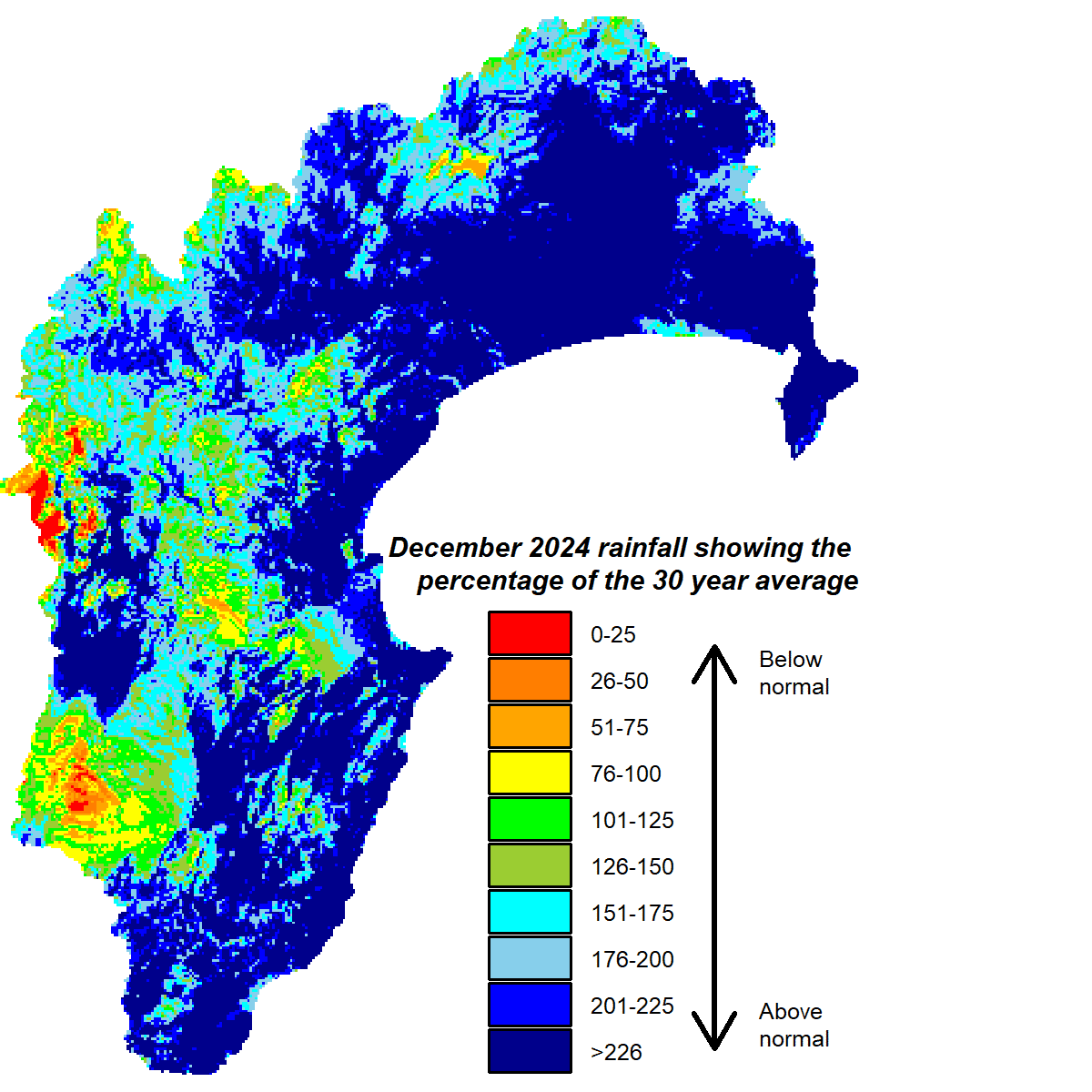
December brought the region a change in weather fortunes. The timing wasn’t great for holidaymakers, but some relief was needed from the extended dry period. It hasn’t helped that temperatures have been grim since people knocked off work for Christmas. Overall though, December’s temperatures were more than 2°C above average and rainfall was approximately 180% of the month’s long-term average. All parts of the region got the rain, with just the Kaweka Range receiving near normal rather than the above normal rainfall that fell everywhere else.
Soil moisture has returned to near or above median levels for summer. River flows have been recovering and we should know in the next month how well the rain has replenished groundwater levels.
The outlook in the three months ahead suggests further rain should come. The La Niña indices are treading a fine line with making an event official, though any event is likely to be brief. Furthermore, the sea surface temperature pattern is atypical of La Niña conditions because the cooler than average temperatures are located centrally in the equatorial Pacific Ocean rather than in the east. Sea temperatures have cooled around northern New Zealand but remain well above average in an area east of the country.
The forecasted pressure pattern has higher than normal pressure to the east and south of the country and lower than normal pressure extending across northern New Zealand, but with the chance higher pressure builds over eastern New Zealand towards the end of the three months. Winds may often have an easterly component as a result and bring us near or above normal rainfall. Modelling also suggests temperatures should improve, which would be a tonic.
All the best,
Kathleen
The new year kicked off with a bang when routine inspections of a biosecurity surveillance trap in Auckland found a single male Oriental Fruit Fly on January 3.
For many across New Zealand’s biosecurity network, this signaled an abrupt back-to-work and a swift move to a Level 1 Response.
The area of Papatoetoe where the find was made was immediately identified as a controlled zone, divided into two sections – Zone A which was 200m radius area from the original find and Zone B was a 1500m radius area from the original find.
Additional traps and lures were added to the zones as part of the response and the checking frequency was increased with an initial goal to determine whether a breeding population was present.
Thankfully to date, no other fruit flies have been found.
As a signatory of the Government Industry Agreement (GIA) deed, NZAPI was highly involved. Biosecurity Manager Rachel Masters, as a member of the Response Governance team, and Chief Executive Karen Morrish, met daily with GIA partners.
To ensure all affected parties were informed, meetings were held with other key stakeholders, exporters and communication teams, ensuring efficient and effective information was distributed in the most appropriate and timely manner.
Preparations are ongoing to ensure we are prepared for any further fruit flies finds or if the response level is changed.
As we move through the response, it has provided the opportunity to test our systems and processes, develop and foster relationships with key stakeholders and collaborate on finding the most effective solutions.
This has been the first fruit fly response since 2019 and highlights the critical role of our biosecurity systems and the 7878 surveillance lures and traps across the country.
The Oriental Fruit Fly (Bactrocera dorsalis) can affect more than 300 hosts including apple, kiwifruit, citrus, and tomatoes and an established population would generate control costs and production losses, with some international markets potentially halting imports from Aotearoa.
It is also a very important reminder of the role of biosecurity when maintaining how we do business, which means now is a good time to consider the part you play and how you could be affected.
New Zealand will continue to face biosecurity risks. And while we have one of the best biosecurity systems in the world, we must all play our part in improving our risk management effectiveness.
NZAPI provides a range of resources on preventative measures that you can be doing now in your business.
If you’d like to know more about how you can do your part, please reach out to NZAPI Biosecurity Manager Rachel Masters on rachelm@applesandpears.nz