

Dr Kathleen Kozyniak
Principal Scientist Air
Hawke’s Bay Regional Council
March rainfall clocked up a concerning statistic. The Heretaunga Plains, Ruataniwha Plains, the region’s south coast and both the Kaweka Range and Ruahine Range have recorded four consecutive months of below normal rainfall. We normally start worrying at three. The March totals didn’t even reach 50% of the month’s average and rainfall accumulations at some sites, for the hydrological year to date (July to June), are behind where they were this time last year – our most recent drought period.
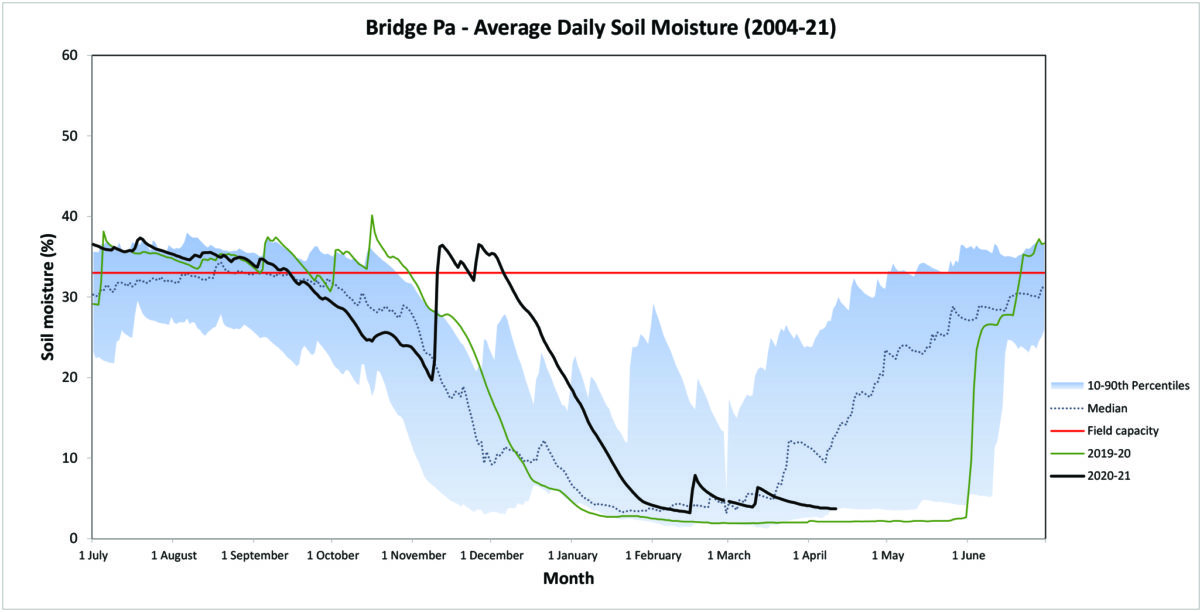
March river flows were lower than average and we’re still very much in the mode of monitoring low flows when we expect to be winding down by now. Soil moisture was below median levels for March and in some places, like Bridge Pa and Crownthorpe, the levels fell into or came close to hitting the lowest 10th percentile of readings. The majority of measured wells had groundwater levels that were in the below normal or lowest ever category. Soil temperatures on both the Heretaunga and Ruataniwha Plains ended the month near average on 19°C.
We’re transitioning from a La Niña event to neutral conditions, though our pattern of weather will be slow to change according to the forecasts for April to June. Seasonal models still persist with higher pressures to the south and east of New Zealand and lower to the northwest. Easterlies therefore continue to feature highly so a bout of westerlies during mid-April may be more of an aberration than the norm. On the whole it doesn’t bode well for rainfall because that same pattern hasn’t delivered a lot since November. There is a vague chance pressures might be lower over the country in May which provides a glimmer of hope that we may get near normal rainfall over the three month period. Temperatures are expected to be near or above average.
Percentage of Normal Rainfall

John Wilton
I have heard that the Royal Gala group this year has not come up to expectations in regard to fruit size and crop volume. I have also noticed that many Royal Gala blocks are bristling with vigorous annual shoot growth.
There is a strong negative relationship between annual shoot growth, fruit set and in particular fruit sizing in apples.
Once you have sufficient leaf area to set and support the crop, any further leaf growth tends to be counter productive because it fuels further unwanted shoots, growth which competes with the fruit, shades reducing colour development and quality increases pruning costs.
Now is a good time to assess block behaviour in regard to cropping, vigour as well as begin to formulate a plan for the future. With the massive increase in labour costs that ben imposed on the apple industry it will be difficult for lower value varieties to continue to remain profitable. Where this is likely to be the case, pulling the trees out immediately after harvest will be your best option to reduce their drag on your cash flow.
Trees pulled out in full leaf rapidly dehydrate so when the weather will allow fires to be lit the trees will burn well.
Young, intensive blocks may be a grafting option. Grafting trees on dwarfing rootstocks can be very tricky, particularly where there are no lower branches to act as sap drawers. In the absence of sap drawers dormant grafting, where it is done correctly is the best option. As the bark does not readily lift in the dormant period rind grafting techniques are unsuitable for grafting at this stage, irrespective of what your grafters may try and tell you.
Dr Kathleen Kozyniak
Principal Scientist Air
Hawke’s Bay Regional Council
What a difference a day makes. We’re still waiting to see the full effects, but the heavy rain on the 9th November looks to have changed the region’s fortunes when it comes to the state of our water resources. Most of the rain, over 200 mm in 24 hours, was focussed on the Napier urban area and parts of the south coast, where the intensity has caused damage to properties and infrastructure. Outside those areas, totals have mainly ranged from 50-80mm over the same period. It’s been topped up with a further 30-50 mm across the region on the morning of the 11th November.
Prior to this we’ve had four months with near or below normal rainfall, soil moisture mostly near or below median levels for the time of year and both groundwater and river flows consistently below normal. Rainfall accumulation minus potential evapotranspiration (PET) so far this hydrological year (from July 2020) was significantly down on historical values. We’ve been getting by but with little in the tank if we did hit an extended dry spell.
La Niña is here and promised much – the seasonal forecast models all indicating we’d get near or above normal rainfall over November to January. So far, they’ve delivered. Not yet halfway through November, the Heretaunga Plains and the south coast have more than doubled their average November rainfall total and the only area to not yet reach its November average is the Ruahine Range (68%). Soil moisture levels have jumped to field capacity, rainfall accumulations are approaching normal levels and hopefully we’ll soon see average river flows show significant improvement and groundwater levels bolstered.


