

Richard Mills, Summerfruit NZ Market Support
In harmony with being a bit of a weather tragic; it’s still dry but I guess the 35mm of rain last month is better than the 14mm of the previous month. Still, nowhere near enough but we will take it and hope for a whole lot more as we settle into winter. Now I’m getting a little more concerned with the amount of winter chilling that is not happening – Hawke’s Bay is flat lining as I write this. By contrast Marlborough is as good as it has been in the last five years and my Central Otago contacts tell me that they have plenty cold down there.
The implication of low levels or late winter chill for dormancy enhancing products (dormancy breakers) is that we need to delay applications to the later end of what would be the application window. If you are not a traditional user of these products and if you are a cherry or apricot grower, especially Sundrop apricots, then a chat with your rep might be well worth while. At least start thinking about options even if there is no need should chill units pick up later in winter.
I have had the privilege of attending a few seminars recently, Young Fruit Grower competitions and a conference in the last couple of months. The first of these was the Regenerative Agriculture Hui in Wellington, which Jen Scoular of NZ Avocado reported on in the May Orchardist. This theme has come back to me several times over the period. At this stage most of the presentations, including that of Brent Clothier at the Summerfruit conference have been at a pretty ‘high level’; more about defining what Regenerative Agriculture might be- rather than what it is. What I have taken out of these presentations is that we have the opportunity to develop what works for New Zealand without being beaten into the US concept of what is needed and without what seems to be a generalised pathway, as is being defined by Greenpeace New Zealand. For me, it seems like an opportunity to think about what our orchards might look like in 50 or 100 years. Put another way, if my grandchildren were to be orcharding what are the improvements I could be thinking of now, so that growing stonefruit is profitable and sustainable and in a continuingly improving soil, water and arboreal environment.
To achieve this the idea that makes most sense to me is to act at a ‘catchment level’. This is illustrated by a farming mate who told me how the farmers in his valley are measuring baseline data on water and nutrient inputs and outputs, and jointly paying someone to do the work. Another excellent example of catchment level progress is the Twyford Water Users group. Both of these examples counter Plan Change 6 that was imposed on the Tukituki River users and has been problematic. Catchment level does not necessarily mean just issues that relate to water, but could refer to similar soil types, or air sheds or crop types. Is there a place for grower organisations such as Horticulture NZ and Summerfruit NZ to gather data and act as the catchment on wider issues?
Is intensification an answer for horticulture? If we were to increase the production levels on a per hectare basis, but retain the same yield per orchard, could the remaining land be retired or planted in carbon credit trees or used for water storage or green corridors or whatever seems appropriate to your catchments needs? Let’s contrast this with the call to de-intensify the dairy industry, or the continuing desire from Government to focus on more and more exports.
Both of the Young Fruit Grower Competitions that I attended were fantastic events and reflective of the locations that they are based in. The Hawke’s Bay event at Toitoi was very slick and good fun, the Cromwell event whilst run on a smaller budget, was equally enjoyable. Congratulations to all of those who stepped up and gave it a go, the industry is proud of you.
Congratulations to the three place getters in the Young Fruit Grower of the Year competition run by HBFA. Liam Sykes who was runner-up and Corey Simpkin who was placed third, are graduates of the Level 4 Certificate in Horticulture run by EIT. The staff of the Primary Industry School are very proud of their achievements.
Year 1 trainees are now fully involved in the fruit support structures classes practicals, which involves the students creating and fixing end assemblies and wire tying. Our graduates tell us this is a very useful skill. This cohort has been recently added to and the numbers are excellent. We have had a number of enquiries about when the next intake which unfortunately won’t be until January 2022.
Year 2 trainees have a number of assessments on the go. Most have now completed the EIT requirements for pruning and just need the on job attestation. Most have also competed the Harvest Quality assessment and are also waiting for the on job attestation for that. Soils has also begun, and whilst they cannot complete the assignment yet, they should be working on it. The second soils class is on the 25th of June. They also should be collecting weeds for their collection.
The 12 Level 3 trainees who started this year are also completing fruit support structures this week.
Year 3 trainees have now completed Human Resource Management. Brian tells me that the trainees have done an excellent job with their role plays and sorting out conflict situations. This week they also complete the class work for pruning. We have an all day field trip planned to look at different training systems, their advantages and disadvantages and in particular the different pruning cuts that need to be made. As of this week, half the delivery and assessments will be completed and the majority of the trainees are on schedule. Well done.
Level 5 Fruit Production have now completed their horticultural business skills course and the Crop Production block course is to be delivered next week. Dave Tanner is the industry expert delivering this course which is about plant physiology and how to manipulate trees regarding timing and quality of the fruit. It is not too late to enroll providing the applicant is working towards a planning and managing level. At the time of writing this news item, the outside temperature is 19 degrees. So good luck with achieving sufficient winter chill! This course will help with making decisions around timing.
As always if you have any queries or concerns please get in touch with EIT Tutor Gordon Reid greid@eit.ac.nz , 06 8301851 or 027 3940410.
Jens Liesebach, KGI Lower North Island Representative
The Mystery Creek Field Days has kicked off in Hamilton and Zespri CEO Dan Mathieson will update growers on how the season is progressing and the latest from our global markets.
The Zespri team has visited Hawke’s Bay twice in the last three weeks. The first event was run by the nutrition experts of the Zespri Global Extension Team. The interactive session on kiwifruit nutrition included discussions about key nutrient sources, losses, soil and seasonal processes that are important to consider when reviewing your annual soil test and fertiliser plan. A highlight was the introduction of a quick and easy nitrate testing kit.
The second event that Zespri hosted focused on the Producer vote, asking Growers if they support conducting a one season commercial trial involving the monitoring, procurement, and marketing of up to 200,000 trays of Chinese-grown Gold3 kiwifruit. Growers will also be asked to decide if they support the use of a China origin Zespri brand on Chinese-grown Gold3 kiwifruit, which meets Zespri Class 1 standards as part of the sales and marketing trial in dedicated retail outlets. It was great to see that 11 growers cast their votes after the informative meeting. Voting will close at 12 noon on 25 June 2021.
Nominations for the 2021 Regional Representative Elections are open until 21 June. The nomination form as well as important information about being a Regional Representative and supplementary documents can be found on the NZKGI website here.
Many growers will be breathing a sigh of relief and hopefully taking some well- deserved time off with harvest now behind them. Some will have started, or be completing a review of the season and forecasting financial results. With some luck, the bottom line in our budgets will be sufficient to meet operating costs and take on the challenge of growing more premium quality fruit for New Zealand and the world.
Many industries have had to battle their way through the global Covid pandemic with unprecedented disruptions to normal business. Our industry has faced its’ fair share of headwinds this season including a labour crisis, massively constrained global shipping, significant increases in operating costs and even extreme hail and weather events to top it off. But despite these adversities, most (I hope all) will soon be planning and preparing for another season, reviewing strategies to face whatever challenges are likely to come. But before this happens, please remember to take a break, recharge the batteries and spend quality time re-connecting with friends and family.
I would like to acknowledge the passing of John Wilton earlier this month. John made a huge contribution to our industry. I was fortunate to have worked alongside John and like many, will miss his razor sharp wit and relentless pursuit of improved fruit production systems.
As an industry it is more important than ever that we work together and support one another to achieve our common objectives. We may have different political views, different ideas about who should do what and different solutions to the challenges we face, but as an industry we are undoubtedly stronger if we work together. As your regional association, HBFA exists to support our members and the fruit growing industry of Hawkes Bay, so please continue to share your views and suggestions with our Executive Committee. I look forward to seeing you at the National Horticulture Field Days and Young Fruit Grower of the Year Competition and Awards Dinner on the 3 and 4 June.
Richard Pentreath
HBFA President
Alan Pollard, Chief Executive, New Zealand Apples & Pears
The government has announced a further border exception for 150 RSE workers to enter the country every 16 days from around mid to late July.
All of the conditions associated with the previous 2,000 worker border exception remain, but in addition employers will be required to fund an additional $828 + GST per worker to cover additional dietary requirements, worker care packages, translation services and water. The government have also introduced a condition that the $22.10 minimum will be extended to apply to all RSE contracts as they come up for renewal.
NZ Apples & Pears did not and does not agree with this proposal. However, despite extensive “negotiation” the government were not prepared to move much from their offer save for some movement on the additional MIQ costs. However, we agreed that it should at least be offered to businesses to make their own commercial decisions about whether to participate or not.
While the additional border exception may provide some relief for the wine industry, particularly given their winter pruning needs, it offers little benefit for our industry. It is likely that the incoming numbers will only be sufficient to offset the number of RSE workers who have expressed a desire to return home. There is also at this stage no guarantee that the Minister will extend the visas for those workers who remained in NZ at the time of lock down and are still here, or came in under the 2,000 border exception. The risk is that unless there is movement on both numbers and visas there will be fewer RSE workers in the country by year end. We are continuing to lobby for visa extensions.
Prior to Christmas, Hawkes Bay industry and local government lobbied the government for a regional solution. It was rejected at the time. NZAPI has commissioned that same consultant to update that submission and again argue for a regional solution. This is again supported by regional businesses and local government.
We need substantially more workers to return to NZ in time for October/November thinning. We have always acknowledged that MIQ is an appropriate process where risk supports it. But we have also argued strongly that the RSE workers should not enter via MIQ given that they are coming from Covid free regions. Not only would this create a safer environment for the workers, and a more commercially sensible option for employers, but it would free up even more spaces for kiwis wanting to return home from Covid infected areas.
If you have any queries please feel free to give me a call: 021 576 109.
Jens Liesebach, KGI Lower North Island Representative
New Zealand Kiwifruit Growers Inc (NZKGI) has appointed Colin Bond as the new Chief Executive Officer. Colin, who took over from Nikki Johnson on 24 May, has an impressive track record over the past 22 years with ANZ Bank, particularly in his most recent role as Regional Manager – Commercial and Agriculture. Colin will bring a wide range of skills and experience to the CEO role and will lead NZKGI well in advocating and increasing value for growers, building on the strong work Nikki Johnson started.
While the harvest of Gold kiwifruit is coming to an end, green kiwifruit has only just started Mainpack. Soil moisture levels are dry, but the lack of rain is facilitating the harvest process. Growers are starting to reflect on the season and prepare for leaf drop, keeping wounds protected from PSA infections. The Zespri Global Extension team will be running a workshop on 26 May, Havelock North to help growers to make the most out of nutrient inputs, while minimising environmental impact.
Zespri and NZKGI are ensuring growers receive a range of information on the topic of the proposed one-year Gold3 trial in China so that they can make an informed decision. A series of Zespri Town Hall online discussions are being held and NZKGI has created podcasts for growers which feature interviews with experts surrounding the Zespri Producer Vote. Zespri is also conducting roadshows on the Producer Vote and is going to visit Hawkes Bay on 3 June, 8.30am at the Napier War Memorial Conference Centre.
Richard Mills, Summerfruit NZ Market Support
It’s dry. What should be one of the key months to recharge soil moisture, in parts of Hawke’s Bay we’ve only received 14mm for April. Only irrigated pasture is growing any grass, and soil temperatures are reported to be down to 12 or 13°C in parts. Anything less than 10° and grass growth should stop and then stock farmers are in trouble. Two dry winters and three dry autumns in a row is going to be really tough – imagine two significant hail years in a row, or perhaps hail followed by Covid-19. Time to shout our pastural cousins a beer and show some solidarity.
Back on the orchard some of the effects of low soil moisture might include ‘hungry’ buds if trees were not properly feed in autumn. If stressed leaves drop early, the problem only compounds. It may well be a bit late for supplementary foliar feeds, but have a chat with your rep. With stonefruit, the flowers are naked i.e. there are no leaves to help power up in spring, so we rely totally on stored reserves.
Now is the time when we start to keep an eye on the progress of winter chilling. It’s predicted that we will be drier and warmer than normal, at least not colder and wetter. At this extremely early point we are have accumulated an average amount of chill, and a few more units than this time last year. In my experience, getting a good start at the end of Autumn is the key to getting sufficient total units by Spring. Should you be intending using dormancy breakers at the end of winter, then this is a parameter that is well worth following to help with correct application timing.
The recent SummerGreen meeting focused on cherries – the effects of climate warming, export and market potential for Hawke’s Bay crops. The key message being less chilling by the centuries end. The preceding presentation suggested there was plenty anyway, so maybe a bit less will not be the end of temperate fruit production as we know it. I think more work is needed in this space before any significant decisions are made.
Three weeks ago I had the pleasure of attending Martin Taylor’s retirement party. A cold beer, a good feed and a few speeches with the highlight for many, catching up with growers and other industry people in a social environment. The amount of knowledge in the room was huge. To this day I lament not downloading a whole lot more information while I was working with him. It’s a pity that we don’t have the technology to put a USB drive in his ear and select download all.
And it is with sadness that I note John Wilton’s death. Another that would have been well worthy of downloading but at least we have many years of The Orchardist articles to fall back on. I understand that John only missed an article once in 40 years of publication. Should we talk to The Orchardist about publishing a book of his articles? Knowing where we have come from will help us move forward, and a lot of what applies to pipfruit, will apply to stonefruit. Not so long ago I had the pleasure of reading the history of DSIR as was in Central Otago and I have a copy of the Ettrick Fruitgrowers Association history. As Martin said during his speech, the days where we had the help of trained independent MAF advisors such as John and Martin, among others, is part of history. But as I looked around at my contemporises, there is heaps of knowledge in AgFirst and Fruition systems, as well as the agchem reps. We are in good hands, but I do miss the social catch-ups in this increasingly corporatised fruit production world.
My first orcharding job was greatly aided by John Rainbow working with NMA, or was it Wrightson NMA by that stage? So maybe the more things change, the more they stay the same.
Johnathan Brookes
The passing of John Wilton is huge loss for the AgFirst team and the orchard industry. I would like to tribute this article to John and include what I believe he would have been discussing this month.
In the last newsletter we discussed the removal of orchard blocks that have little, if any future in our new high labour cost industry. Orchard blocks are going to fall into three basic categories.
Replant blocks – For blocks that are being removed it is critical that you spend time planning to ensure you get the right results. – Pick a planting system that you believe will still be economically viable in 20 years. Decide on a planting density that optimises your site and your planting system, our OrchardNet production data base shows no real relationship supporting super high tree densities and relative gains in profitability.
Make sure the replacement area is properly prepared to get the best out of the new trees when they arrive, soil sterilisation, nutrition, drainage, ground preparation, irrigation design, tree support structure, consider the future climate and if there is justification for hail netting to be part of the planning, every one of these tasks can have a significant effect on ultimate block performance
Grafting blocks – For blocks that are suitable for grafting you need to consider – What style of graft you will do? how many grafts per trunk? do you need to leave branches to maintain sap flow to the tree? do you need to upgrade the support structure? grafting tape? or grafting paint? or both? when am I going to cut down the trees? and when am I going to start grafting?
Existing blocks – In the blocks you are leaving in the orchard focus on tasks now that should make potential labour improvements at harvest. Focus on reducing waste fruit, that will not make harvest quality, and target ways to make harvesting easier or more efficient. Start the year with an optimised block yield target, using history and industry benchmarking to fine tune your goals. Create effective pruning plans, built around optimised yield and vigour targets, optimise the light distribution throughout the trees – Prune to make the pickers happy, is the block platform ready?
John always said fruit growing is easy – “Just don’t make any mistakes”.
Dr Kathleen Kozyniak
Principal Scientist Air
Hawke’s Bay Regional Council
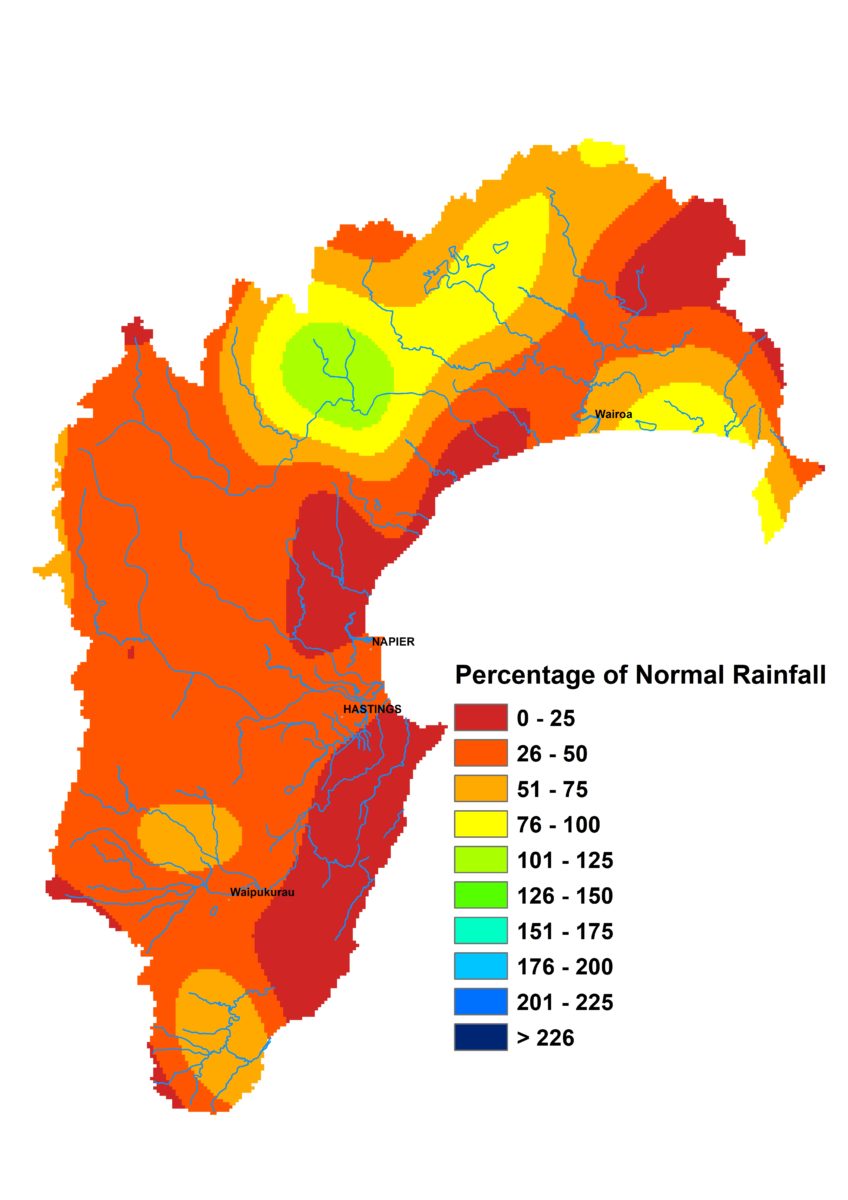
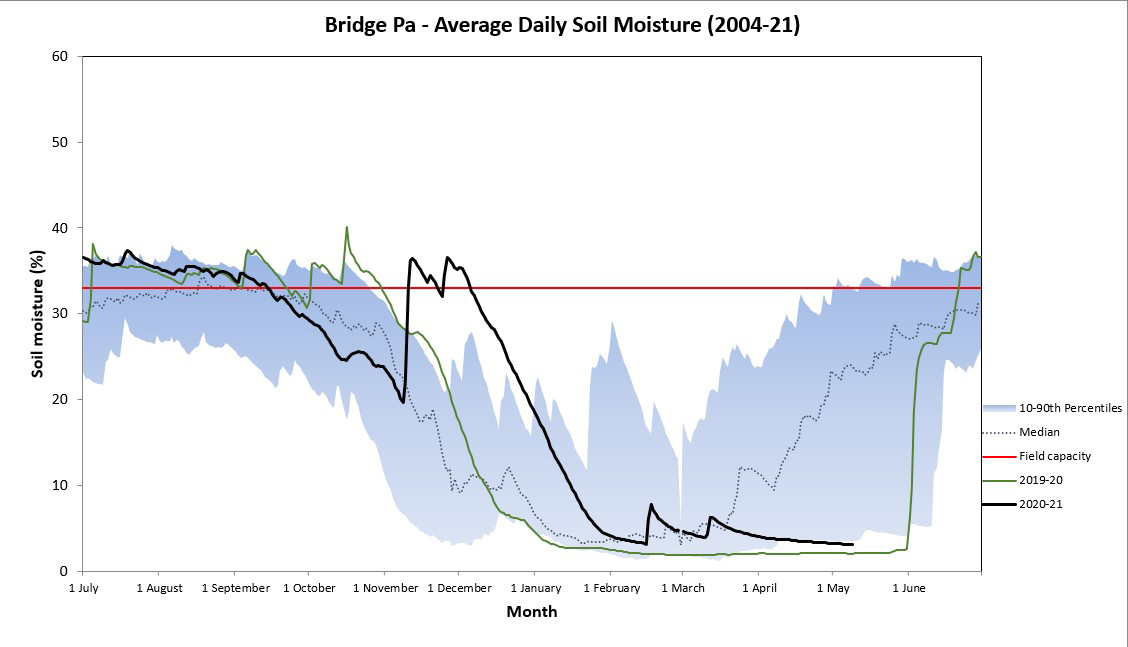
Heavy sigh. April sees another month of below normal rainfall – the tally is now five consecutive months for areas such as the Heretaunga and Ruataniwha Plains, the Ruahine and Kaweka Ranges and the southern coastal area. At some of our sites in those areas, including Bridge Pa, the rainfall accumulations for the hydrological year are lower than those at the same time in the 2019-20 year.
April was the carbon copy of March in a couple of ways. Both months saw only 40% of average rainfall and both had very similar daytime temperatures – averaging approximately 20°C. That meant that April’s temperature was a mighty 2°C above average.
April’s river flows were very low across the region, averaging only 27% of normal, and the majority of groundwater wells we monitor were below normal for the month. Soil moisture levels ended April in the lowest 10th percentile of readings for the time of year at Bridge Pa and Crownthorpe and below median levels on the Ruataniwha Plains. It’s not a pretty picture and the longer it takes for rain to come, the uglier it gets.
The La Niña is almost history but seasonal forecast models show little change in the general pattern of weather. We still hang on to lower than normal pressure northwest of the country and higher to the southeast. We can expect a mix of northeast and southwest winds as a result along with a three month forecast on repeat – near or below normal rainfall and near or above normal temperatures. The first half of May is looking unsettled and we need it to deliver on its promise rather than be the fizzer that these unsettled periods have been to date.
Percentage of Normal Rainfall
John Wilton
After the problems of this harvest season and its labour shortage, there will be a lot of older blocks planted to poorer paying strains and varieties which have little, if any, future in our new high labour cost industry. The sooner these are gone, the less financial drag they will cause you.
If these trees can be pulled out well ahead of dormancy their transpiring leaves will quickly dry out the wood leading to a good, clean burn once it is possible to light fires again.
If trees are not available for their replacement, do not let this hinder pulling the block out. Bare ground loses a lot less money than a non-performing redundant variety. Each hectare pulled out will release around $15,000.00 of working capital to be used elsewhere in the business.
The immediate post-harvest period is also a good opportunity to tidy things up around the orchard. For instance, I have noticed a few dead trees with lots of silver leaf spore production potential. These need to be removed now and burnt before the pruning season begins. Once we get some wet weather, these old stumps will begin spore production again. If you are going to use them for firewood, store them in a dry place so they do not get wet and start spore production again.
There has also been a niggling amount of black spot around this season so in blocks where it has been a problem, a ground spray of urea at 5% concentration is necessary as soon as most leaves have fallen.
Check trellis support systems and mend any that appear to be failing. Many of the older tree supports are not robust enough for the crops we are carrying today.
Check nitrogen nutrition. In areas where the crop coloured well and foliage was pale green, or going into autumn colours early is indicative of low or marginal nitrogen levels. Lush green foliage with late leaf drop is indicative of excess nitrogen.


