Dr Kathleen Kozyniak
Principal Scientist Air
Hawke’s Bay Regional Council
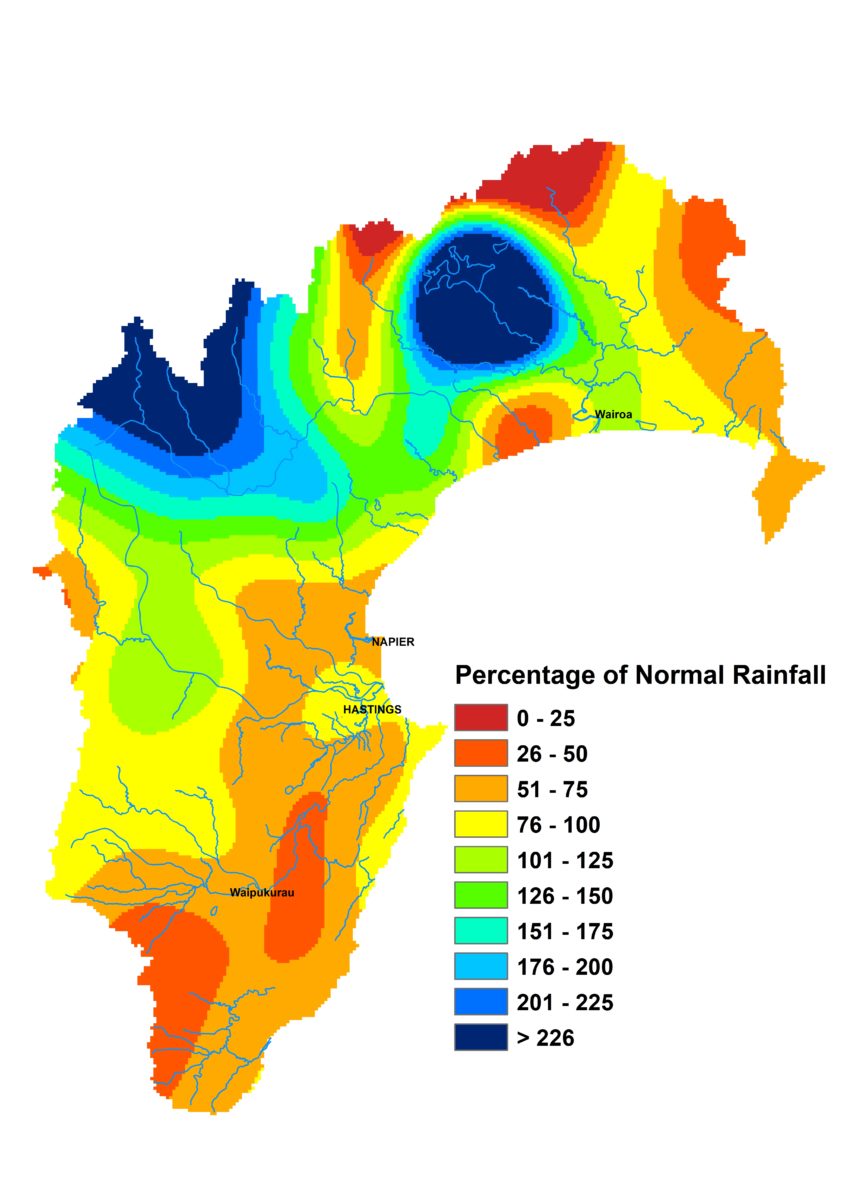
June’s weather was just what the doctor ordered. All areas of the region received near or above average rainfall for the month along with impressive temperatures 1.5-2.5 °C above average. Grass growth staged a late rally due to the warm, wet combo – and it was sorely needed after six months of below normal rainfall across the parched Heretaunga and Ruataniwha Plains and south coast.
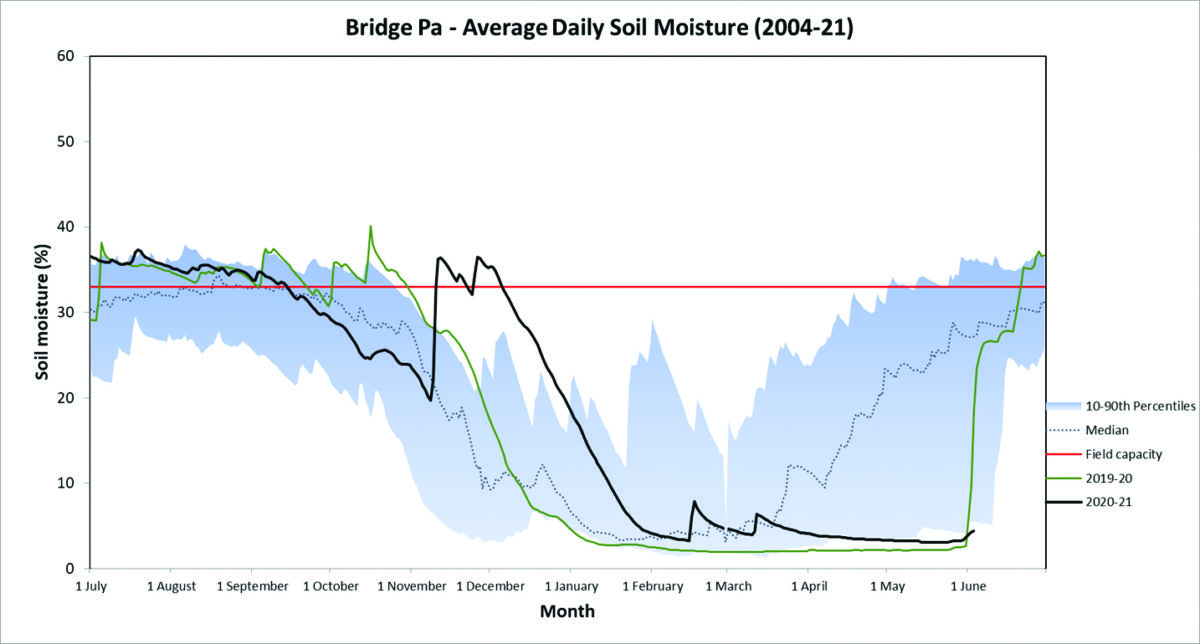
Most of our river flows were within the normal range for June and it was great to see soil moisture levels bound upwards to field capacity. Groundwater levels still dragged the chain at below normal levels but hopefully the good June rainfall filters through and soon fixes that. Soil temperatures spent most of the month in double figures but dipped a little below 10 °C to close out the month.
We currently have neutral El Niño-Southern Oscillation conditions, which may persist for the rest of 2021 but there is speculation that a La Niña might reemerge later in the year. We learned from last summer that a La Niña doesn’t preclude drought, though typically we expect warmer, wetter conditions brought to us on a northeasterly flow. It’s possible too that we’ll have a negative Indian Ocean Dipole for spring, which is another circulation pattern that can influence the region’s rainfall. The negative mode enhances the likelihood of good spring rain. Forecasts for the next few months are for northeasterlies to regularly feature and rainfall and temperatures to be near or above average as a result. Sadly we’ll still have to brave the occasional, wintery, southerly blast.
Percentage of Normal Rainfall


Alan Pollard, Chief Executive, New Zealand Apples & Pears
Although the 2021 selling season continues, the industry has turned its attention to the 2021/22 growing season.
If there are no significant weather events, such as the severe hail that impacted Nelson and Central Otago at the end of 2020, our estimate is that across New Zealand there will be an additional 115,000 metric tonnes of pipfruit to harvest over what was available to harvest in the 2020/21 growing season, which will require an additional 2,000 workers over the number that were required for the previous year. Clearly, faced with that prospect, something has to change and change quickly.
NZAPI has long argued that there is no sense in bringing in workers from COVID free Pacific countries, and putting them into the one place in New Zealand where we know there is COVID – MIQ facilities. A vaccination programme coupled with the COVID free status should enable the freer movement of RSE workers across our border.
The government has also signalled that it expects all industries to develop an Industry Transition Plan (ITP), which sets out how an industry will transition to a high productivity high wage environment. Having an ITP will be a prerequisite for an industry unlocking sufficient seasonal labour in the short term while transitioning in the medium to longer term. An ITP addresses such things as attracting and retaining talent, training and growing talent, accessing sufficient seasonal labour, and developing and adopting technology and best practice. In the case of the apple pear and nashi industry, these are all areas that are already receiving attention by NZAPI and our members. NZAPI is the first industry association to respond to the government’s challenge, and draft an ITP. We are currently consulting with industry members and government agencies on the draft, and are looking to finalise the document in the next couple of weeks.
We continue to work with Ministers and officials to try and get some certainty for growers for the coming season. With vaccinations being rolled, recognising the COVID free status of much of the Pacific Islands, and our commitment to transformation in accordance with our ITP, there is no reason why that certainty couldn’t be given now.
Watch this space!!
Richard Mills, Summerfruit NZ Market Support
I have had the pleasure of a couple of trips to Central Otago this month so I thought we might compare and contrast the Hawke’s Bay and Central Otago stonefruit industries. Are the districts complimentary or competitive?
Climate/Geography
It’s further south and during the winter, much colder. More than that there is usually snow hanging around the nearby hills at this time of the year. The three main areas based around Cromwell, Earnscleugh/Alexandra and Roxburgh are different to each other as well. Roxburgh seems to me to be a difficult location to grow fruit, it’s the furthest south and open to the weather that roles up from Southland. They are resilient people and need to be so, but the COVID-19 labour scenario might be a step too far for them.
Cherries dominate the more northerly Cromwell area, Earnscleugh/Alexandra has a good mixture of all the five stonefruit and Roxburgh tends to have lots of apricots.
The Clyde research station has accumulated 1036 Richardson Chill Units and Twyford 760 to date. For reference, Clyde is having a good cold winter and Twyford is not.
At times the fog will come and settle in for two or three continuous weeks, which can make even the long-term locals feel a bit emotionally flat. Then the sun comes back and the views from every orchard are just stunning.
Here we can drive from Bay View to Havelock North in under 30 minutes, whereas the drive time from some of the cherry blocks at Bendigo outside of Cromwell to Teviot takes a good hour. Napier airport to the closest stonefruit block – 5 minutes. Queenstown airport to the closest stonefruit orchard is 45 minutes. The area is just a bit isolated, which is part of the charm.
In a pre-COVID-19 world, pruning would not be the first choice of things to do during the depths of winter, it’s just too cold. And that’s ok for stonefruit that we might want to prune outside of the winter bacterial infection time.
That cold difference is evident at harvest time with the same variety blooming and harvesting 3-4 weeks later in Central Otago. That area difference is complimentary in the local market with one area starting up as the other is winding down. This is what occurs most of the time, but when Hawke’s Bay is a bit late and Central a bit early, the marketing people can get jumpy. There is a longer growing season in Hawke’s Bay which means that some of the very late cultivars will not ripen properly in Central, they just run out of growing degree days.
Support Services
There is a PFR station in Clyde but it is significantly smaller and with less capacity than the station in Havelock North. They focus on plant physiology and plant breeding and have done a lot of work on frost mediation in the past. You have Fruitfed, Horticentre and Farmlands competing for business in Hastings as do the Central Otago growers but the technical leads for those companies are based in Hastings. Other companies such as AsureQuality will tend not to have an office in Central but may well do in Hawke’s Bay. We are fortunate to have New Zealand Apples & Pears based here and we benefit from the R&D that occurs locally.
Summerfruit NZ bases itself in Wellington and not in either region, mostly so that government and quasi-governmental organizations are close by when needed.
Area Composition
My previous role in R&D was happily based in Hawke’s Bay as so many different crops are grown here. Onions, green vegetables, covered berries, cherries, apples, kiwifruit, figs, grapes; the list goes on. Central Otago from drive past viewing tends to be some grapes, a few apples and stonefruit, the majority of that now in cherries. And how the cherry area is growing. The total New Zealand area in stonefruit is about 2300 ha; and I know of several blocks in the 80-100 ha region that are being developed at the moment. I guess that the area in stonefruit in Hawke’s Bay is static or maybe even decreasing, being replaced with apples while central is in an expansion phase. This expansion reminds me of what happened in Hawke’s Bay with apples 20 years ago, more of a corporate mindset and expansion to non-traditional growing areas such as Central Hawke’s Bay.
Each area has its dominant grower, some middle-sized blocks a quite a few small players. I visited a newly developed 3 hectare cherry orchard in Cromwell which is not unusual, but here that three-hectare block would be part of a larger pipfruit enterprise.
Cherries dominate the more northerly Cromwell area, Earnscleugh/Alexandra has a good mixture of all the five stonefruit and Roxburgh tends to have lots of apricots.
People and Workers
The relative isolation, small variation in crop types and small permanent population size does not work in Central’s favour. According to Wikipedia there are 23,100 (2020) people in Central Otago in total, with Hawke’s Bay nearly 8 times that with 178,600 people. All of Central Otago is about half the size of Hastings. In summer it’s a fantastic place to be on a working holiday but once the harvest season is over workers tend to want to be somewhere else, somewhere warmer. Much as Hawke’s Bay loses workers to kiwifruit, Central loses workers to Hawke’s Bay apples.
I am starting to see a few Hawke’s Bay people turn up in managerial roles down there, again the pool of skilled people is a little shallow in an area that is expanding. There is opportunity for some younger growers and support people to go and get experience in a different area and bring back an expanded skill set.
They are really concerned about where the seasonal workers will come from for 2021-22, much as Hawke’s Bay is, but with more of an anxious edge. This season just gone we sort of got away with getting the job done, and Central did to, but only because rain destroyed a big part of the export cherry crop.
Gate Sales
While we still have the occasional gate sales enterprise in Hawke’s Bay, that tradition seems to be hanging on a little longer and stronger especially at the entrance to Cromwell and through Roxburgh. I’m picking that it’s the passing traffic being funneled through these areas much like Pakowhai Road used to be, and as Kirstin’s Corner is now.
Innovation
Not all cherry blocks have bird exclusion netting, but more and more do. Imagine being able to pick a viable cherry crop in Hawke’s Bay without netting – not a chance. Rain covers are popping up on a few blocks and there is a cherry crop being grown inside what might be considered a big greenhouse. This orchard will be directly competing with the climatically earlier cherries from here.
Last week, I was shown some of the packaging that was being developed and used by New Zealand Cherry Corp for both export and local market sales and it looked pretty impressive. E-marketing from a dedicated cherry block was one of the packs, as was a high end box with only 48 fruit, aiming to be sold for a silly price in China.
Another of the innovators is Mike Casey at Forrest Lodge, Mike is creating a niche for himself and telling the world about it, and it’s this sharing of innovation that I appreciate. There’s a tag line that I remember from the avocado presentation at the Sensational Summerfruit roadshow, ‘take from the best and give with the rest’. When the electric tractor arrives all of the orchard operations will be driven from solar power generated on the orchard – including the wind machines. Hop onto his website at https://www.forestlodge.nz/
So, is Central Otago stonefruit complimentary or competition for Hawke’s Bay? Neither and both I think is the answer and as always, the real answer is in the detail. The largely export driven cherry crop can be an innovator and not directly competitive on the local sales, until something goes wrong, then it is very disruptive. Like the Bay View crop is to later areas on the plains so are Central Otago apricots, nectarines, peaches and plums; just that bit later until there is very big crop and cool stored fruit comes into play.
Everyone is trying to make a buck, sometimes with success and sometimes not within in the same industry. We are all competitive with each other to some extent and most of the time manage to play together nicely.
Jens Liesebach, KGI Lower North Island Representative
Finally, we are getting meaningful accumulation of winter chill units. Whilst it might slow down pruning, it will be great for budbreak. Application of budbreak sprays will commence at the beginning of August.
As the hydrogen cyanamide season approaches, there’s plenty you can do now to ensure a smooth run. Hydrogen cyanamide applications attract a fair amount of community concern, and we have to work together as an industry to ensure that we don’t give any reason for spray complaints. If you have any concerns or need any assistance, you can contact Jemma Pryor at Zespri on 027 283 6192 or jemma.pryor@zespri.com
Zespri recently announced the results of their Producer Vote regarding a one season commercial trial for the monitoring, procurement, and marketing of up to 200,000 trays of Chinese-grown Gold3 kiwifruit. Whilst there was strong support from the industry for the trial, this did not reach the 75 percent threshold required under the regulations meaning the proposed trial will not proceed. Zespri will continue to monitor the situation in China closely and as part of its core business activities, will continue its research and development partnerships in China to better understand and monitor the performance and quality of Gold3 in China. The industry will be kept informed of further developments. .
We all know that New Zealand produces plenty of great food to feed the world. One of the best known examples is the export of 95% of our dairy products, however have look at the RNZ webpage “Who’s eating New Zealand”. There is a brilliant visualisation of how much money we extract from overseas markets and how the ranking by counties has changed over the last 30 years. For kiwifruit, Japan was ranked number 10 in 1991 at $22,495 and China was not even mentioned. Things have definitely changed.
Please keep Wednesday, 18 August 2021 free for the NZKGI AGM which will be preceded by the KVH AGM at 9am and will be followed by the Zespri AGM at 1.00pm at the Trustpower Arena, 81 Truman Lane, Mount Maunganui.
I look forward to seeing you there.
Leander Archer
AgFirst is running a new project in the Hawke’s Bay investigating the impact of tile drains (referring to any sub-surface drainage) on water quality. All sectors need to be measuring and understanding their environmental footprints, and this project addresses the lack of horticultural data in this area.
Tile drains are used to divert excess moisture from the soil. This increases crop health both in winter (more oxygen to roots) and in summer (more roots survive increasing drought resilience). This is key to maintaining food security and increasing climate change resilience. This project seeks to understand whether nutrients are being lost below orchard root zones and carried into tile drains and draining into local waterways.
We hope this project enables us to better understand the impact of tile drains on water quality, so that, if needed, growers can implement the required management strategies to improve nutrient efficiency. This will benefit not only the environment, but also orchard productivity by addressing the loss of valuable soil or nutrients that are essential for crop growth.
The project will collect a three-year dataset on 16 farms in the Heretaunga Plains in Hawke’s Bay with varying horticultural land uses. It will set up two trial sites on each farm, enabling experimentation with new management strategies in year three on one site, while leaving the other as a control.
The Heretaunga Plains has been selected because it has extensive tile drainage networks and a range of groundwater pressures and soil types, and much of the catchment is used for high-value horticulture.
The AgFirst team is at the end of the site selection phase and will soon be moving on to preparing those sites for monitoring, planned to begin in September.
Nine co-funders, including Hawke’s Bay Fruitgrowers Association, have backed AgFirst to carry out the project, and have leveraged this money using the MPI Sustainable Food and Fibre Futures Fund.
There are several assessments due in this week, so to some degree it is crunch time. A few trainees are struggling with their workloads. I know when I visit, that many managers are totally supportive of their trainees and are prepared to give them time and space at work. In many cases it is just a matter of the trainee asking for help. EIT tutors really appreciate this support. I have started some visits to keep you in the loop but I will have a better picture of who needs extra support after marking this week’s assessment submissions.
Year 1 Trainees have now completed fruit support structures and now in smaller groups are completing chainsaw training. With the time we have available, Warren can sign off the practical components to a capable level but managers need to give their trainees a reasonable amount of experience on job to be signed off at the outstanding or accomplished levels.
Year 2 Trainees have the soils assessment due in this week at the tutorial. As they have had some class time to do this assessment, I am expecting some high class work. Additionally, they have a practical to complete which involves applying some sort of soil management technique. Examples could be fertilising, applying lime, drainage, rotary hoeing and many others. It is mostly an on job assessment so please discuss with your trainee what they can do.
Quite a few trainees have completed their harvest criteria assessment but do not yet have a final grade because they do not have the small on job attestation for the health and safety component.
Year 3 Trainees also have an assessment due in this week, namely pruning. Part of this assessment involves interviewing their manager about new training techniques. If this has not been done then they have not completed their work. So please ask them about it. The last of the Human Resource assessment is also due.
In preparation for the next course they have a task to complete called the Visual Soil Assessment. This involves them digging a small soil pit and assessing the characteristics of the soil for its health. It is a cheap and useful method that can be applied to all soil types and land uses. Analysing their Visual Soil Assessment results is part of their assessment for the Growing Environment course.
Fruit Production Diploma. The Crop Production course was taught by Dave Tanner of Startafresh. Dave is a plant physiologist and he is an expert in bridging the gap between the production side and the post harvest side of the apple industry. Highlights of the course were looking at the new Craigmore development in Central Hawke’s Bay and the intense plantings (11,000 trees per ha) of the FreshCo Riverside block. The intensification and new developments are certainly going to be challenging in a world affected by COVID-19.
This week the team are bringing a water sample to class to analyse the qualities of their drainage water. On the basis that “you can’t manage if you don’t measure” they should get a clear idea of issues to do with nitrate leaching and phosphate runoff. This knowledge will be useful when they come to do the farm plan which is part of the assessment.
As always if you have any queries or concerns please get in touch with EIT Tutor Gordon Reid greid@eit.ac.nz , 06 8301851 or 027 3940410.
Alan Pollard, Chief Executive, New Zealand Apples & Pears
Last week I had the privilege of attending the Hawke’s Bay Young Grower of the Year awards dinner hosted by HBFA. Yet again, the evening was very well organised, well attended, and the audience was treated not only to a superb meal but to a series of very well delivered speeches.
The need to develop our next generation of leaders has never been more important. As we transition to our workforce of the future we have to be encouraging new talent with new ideas to enter the industry and for those in the industry to develop and grow meaningful, sustainable and rewarding long term careers.
I am currently on the governance group for the development of a plant strategy. Covid taught us many things, but one learning in particular was that government and industry do not share a common understanding of what the plant sector actually is, what are its drivers for success, and what we need to do collaboratively to grow our contribution to the NZ economy and the wellbeing of our people. The governance group consists of industry, government, Maori, and science leaders, and the strategy is being formulated to ensure a common understanding of horticulture, a commitment to investing in things that will support the growth of the sector, and the removal of barriers to success.
In launching Fit for a Better World in November last year, the Prime Minister specifically highlighted that the primary sector would lead New Zealand’s post-Covid recovery. There is no doubt that horticulture is the best placed of all of those primary sectors to achieve this.
Underpinning the drivers for horticulture’s success is a permanent and seasonal workforce that is highly skilled, well trained, well rewarded, and with access to clear career pathways supported by an education and qualification framework that is fit for purpose. That is why we have taken a leadership role in the Review of Vocational Education, through our Capability Development Manager, Erin Simpson, ensuring that the future vocational education structure will deliver our workforce of the future.
A continued investment in growth and innovation will ensure that there are great opportunities for young horticulturalists to progress rewarding and exciting careers. Hawke’s Bay offers a pool of young people looking to establish long term careers, and an employment environment where those careers can foster and grow. And events such as the Young Grower competition showcase what our industry can offer.
The future of the industry depends on there being a pipeline of young and enthusiastic talent who see a career in and are passionate about horticulture, being prepared to question and challenge the norm and committed to helping to shape our future. The participants in this year’s competition have put their hands up and flagged that they have aspirations for future leadership in our industry. As industry leaders our role is to support their aspirations and provide them with every chance for success.
The 2021 Apples and Pears Conference will be held at Toitoi in Hastings 11 to 13 August, and workforce features heavily in the programme. The conference is focused on building resilience in challenging times. The sessions will look at what Covid has taught us, and explore what the future holds for Maori engagement, technology, our workforce, our orchards, the regulatory environment and how we will maximise our shareholding in Prevar. I encourage you to register for the conference at www.applesandpearsconference.nz
Earlier this month eight talented young fruit growers competed in the 16th Hawke’s Bay Young Fruit Grower of the Year competition and thanks to the calibre of the contestants, some great weather and meticulous planning, the event was a huge success. My sincere thanks to everyone who contributed in some way including those who came along to support the contestants. We look forward to supporting our winner, Regan Judd as he moves onto the National Young Grower finals for the 2nd time following his win of the 2019 competition. Good luck Regan, I know you will be prepared for whatever challenges you might face in Wellington. The HBFA executive believe this is an important event for our local industry and we remain committed to nurturing and continuing to develop the competition to create the best possible experience for contestants. Next year promises to be better again.
Having spent 13 year’s happily residing in FruitFeds’ building on Maraeakakaho Road, next week HBFA will be packing up the office and making a move to the NZAPI building on Eastbourne Street West. Thank you FruitFed for your ongoing support and providing the Association with this space for many years! We also look forward to the opportunity of working more closely with NZAPI on issues of significance to our members- our thanks to NZAPI for making this space available to the Association. Our new contact details can be found in the footer of this email.
With orchard redevelopment now underway across the region, a reminder to all growers to please pay attention to the council rules for outdoor fires and follow best practice at all times. Whilst the majority act responsibly, it is up to all growers to call-out those who put our reputation at risk.
Nga mihi nui
Richard Pentreath
HBFA President
Dean Rainham
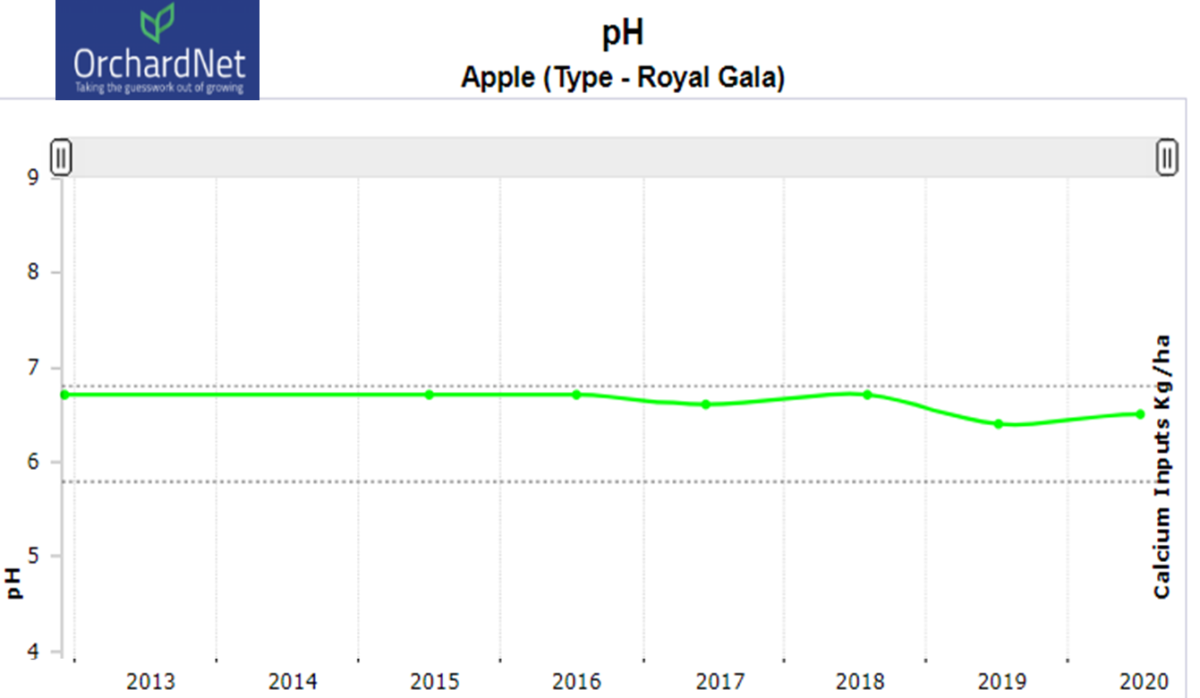
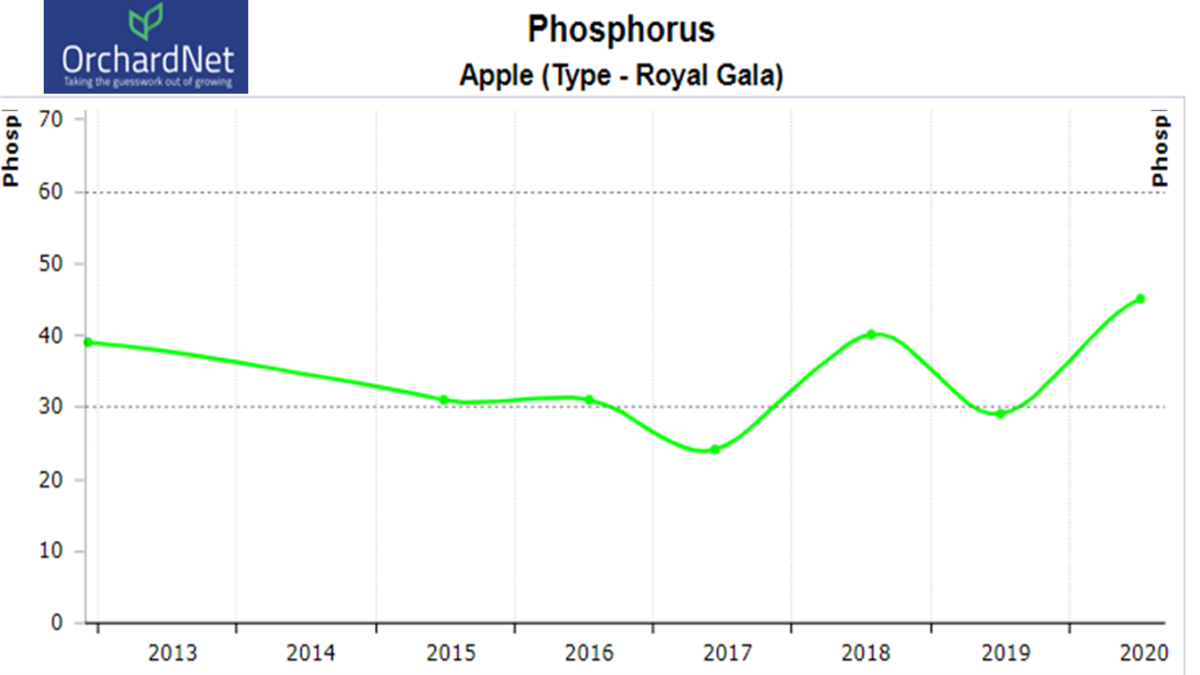
The real benefit of soil testing is to monitor nutrient trends over time. Variation across the block and between years can then be considered so much more informed fertiliser programs can be developed.
Reacting to a one-off soil test result without analysing the trend maybe a wrong move, with unintended consequences by creating imbalances and having adverse effects on productivity.
When interpreting soil tests, it is important to take in account both nutrient sufficiency and balance. Sufficiency is having enough, balance is having enough in the right ratio. It is important to address any inherent soil nutrient deficiency, but it is equally important to correct the balance of nutrients in the soil. For example, too much magnesium will suppress potassium uptake, too much potassium will suppress calcium uptake, too high pH will render trace elements unavailable. Tracking nutrient trends over time is helpful to make the best decisions.
The Nutrition Centre in OrchardNet™ is designed to capture all soil tests results for each block by variety and graph them over time (Figure 1). This makes analysing the trends much easier which enables more tailored fertiliser programs for each block.
Dr Kathleen Kozyniak
Principal Scientist Air
Hawke’s Bay Regional Council
May rainfall seemed like a good news story at first – reaching 102% of the long term average. The distribution of rainfall wasn’t ideal though and focused on the northern half of the region. The usual suspects, being the Heretaunga and Ruataniwha Plains and the south coast, were short-changed and reached only 60-70% of average May rainfall. It’s six consecutive months of below normal rainfall for those areas. They keep mounting.
River flows averaged only 40% of normal May flows and groundwater levels ended the month predominantly below normal. Soil moisture levels recovered nicely in locations north of Napier. It’s a different story for those to the south where you’d be hard pressed to find anywhere that had close to median levels for May and some sites, like Bridge Pa, couldn’t find a way out of the lowest 10th percentile of readings. Soil temperatures ranged from 8°C to 11°C as we tipped into winter, which is about normal, and air temperatures were mild for May.
La Niña is no longer a player in our weather and the neutral mode should persist through winter and spring. The main feature for winter seems to be lower than normal sea level pressures across Australia and the Tasman Sea. We are likely to get a mix of northeasterlies and westerlies as a result, warmer than usual temperatures and near normal rainfall. Both NIWA and Metservice are throwing the possibility of above normal rainfall in their forecasts, the former for the winter season and the latter for June. Our southern half would really appreciate it.
Percentage of Normal Rainfall