
Dr Kathleen Kozyniak
Principal Scientist Air
Hawke’s Bay Regional Council
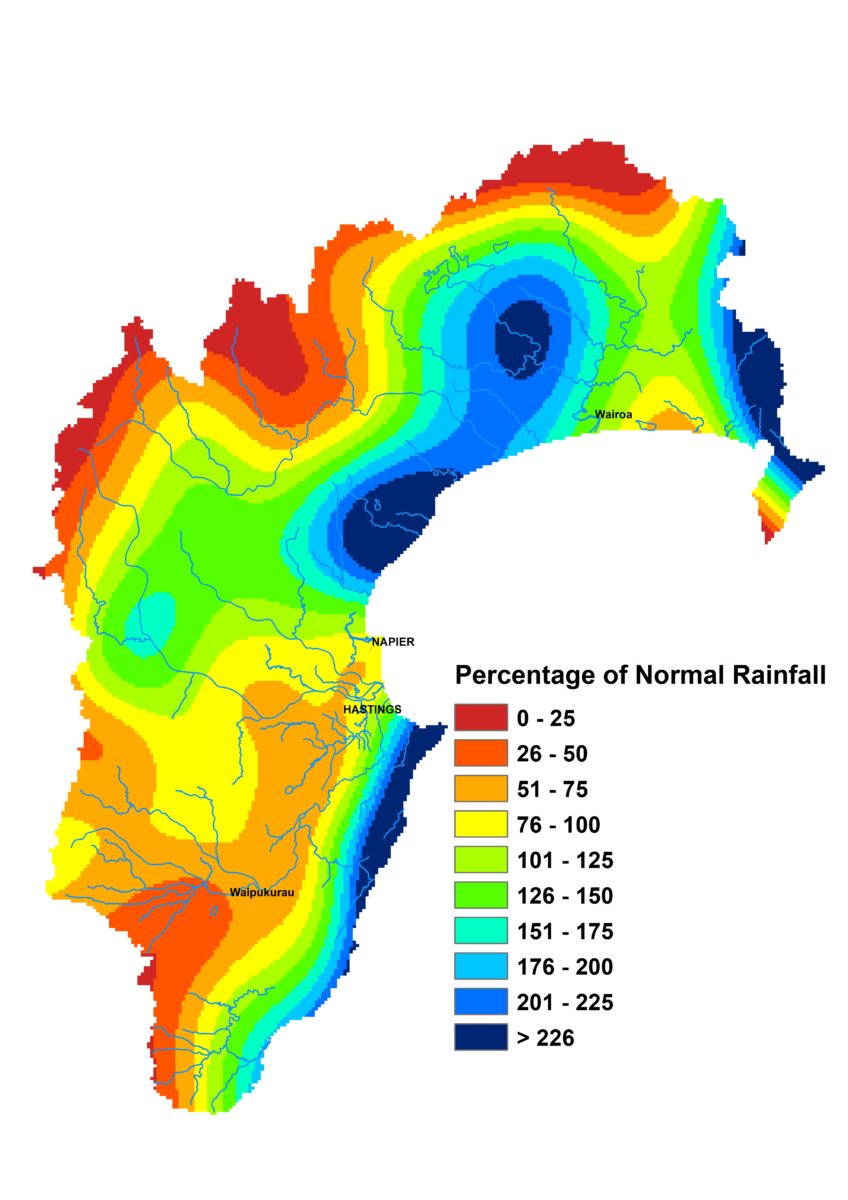
Spring has treated the region generously so far. We had above normal rainfall in September, followed by near normal rainfall in October, then November kicked off in style with much of the region hitting November averages already. The one worrying aspect of October’s rain was that a few areas, namely the Ruahine and Kaweka Ranges and northern Hawke’s Bay, got just two thirds of their month’s usual total. Early November rain made up for the lost ground in northern Hawke’s Bay and the Kaweka Range, but the Ruahine Range wasn’t so fortunate and still needs 60-100 mm to hit the November average.
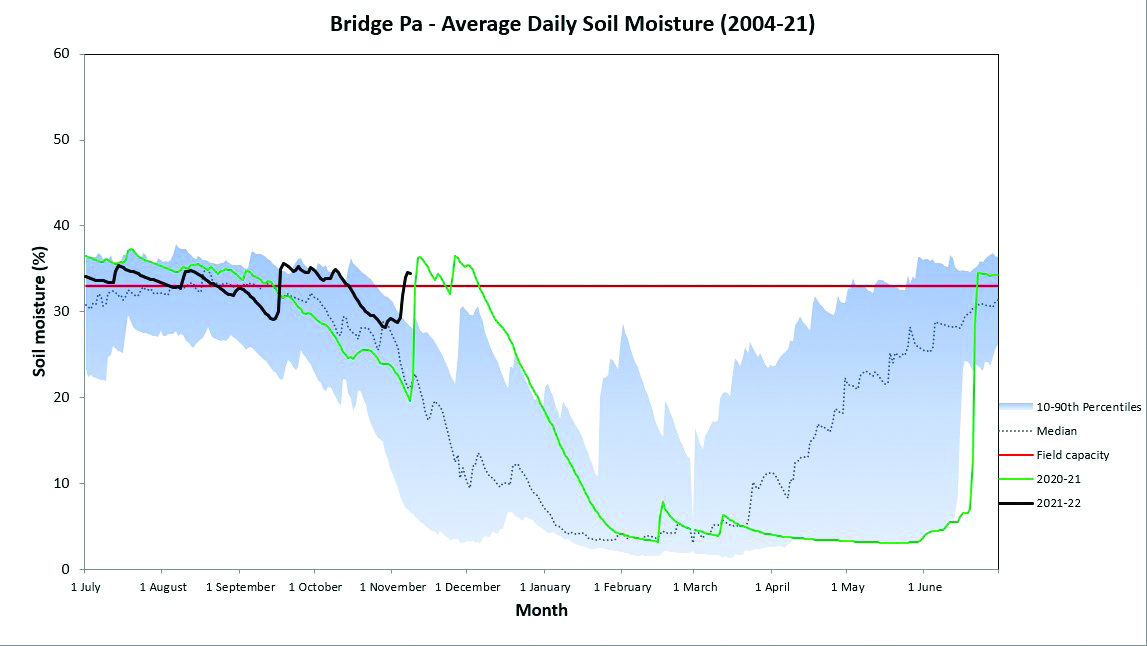
The lack of rain in the ranges meant October’s river flows were below normal while soil moisture levels across the region were looking good for the time of year. October’s groundwater levels appeared to improve on the previous month but the majority of our sites remained below normal – it’s just that the majority has slimmed a little. Temperatures were warmer than usual, the overnight temperatures in particular, and soil temperatures ended the month on about 18°C on the Plains.
A La Niña event is most likely with us for the summer. Warmer than usual sea and air temperatures are expected over the next three months, along with higher than normal sea level pressure over central and southern New Zealand and lower to the north. That should bring us more easterlies than normal and the onshore flow helps our chances of getting decent rain. So near normal rainfall over the period is the pick but it’s possible, with the forecast pressure pattern, that the rain favours the north rather than the south.
Percentage of Normal Rainfall
Jonathan Brookes
The spring season to date has started off like the last couple, not being over wet in late winter but ending up with regular spring rainfall topping up the soil to where field capacity in some locations is exceeded, and drainage events are occurring.
It is also the start of the AgFirst led Sustainable Food and Fibre Futures Fund project “What’s Coming out of Tile Drains”.
We are all aware of how important tile drain systems are to the success of fruit growers, as significantly more trees die in Hawke’s Bay every year from excess water than from dehydration. As an industry we need to understand the behavior of tile systems with regard to flow and nutrient concentrations, which is the focus of this 3 year project. With an improved understanding of the impacts horticultural has on surface water quality we can finetune our practices around efficiency of water and nutrition, to ensure water quality is sustainable in the long term.
The project is only just underway, but we are already seeing some interesting differences in flow from September and October between the different tile drain monitoring sites.
The key messages so far are that tile drains systems are a lot more complicated than many people think and are very location specific. The more we understand them, the more likely we can manage water and nutrition on our properties to find the sweet spot that allows for optimum block performance outcomes as well as minimising our surface water effects, helping to ensure we keep our social license to keep doing what we do well – fruit growing.
Richard Mills, Summerfruit NZ Market Support
Weather
Enough of the rain and overcast conditions thanks very much. The rainfall totals seem to have varied around the district with the coastal areas coping a bit more; there were lingering puddles out near Red Bridge that were not so visible further inland. There has been hail damage in the early areas but I don’t think it will impact on the overall amount of fruit for sale to much. Not nice for those that are dealing with it but OK for the overall production. As the harvest gets under way this week and next, we will see how good the brown rot control was.
Now we need some good temperatures and sunshine to harden the exterior of the fruit and get the sugar levels up.
Growing degree days in Bay View, for example are pretty good, better than average in fact. There has been 345 units accumulated (as of November 8) but this is behind last seasons exceptional accumulation. This is confirmed by growers suggesting that harvest will be 5-7 days behind last season. The stations that we access are a little above or a little below average, nothing to different to the five-year average.
| Weather Station | GDD (1 Sept to Nov 8) |
| Bay View | 345 |
| Twyford | 233 |
| Pakowhai | 241 |
| Lawn Road | 204 |
| Ruahapia | 208 |
| Havelock North | 196 |
| Longlands | 251 |
| Te Aute | 236 |
The table above is a good illustration of why Bay View grows the early fruit. For cherry growers the Marlborough comparison of GDD is 207 from trees that flowered at the same time as Hawke’s Bay -excluding Bay View.
Crop Loads
To add to the bit of hail damage there is a few blocks no longer in the ground, across peach, nectarine and plum. Especially plums. Apricots seem relatively stable in area and there will be a few more cherry blocks producing fruit.
Crop loads on cherries might be lower than growers had hoped, at least a bit patchy. Apricots seem to be pretty much there or there abouts, as do peach and nectarine. Hand thinning in a number of cases has been quick which all bodes well for size and possibly quality. The reports on labour availability to date have mostly been adequate, but not oversupplied.
Some Take Home Thoughts
Jens Liesebach, KGI Lower North Island Representative
What a relief it was to get some spring rain. Whilst the region received approximately 80mm rain, Gisborne received 250mm rain in the same timeframe. In contrast, Opotiki had very strong gusts that blew out perfect shoots and devastated spring canopies. Green kiwifruit growers are poised to bring in the bees whilst Gold growers are starting to sharpening secateurs for male pruning.
The Zespri Grower Roadshow at the beginning of the month was well attended. Shipping of fruit from the current season will finish in six weeks. The next harvest is predicted to be a challenging one. Not only does Zespri expect an additional 17M trays of Gold kiwifruit compared to the current season, but it is also estimated that the Bay of Plenty alone will be short of 6,500 workers during harvest. Zespri is talking to all stakeholders to find solutions to get the fruit from the orchard to the market as smoothly as possible. The last message from the Roadshow was that Zespri is going to release red and gold kiwifruit license in 2022 with a tweak of the conditions.
KVH is hosting a series of regional biosecurity workshops to assist growers with the development of an on-orchard biosecurity programme; helping growers to identify key practices to enhance biosecurity measures and to manage the threat of unwanted pests and diseases. The Hawke’s Bay workshop is scheduled for Wednesday, 17 November, 9am at the Crown Hotel, Napier.
The Zespri Global Extension team invites you to an on-orchard irrigation workshop on Thursday, 18 November, 10am at 2 Moteo Pa Road, Puketapu. At this workshop, you will learn about how to calculate irrigation needs for your orchard, strategies for applying water, soil moisture monitoring and where to measure soil moisture on your orchard. You will learn and practice how to prepare a simple weekly water budget and daily irrigation schedule based on the specifics of your orchard. Please register for this workshop here.
The Zespri Pre-Harvest team is coming to Napier to discuss good agricultural practice. The GLOBAL G.A.P. certification programme exists to deliver assurance to our customers, however for it to be really successful, it needs to work for growers. This is your chance to have some input into the future direction of the GAP programme. All growers, orchard personnel including contractors, advisors, managers, grower services and others working with, or on orchards are encouraged to attend the forum on Wednesday, 24 November, 9:30am at the Crown Hotel. Please register here.
See you at the workshops.
With plenty of rain and coming into some hot weather, Hawkes Bay’s summerfruit, pipfruit and kiwifruit will be growing well. Early Royal Rossa apricots and Mayglo nectarines will be ready in a couple of weeks.
Unfortunately, some pockets of Hawke’s Bay were touched with hail a few weeks ago, causing damage to orchards in Bayview and Esk Valley. Also hit were orchards down Napier Road, Karamu Road and isolated areas near Haumoana- we certainly feel for those growers who have been affected.
Most apple growers have finished their thinning sprays now and as usual there is a mixed bag of results. For kiwifruit growers, long periods of rain and cool temperatures haven’t been ideal for pollination. Thinning is underway on many orchards and will be the major undertaking for growers over the next couple of months.
NZAPI’s labour meeting held on the 29th October revealed some grim predictions for the coming harvest season, with labour shortages predicted to be in the vicinity of:
Thinning: 1,200
Harvest (picking): 1,612
Post harvest (packing): 1,381
Approximately 4,000 – 6,000 holiday working visa holders are still in New Zealand, but there is strong competition for their services from the hospitality sector who are also short of labour. Unemployment is extremely low which limits our potential labour pool.
The industry is on track to bring in the remaining RSE workers to reach our allocation of 14,400 workers. HorticultureNZ and NZAPI have built strong relationships with key Government Ministers and have been working tirelessly on growers behalf in this labour space. We are in unprecedented times; with a volatile economy due to COVID and a Government who has a very strong mandate to push through different policy changes in labour and immigration, we are in for a bumpy ride in the coming year.
Repatriation flights are occurring weekly now, some RSE workers are returning home for the first time in two years. Not only is this an opportunity for these workers to reconnect with loved ones but also an opportunity to recharge the batteries after a long stint in New Zealand.
This Friday we are holding our first Gumboot Friday event. I want to encourage as many of our growers to come – just walk straight off the block and join us for a sausage and beer down at the Cornwall Park Cricket Club. This will be a great time of connecting with other growers, networking and meeting some of our HBFA executives. We also have a couple of guests who will give an update on labour initiatives. As I’ve said in the past, as growers we need to support each other, be willing to help each other out with labour pooling where we can. I call on large supplier groups to support their smaller growers when the need is there – together I believe we can get through this. As an Association the well-being of all our growers is important to us, so please talk with each other and ask for help. HBFA will be checking in on our growers in the coming months so expect a check-up call at some stage.
Finally, I would like to end my report with a huge thankyou to NZAPI’s outgoing CEO, Alan Pollard. Alan has been CEO for nine and half years and the industry has grown immensely under Alan’s leadership. Alan’s support and willingness to share his in-depth knowledge of the industry has been invaluable to the Association and we wish Alan all the best in his next season of life.
Brydon Nisbet
HBFA President
After five days of constant rain, we certainly managed to turn on the sun dial for our Annual Fishing Competition!
Thanks to all the anglers, growers and businesses that turned out and supported the event – the prizes were outstanding again this year. We really enjoy hosting this event and look forward to the 2022 event!
Category Winners
Snapper: Gary Miller, 9.17kg
Kingfish: Amon Corbert, 12.4kg
Gurnard: Steven Brookes, 1.10kg
Groper/Bass: Shaun Fletcher, 15kg
Kahawai: Pena, 2.41kg
Tarakihi: Matt Hibbert, 1.88kg
Blue Cod: Ivan Angland, 0.59kg
Trevally: Abe, 1.59kg
Special Species: Wallace Wade, 2.45kg
Red Cod: Willy Thow, 3.64kg
Barracouta/Gemfish: Robert Griffiths, 5.1kg
Mackerel: Phil Thomas, 2.55kg
Skate/Ray: Jordan Hay, 3.83kg
Other Species (over 1kg): Liam Sykes, 4.81kg
Clare and Gordon are completing a round of on job visits, with reminders that EIT work still needs to be done in these difficult times. We have been very flexible with due dates, but there are deadlines such as the Hawke’s Bay Fruitgrowers’ Association Industry Awards Night on the 27 January that need to be met. By good management, most of the trainees are on target to finish their work and graduate with Level 3 and 4 certificates.
Additionally, HBFA have a number of scholarships that have recently opened, for those who are on target to finish. I encourage all trainees to apply for scholarships because they might as well get some financial reward for their work as well as the honour of earning a certificate. To apply online visit here. Applications must be submitted by 5pm, 30 November.
In our visits we have been very pleased with the support being given to the trainees with in work time to complete assessments and of course the work of the trainer to sign off the attestations.
The Year 1 trainees almost completed all their classes at EIT and it is just a matter of getting the final attestations signed for the practical work. We are very pleased with how this cohort are progressing. This is a large cohort but can be added to for next year for those in the industry with experience or have done the on job variation of the Certificate in Primary Industries Operational Skills qualification.
Year 2 trainees have a number of assessments on the go, with snap that weed project, weather and propagation all nearing completion. These assessments have been the main topics of discussion in my visits. We have even run some extra classes to help those who have struggled or missed class through work commitments. The next class is on the evening of the 21st of October.
Year 3 trainees result sheets look good and most trainers are pleasantly surprised, as there are very good marks being achieved by those who are prepared to go the extra mile. The Advanced Botany assessment is due and the first two parts of the soil assessment can be completed. The next class is on the 29th of October.
The Fruit Production Diploma students are beavering away with the relatively large amounts of work required these assessments. As most of these students are some positions of responsibility they are time poor and once again we have undertaken to be as flexible as possible with due dates providing we can see some progress. All the tutors, Brian, Chris and Gordon have offered their time outside of class to help and guide. They just need to ask.
Erin Simpson, Capability Manager for NZAPI has been proactive in organising a meeting for next week with interested parties to look at a unified delivery of the qualification across the country. This meeting has exciting possibilities.
As always if you have any queries or concerns, please get in touch with EIT Tutor Gordon Reid greid@eit.ac.nz , 06 8301851 or 027 3940410.
Dr Kathleen Kozyniak
Principal Scientist Air
Hawke’s Bay Regional Council
September’s rain was a big relief. The region received above average rainfall and in some areas, well above average. That included the Ruataniwha Plains, the south coast and northern Hawke’s Bay. Soil moisture levels are either near or above median levels for the time of year, which is encouraging for the start of spring. I understand that some people are still finding it quite dry at depth though.
River flows could do with more rain and remain below seasonal averages in places such as the Ngaruroro Catchment. Groundwater levels continue to be stubbornly below normal for the time of year. Air temperatures were average for September and soil temperatures ended September on about 12°C on the Plains and 9°C on higher ground.
I mentioned last time that a tussle was happening between different climate influences and thankfully during September those favouring wet weather appeared to win. They include a waning Indian Ocean Dipole, warm seas around us, and a La Niña event that looks increasingly on the cards. On the other hand, sea level pressures are forecast to be higher than normal over eastern and southern New Zealand in the next three months, potentially bringing drier skies.
Falling out of that mix is a forecast for near or below normal rainfall and warmer than usual temperatures for the few months ahead. The start of the tropical cyclone season is almost upon us and the latest forecast is for an increased chance of one or more ex-tropical cyclones bearing down on northern New Zealand during the season. Hopefully we don’t end up with a dreaded mix of drought conditions and one torrential storm!
Percentage of Normal Rainfall

Sarah de Bruin
Timeliness of tree training into a 2D canopy ensures the canopy remains calm and the trees continue to be balanced. Regular attention is required to fill the structure with the right branches and establish the trees within the system. Narrow, calm branches need to be brought down and secured onto the wires. Tying down branches regularly through the season, starting when the branches have a length of 25-30cm, will improve bud density and lower vigour.
Decision making for which branches to tie down may seem intimidating, but can be broken down into three simple rules:
Leaving wires bare reduces the potential yield in this system. It is important to fill the wires with any available branch options rather than missing an opportunity. Unideal branches can always be replaced with better options further down the track.
Trained in branches should come from within the target zone of 80mm above and 50mm below the wire. Branches within this zone create a wide crotch angle, greater than 45 degrees when secured to the wire. This promotes the best sap flow and the least vigour. If the angle is too steep between the branch and the leader, a vigour response will occur off the back of the branch.
Branches which are less than 30% of the trunk diameter should be trained in. Thicker, heavier branches have a heavier sap draw. The tree will allocate resources to these heavy branches, reducing the allocation for vertical growth.
If the canopy is young, the focus should be directed to filling the bottom wires. The taller the tree grows, the harder it becomes to direct sap flow to the lower branches. Once these bottom wires have been established, attention can shift to further up the tree.
Using the three simple tree training principles in a timely and systematic approach, will help to achieve the uniform interception of available light and grow consistent and highly coloured fruit.
Richard Mills, Summerfruit NZ Market Support
This time last year I mentioned that the first harvest is only a few weeks away, which is till true for this season, and that growing degree days were about 30 units ahead of the 2019-20 season. This year we are 30 units behind last year or put another way, very average. Last year we were already seeing brown paddocks on the local hills but not this time around. What we are needing is to keep the cover sprays interval nice and tight.
Bloom has generally, but not always been strong and pollination generally good although we wait to see the true extent of fruit drop. I have seen the odd block that has failed to set for whatever reason.
Last month I mentioned the agroecology project that Summerfruit and kiwifruit, among other top fruit crops, are involved with and how citrus is leading the project in Gisborne. The questions that I wanted to pose on your behalf were not asked, wrong forum, but there were some interesting insights that I have borrowed from the various presentations. From what is proposed, and should we take some of this on, there will be some very different looking orchard floors in the future. While Hawke’s Bay growers have not gone to wholesale planting of pollen and nectar producing plants yet, there are examples of changed orchard floor systems where straw has replaced herbicides, broadleaf only herbicides have taken over from total control, and where no herbicides are allowing grasses and flowering plants to share the space with fruit trees.
To remind ourselves of the potential benefits of beneficial insects check out these videos, perhaps on a large screen and with your children in attendance.
https://www.youtube.com/watch?v=StSO7LSzzAw
https://www.youtube.com/watch?v=YSRo2sgR45c
https://www.flickr.com/photos/meanboy/3516421351
To help feed those beneficials the picture below illustrates a mock-up of a possible orchard floor with the SNAP vision taken to a logical conclusion. Shelter, Nectar, Alternative prey and Pollen. It’s worth a thought and I’m interested to see what we can share and learn as an orcharding community in Hawke’s Bay.


