

All that remains for this year is to say a very big thank you to all the trainers of our trainees from the staff at EIT. We appreciate all the work you put in to impart your knowledge and enthuse young people for the industry. Let us hope that 2022 is not as manic as 2021.
The timetable for next year is below for all years of the trainee programmes as well as the Level 5 Diploma. As usual the starts are in January before the main harvest.
2022 EIT Level 5 Diploma Timetable
Tutorials are run in evenings so that you can work most of the day and still come to class where there is a wide range of help and support available (such as the tutors, learning advisors, library and computers). Each trainee is expected to bring along any work needing completion and to pick up marked work that may need re-assessment.
For those who applied for the HBFA scholarships, you will be notified early next week if you have been succesful. You need to attend the HBFA Industry Awards Night to recieve your scholarship.
As 2021 comes to an end, our eyes are all on what 2022 will bring. It’s been another unprecedented year like no other with:
New Zealand needs to get back to business – we need our working holiday day visa holders back and more skilled migrant labour available for the primary sectors. The rest of the world has moved on and we need to as well. The Government is allowing 14,400 RSE to come into our industry without the need to go through MIQ – this is a win for us. There is a possibility that this could increase at some stage next year with unemployment rates being so low. I want to thank NZAPI and HortNZ for their tireless work in the repatriation of our RSE’s and the logistics of bringing so many workers to New Zealand.
As I write this, I feel for the stonefruit growers who will be affected with the rain we are currently experiencing- it couldn’t have come at a worse time. Apple growers will be wary of rots, secondary blackspot and the continued spread of fire blight – so it’s a time to be vigilant. The positive of course, is you can’t beat rain for irrigation and mixed with humidity, should equate to a good growing season!
I would like to acknowledge one of our long-standing contributors to our newsletter, Gordon Reid (EIT horticulture tutor). Gordon has been training students for over 18 years and has seen many people successfully go through our trainee – cadetship programme. Gordon is retiring at the end of January so he can focus his energy on fishing and biking. We thank you Gordon for your unwavering commitment and passion to the industry (Gordon was awarded the HBFA Joe Bell Award in 2016 for services to the industry). I’m sure we will see you around the traps, and possibly on a tractor helping out at some stage in the future!
Terry Meikle started his role as CEO to NZAPI this week. We warmly welcome Terry and look forward to working with him collaboratively next year.
Many of our HBFA executive team work in fulltime, demanding jobs. The Association has undergone a number of changes over the past few years. Our executive team are no longer individual growers, many work for larger organisations and are constrained by available hours outside their day job, young children and family commitments. We continue to realign HBFA so our core priorities are still being undertaken, whilst ensuring these foundations will be enduring.
With that in mind, we have recently engaged Charlotte Drury who will be assisting the Association in the RMA space. For several years, Charlotte has been contracting to HortNZ and we are thrilled to have Charlotte providing advice and recommendations on horticulture matters pertinent to Hawke’s Bay. Charlotte will also be providing monthly updates in our newsletter.
We are currently working on other areas of realignment within HBFA and this work will continue into the New Year.
Finally, I want to thank all the executives who give their time and energy on behalf of our members and growers. Sheryl Mackie and Jo Pentreath have both bought a level of professionalism and excellence to HBFA which has provided a solid platform to strengthen our core activities.
I look forward to our Industry Awards Night on the 27 January at the Toitoi Arts & Events Centre and hope to see you there.
Have a great Christmas and New Year. Lets look forward to a positive 2022!
Brydon Nisbet
HBFA President
Dean Rainham
The chemical thinning window was a challenge this year with the results varying from the good, the bad and the ugly.
Now that fruit is sizing it’s obvious that some blocks are carrying excess crop loads. This may impact adversely on next year’s bloom.
Application of three NAA sprays over the December period has been shown to enhance return bloom and improve your chances of a good crop next year. Floral bud initiation for next year’s crop is happening right now in the tree and the summer NAA program enhances this process. The NAA can be applied with the cover spray.
This does not replace lowering crop loads to optimum levels as soon as possible. Prioritise blocks by profitability, those that are grossly over cropped and those varieties that pay more for a larger fruit size profile.
Consider sending a skilled team through your most variable blocks, targeting those 20% of “on” trees that make 80% of the variability. Low the crop loads early on these trees and increase the chance the block will even up for next season
Dr Kathleen Kozyniak
Principal Scientist Air
Hawke’s Bay Regional Council
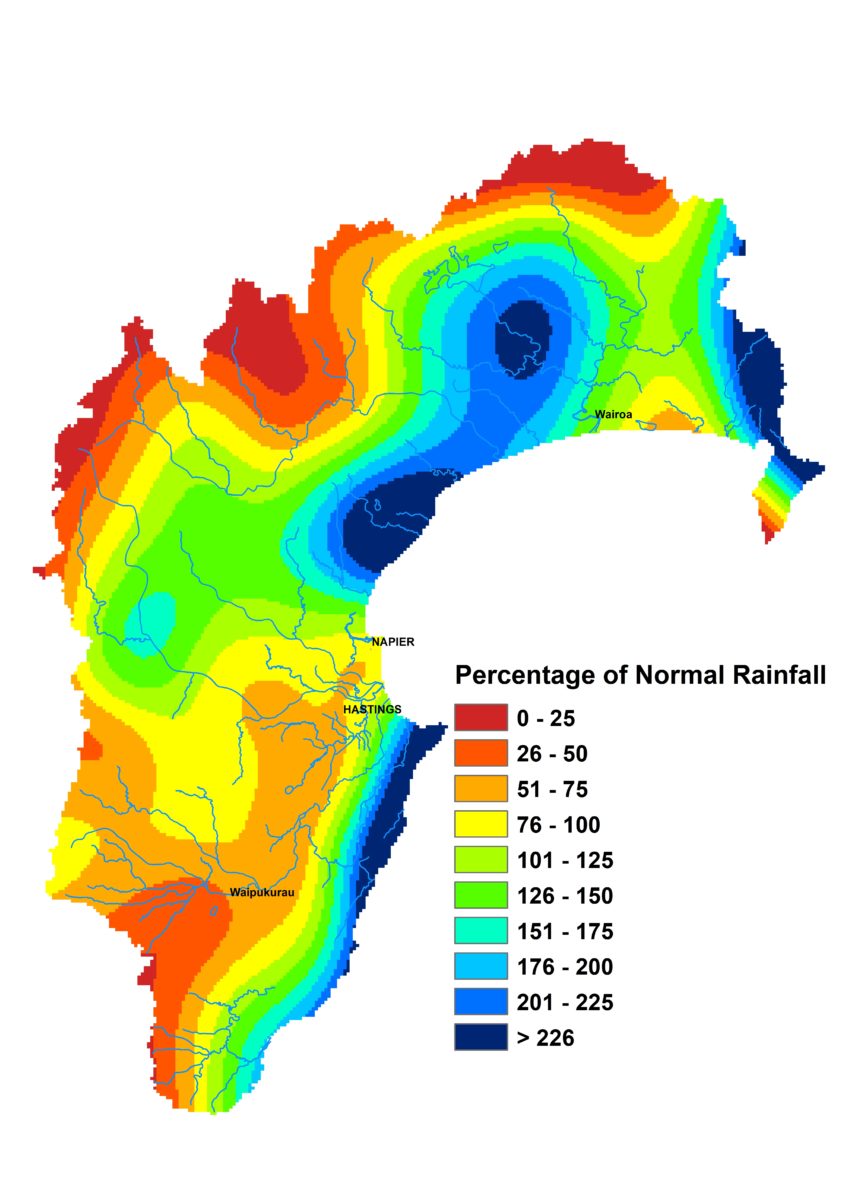
What an excellent spring! We had good rainfall throughout, with above average November rainfall closing it out. All parts of the region hit 100% or more of the month’s average rainfall and river flows were well above average as a result.
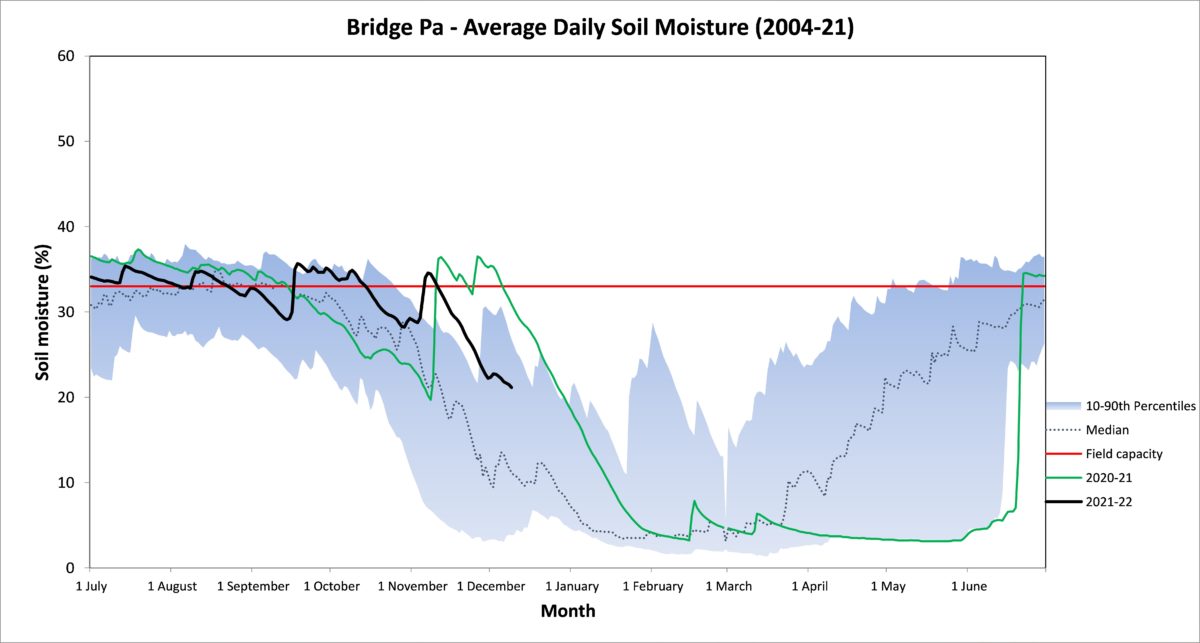
Here’s a shocker, November’s groundwater levels appeared vaguely normal for the end of spring, after running below average for what seems a very long time. The picture was also rosy for soil moisture, which despite having dived precariously in Central Hawke’s Bay during an extended dry spell in mid-November, bumped back up thanks to welcome rain in November’s final days. Soil temperatures hovered around 20°C on the Plains through November and air temperatures were on steroids. Overnight temperatures reached almost 3°C above normal.
There could be more of the same ahead. We are in the throes of a La Niña event and surrounded by an unusually warm ocean at the moment. We can expect more easterly winds than usual,. arising from an expected pattern of higher than normal sea level pressure over southern New Zealand and lower to the north of the country. It’s a set up that increases the likelihood of reasonable rain when rain does come our way and the seasonal forecast models suggest as much, predicting normal or above normal rainfall for summer. And don’t expect the thermostat to taper – warm seas and hotter than normal temperatures are predicted to stick around.
Percentage of Normal Rainfall
Hopefully all of you with mixed waste issues have now heard that an Order in Council to allow the burning of prohibited material like plastic and tanalised/treated timber come into force on 5 July 2023. This means that big, intertwined and really hard to separate mixed waste piles can now be burned. There are some conditions that need to be complied with –
The full text of the Order in Council is available here: Severe-Weather-Emergency-Recovery-Resource-ManagementBurning-of-Waste-Order-2023.pdf (hbrc.govt.nz)
Any questions about burning mixed waste, or other frustrations with planning or council processes, please get in touch– 027 3225595 or Charlotte.Drury@hortnz.co.nz
Dr Charlotte Drury
View Research and Resource Management
Richard Mills, Summerfruit NZ Technical Advisor
Enough of the rain and overcast conditions thanks very much! That was last month’s opening comment. It would appear that La Ninã is well and truly settled in with warm and moist, if not just plain old wet conditions.
As an industry we are now well into the harvest season, some cherry blocks have finished completely and others will be hoping to be well out by Christmas. This will give marketing space for Central Otago cherries. Apricots are now into the major Sundrop variety and at this rate there won’t be much left by New Year. There is certainly split fruit on the early nectarines, peaches are looking good and plums in volume will start up soon.
Part of this job is getting onto orchards and seeing what is happening first hand, a bit like an old-fashioned Apple and Pear Board rep from way back. The benefit is that you get to see the emotion and stress of growing stonefruit and to be able to see a bit of the frustration and hopefully share a smile or two. And often enough walk out with a little bit of really fresh tree ripe fruit.
Over the weekend I tipped 12 mm out of my rain gauge twice over the weekend, with the growers visited today having received close to 40 mm in the same period. In previous seasons a normal response would be to get more people on the orchard and get the fruit picked in response to this warm wet period but the workers, especially skilled workers are just not available. The smaller Summerfruit grower are starting to get squeezed. Partly because they are not there and partly as the apple growers are wanting to get their apples thinned by Christmas. There might be stone fruit left on trees as it will be too ripe to cope with the necessary logistics of pick, pack, transport and supermarket shelves. Interesting how much difference a week makes when you include warm wet conditions – we have gone from coping to feeling a little disparate and there is also a need to get on the sprayer again before the next wet spell.
I was told during last weekend, of a nectarine variety that had had three picks within a week and was now finished. Round and round with no breaks in between. Just as well the pipeline into the supermarkets had not yet been filled up. This harvest pattern may become the norm for a while if the weather patterns don’t change.
The point of the rant is to suggest that if you can spare fice minutes to lean over the fence, real or metaphorical and have a quick chat with a stone fruit grower, it will be most appreciated. Should you be able to share a worker or two that will be even more appreciated.
I see that NZAPI are providing another well-being webinar with Sir John Kirwan and the Mentemia team. This next one is about how to make the most of your holidays. I hope you were able to tune in and save the ideas for sometime next year when the Summerfruit season ends. I find these presentations valuable and the reinforcement of ideas even more so.
Along with the rest of the Summerfruit NZ team we wish you a relaxed couple of days off. I’ll be around to help if required over this period but the others are taking a well-earned break. Bring on the sunshine.
Jens Liesebach, KGI Lower North Island Representative
Welcome to the new COVID-19 Protection Framework – the traffic light system. Zespri and NZKGI have revised the kiwifruit industry Covid Protection protocols to align with this new framework to ensure that growers, workers and industry representatives are protected and prepared for the next stage in New Zealand’s response to COVID-19. New on-orchard protocols under the new traffic light system are available on the NZKGI website here.
The use of chemicals for crop protection or plant nutrition is widespread. Some of the chemicals applied can leave long lasting residues or cause other side effects. For this reason, Zespri approves and controls the use of chemicals on producing kiwifruit vines. A summary of allowed chemicals can be found on the canopy webpage in the Crop Protection Standard summary. One of the latest changes includes the use pattern of Kiwiguard as it is only allowed to be used prior to fruitset. Furthermore, the insecticide Proclaim Opti is not the same as Proclaim. Proclaim Opti must only be applied to Kiwifruit with a Justified Approval (at the grower’s risk). Please check the Zespri Crop Protection Standard again after the next update in January 2022 before applying further products to make sure the product you plan to use is still permitted by Zespri.
Zespri has been reviewing the KiwiGreen Crop Protection Standards in order to maximise the volume of fruit that meets China market requirements. Targeted species of this programme include Scale, Leafroller and the Wheat bug. An incentive of 25c per tray has been offered to growers who meet the KiwiGreen standards. Although the requirements have fundamentally stayed the same, there is renewed emphasis to ensure that any recommended actions (if required) are undertaken. Further information on KiwiGreen and the key Incentive requirements can be found here.
Have your say and take part in a NZKGI Performance Survey. Let them know what you think and go into the draw to win one of three $100 prezzy cards. Your feedback will be anonymous. It’s quick and simple. Click here.
I wish you all a well deserved break during the Christmas and New Year period.
Anna Lambourne, NZAPI Member Engagement Manager
New CEO at the helm for NZAPI
This week NZAPI has welcomed Terry Meikle in the role of CEO. A great asset to the industry, Terry joins the team bringing a wealth of experience in strategic management and international trade relations, having led New Zealand agriculture and horticulture interests across the Americas. Terry will be out and about meeting people across the industry over the next few weeks.
Eye on the Market
Markets have all performed well this export season, they have been firm with good demand across the board, despite the challenges. We are expecting them to continue to be receptive this coming harvest, however, it is likely we will continue to face challenges around increased costs, and issues with container and shipping supply. COVID-19 could also impact on operational capacity in the supply chain.
Is important to take stock early, and work with your exporters to review your marketing plans, to understand where to prioritise your time and resources. Think about your target markets and what specific attributes (size, colour, variety etc) are important to supply fruit into those markets.
Remember the best time to influence the crop is early and work closely with your partners including packers, exporters, logistics agents, and labour supply.
Busy time for RSE arriving
New Zealand Apples and Pear’s – RSE and Seasonal Labour Manager, Emma Sherwood has been incredibly busy coordinating a whopping 1,729 RSE staff arriving in New Zealand this month, under the new Quarantine Free Travel system. Next year it looks just a busy with another 41 flights organized to bring a further 6,204 RSE workers from three countries before the end of March.
Covid-19 Industry Support
The next few months look set to challenge us with COVID likely to reach Hawke’s Bay impacting business continuity and market access. It is important that businesses and packhouses get ready now! Get prepared and ensure prevention protocols are in place to reduce the risk. Have a plan in place for what to do in the situation of a positive case happening in your business. NZAPI have put together some great advice and templates to help you get ready. Check them out here.
Alan Pollard, Chief Executive, New Zealand Apples & Pears
This is my last contribution to the HBFA newsletter as CEO of NZ Apples & Pears. I will officially step down on Wednesday 17 November. My replacement, Terry Meikle (coming to the role from MPI) will commence in the CEO role on 13 December.
I have been in my role for a bit over 9½ years and feel so privileged to have had the opportunity to work in such an amazing industry.
When I joined in March 2012, export returns were about $340m. In 2020 they hit $917m, not far off our $1b goal.
It is easy to lose sight of the long term prospects for the industry, when all energy is being invested in trying to keep businesses operating in the face of short term challenges such as labour constraints, logistics challenges and escalating costs. But if we can navigate a path through these short term issues the future does look very bright.
The government have been slow to show any level of support for the industry, a shameful situation when it was industries such as ours that kept New Zealand trading during the COVID lock down and ensured food security for kiwis and consumers overseas. It is also industries such as ours that will lead New Zealand’s post-COVID recovery. And it is poor/no government planning that is holding us all back from reconnecting with the world. There was no plan to be prepare for a Delta variant, no investment in health infrastructure to ensure that the country could cope with the inevitable increases in community cases and hospitalisations, and no rational thought as to how we can implement systems to support our reconnection. The focus remained on elimination and that has failed us all.
I want to acknowledge the cooperation and support from HBFA. It is great having the Association in our offices, making it easier to engage. We have so much that we can collaborate on, particularly around labour, capability and education. I am sure that our relationship will continue to grow.
Finally, I want to thank and acknowledge all of the growers and other members of HBFA. I have immense respect for our growing community and I thank you all for including me in the journey over the past 9½ years. I will follow the progress of the horticulture sector with interest and I wish you all well for the future.
What a difficult spring so far! We realise that the weather on top of on-going COVID issues and labour shortages are creating time problems for our trainees so we really appreciate that managers are prepared to release their trainees and give them time on rainy days to do their EIT work. We also appreciate the good communication between trainers and EIT staff. It is always great that managers are welcoming when we plan our visits.
There are very few classes left for this year so it remains to mop up work that is due.
Year 1 trainees have now completed all their formal classes for this year. There are just two tutorials remaining for any last minute resubmits or questions. For the first time this year we have run a “taster day” for the year 1 trainees to give them some insight into what they are going to do next year in the Level 3 Fruit Production. It is a larger course credit wise and a bit more academic so we have set them up with some tasks to help with some completions for next year. An example is that we have given them a template to diarise irrigation tasks that they can start on now. They need ten diary entries over a three month period that covers not only what task is being undertaken but why it is occurring.
The first class for next years’ Year 1 trainees is on Thursday 13th of January.
Year 2 trainees have one more formal class, irrigation. Many of them are feeling the pressure of a lack of time. It is important that the next two tutorials are well attended to get help and get work completed. Again communication is key because we do understand.
The first class for next years’ Year 2 trainees is the 13th of January.
Year 3 trainees have similar deadlines and of course we want to see them graduate at the HBFA Industry Awards Night in January. There is also only one formal class left for them which will be a combination of Crop Protection and the Growing Environment. Again it is important for them to attend the tutorials to ensure they complete all requirements. A number of them have applied for HortNZ scholarships, so there is certainly some urgency to complete.
The first class for Year 2 trainees next year is Weeds on Friday the 21st of January.
Diploma in Fruit Production classes have now finished for the year so it is just a matter of completing assignments. Brian, Chris and I are still available to help and guide anyone who needs it. There has been some stunning work produced by this cohort.
The first class next year is on Wednesday 19th of January.
As always if you have any queries or concerns or enrolment queries, please get in touch with EIT Tutor Gordon Reid greid@eit.ac.nz , 06 8301851 or 027 3940410.


