
Its been a busy few weeks, with the Young Fruitgrower competition as well as the HBFA Industry Awards Night, both opportunities to celebrate our success stories, and see future leaders of our industry starting to step up. Our warmest congratulations to all involved.
Our first year students are stepping through practicals this month, with fruit support structures almost finished and chainsaws about to start. These classes are small groups, so each student gets plenty of close supervision. They should be asking managers to let them practice these skills. Our level three students should have completed the harvest criteria and botany/pruning assessment, and be working on their weeds and soils. Level fours should have handed in complying with market needs, their HR should be almost done, and pruning also well in hand. It is crucial students keep on top of assessment work at this time of year, and please be pro-active in nudging them along. We are doing our best to visit everyone to make sure you know your obligations, as well as giving you an opportunity to hear direct from us how your student is getting on.
Our Diploma students are coming to the end of Leadership and will be starting Crop Protection in the last week of June. The Post Harvest Diploma has a new intake starting at the end of July so please start discussing this with your staff. Any questions about either Diploma should be directed to Chris, cthorman@eit.ac.nz .
We have recently sent out a short survey monkey for feedback – if you have not seen this please email Clare cbuckner@eit.ac.nz for the link, we really appreciate your comments.
The 2022 Young Fruit Grower of the Year day competition held at the Tomoana Showgrounds on 26 May, ran as a standalone event this year, due to the cancellation of the National Horticulture Fieldays earlier in the year.
Contestants were tested on theoretical and practical challenges over eight modules facilitated by competition sponsors Agfirst, Fern Ridge Fresh, PGG Wrightsons, Mr Apple, Norwoods, Tumu Timbers, Farmlands and Irrigation Services. The theoretical and practical modules were designed to exercise the contestants skills and knowledge on pruning, manual handling, health and safety, export market requirements and quality control.
“I learnt a lot from each module, identified skills that I could improve on and challenged myself,” said winner of the competition, Maatu Akonga. “My colleagues and mentors encouraged me to enter the competition and I’m glad I did. It has given me the opportunity to see where I am at in my career and to grow my skills further.”
Maatu says meeting other young growers was the highlight of the competition. “The other contestants were great,” says Maatu. “I’ve built some good friendships and developed industry connections with a range of companies too.”
Thrown in for a bit of light relief during the day (for the contestants!) was the Bostocks Hortisports competition, which this year, had contestants pairing up and undertaking consecutive challenges. The day ended with the popular Hurford Parker Tug of War competition which this year had a record of 13 teams vying for the title.
“The competition is not only about identifying future leaders of the industry but also bringing together our industry,” said Brydon Nisbet President of HBFA.
“It has been an incredibly tough year for the entire sector and is was humbling to see our young horticulturists supported throughout the day by their colleagues and then providing an opportunity for their workmates to have some fun with the Tug of War competition!”.
“The competition simply could not run without the support of all our sponsors- station judges, our Hortisport and Tug of War Sponsors, speech judges, the HBFA executive team and the contestants businesses. Everyone has a critical part to play in the competition- thank you.”
Maatu will go on to represent Hawke’s Bay in the final in September and he is looking forward to the challenge.
And for those that are thinking about entering the competition, Maatu’s advice, “ I would say, step outside your comfort zone – you never know what you can achieve.”
The future of Hawke’s Bay’s horticulture industry was on display at the Hawke’s Bay Fruitgrowers’ Association Industry Awards Night last Thursday.
The Awards Night recognises the achievements of the Eastern Institute of Technology and Primary ITO graduates, scholarships recipients and contributions to the horticulture sector with the presentation of the Fourneau Trophy and the Emerging Achiever Award.
The inaugural Emerging Achiever Award was presented to Emma Sherwood, NZ Apples and Pears Inc. This award recognises an individual in the industry who has already demonstrated their ability to positively impact horticulture and shown in their own way, effective and positive leadership skills to strengthen relationships.
“We value this skill as a key building block to help unlock future success of our industry through cohesive, relationship-building partnerships and we believe that this year’s inaugural recipient has already displayed and will continue to positively impact our sector in the future,” said Brydon Nisbet, President of HBFA.
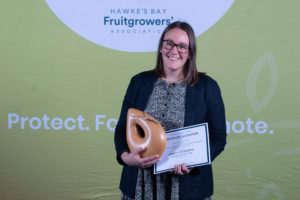
Emma Sherwood, NZAPI. The inaugural recipient of the HBFA Emerging Achiever Award. Photo by Bruce Jenkins Photography
“Emma has developed strong relationships with senior government officials and has become a trusted colleague to many within the horticulture sector and central government. Her considered and enthusiastic approach has been pivotal to the successes that growers have had seen over recent times with access to RSE colleagues from the Islands,” said Nisbet.
The Fourneau Trophy for innovation in horticulture was awarded for the H2ortigator innovation, developed by Brendan Hamilton.
H2ortigator is a tailored solution for plant water management. The tool enables young plants to be provided with specific irrigation, whilst also providing physical protection, and greatly reducing or eliminate competitive weed growth.
“For the past two years we have trailed this innovation on a number of orchards and vineyards around Hawke’s Bay including T & G Global, Mr Apple, Rockit, Freshco, Te Mata Estate, Craggy Range, Constellation, Villa Maria and Ngai Tukairangi Trust in Hawkes Bay, and John O’Neil, Travelers and Southern Cross Horticulture in the Bay of Plenty.
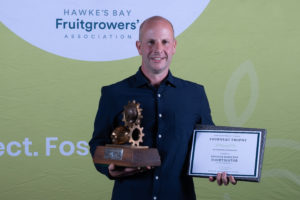
Brendan Hamilton, H2ortigator. 2022 recipient of the Fourneau Trophy. Photo by Bruce Jenkins Photography
The results to date have been extremely exciting with significant growth gains on those blocks H2ortigator have been trialed on”, says Brendan Hamilton. “We are really excited to offer this as a commercial service to the industry this year”.
“ We are honoured to be the recipient of the trophy. Thanks to Callaghan innovation, without their support we would have struggled to test and trial H2ortigator across the broad range of fruit crops we did this season,” said Hamilton.
The Hawke’s Bay Fruitgrowers Association Charitable Trust, in conjunction with funding from the Horticentre Charitable Trust, also provided 29 scholarships for students living in Hawke’s Bay and working towards their Level 4 Industry Training Qualification or higher qualification.
Toby Ploeg of Bostock NZ won the Bostocks NZ Organic Trainee of the Year Award.
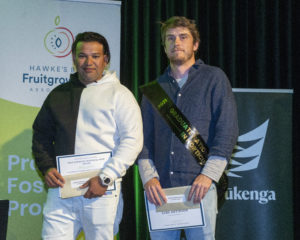
Manoj Negi and Luke Atkinson, recipients of the Horrocks Memorial Awards
The Horrocks Memorial Awards for overall excellence in Horticulture were presented to Luke Atkinson (RJ Flowers) at the Eastern Institute of Technology, and Manoj Negi (Douglas Fruit Company) at Primary ITO.
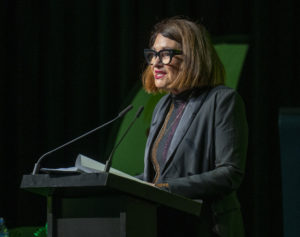
Mayor of Hastings, Sandra Hazlehurst
Hastings Mayor Sandra Hazlehurst, spoke at the awards ceremony, said it was great to recognise and celebrate excellence in the industry.
“The horticulture sector employs more than 8,000 full time and seasonal workers; it opens up exciting career pathways for our young people.I was inspired to meet the Young Fruit Grower of Year Award participants a couple of weeks ago. Many of these young people joined the industry at entry level and are now high achieving hort cadets and managers. I have no doubt they will go on to become future industry leaders,” she said.
Jonathan Brookes
One of the key skills of being a successful grower is understanding where to put your best effort in your business that ensures you are making improvements that allow you to continue to succeed into the future. I often use the sport analogy “what won the last world cup, will often not win the next one” the same is in fruit growing.
A good question to ask yourself is – what happened this last season? What did I learn from it and how will the learning turn into improvements in my business going forward?
For each grower it will be different:
The 2022 season will be remembers as being generally more difficult than kind, with the weather providing more challenges than solutions. What should also be remembered is that there were still some very good fruit grown in this region in these same conditions.
The winning growers were those that generally did not have knee jerk reactions to challenges, but did plan well in advance:
Just remember that next years game is unlikely to be the same as this year, but I am sure it is going to be another exciting ride, get you planning underway to optimise your results.
Dr Kathleen Kozyniak
Principal Scientist Air
Hawke’s Bay Regional Council
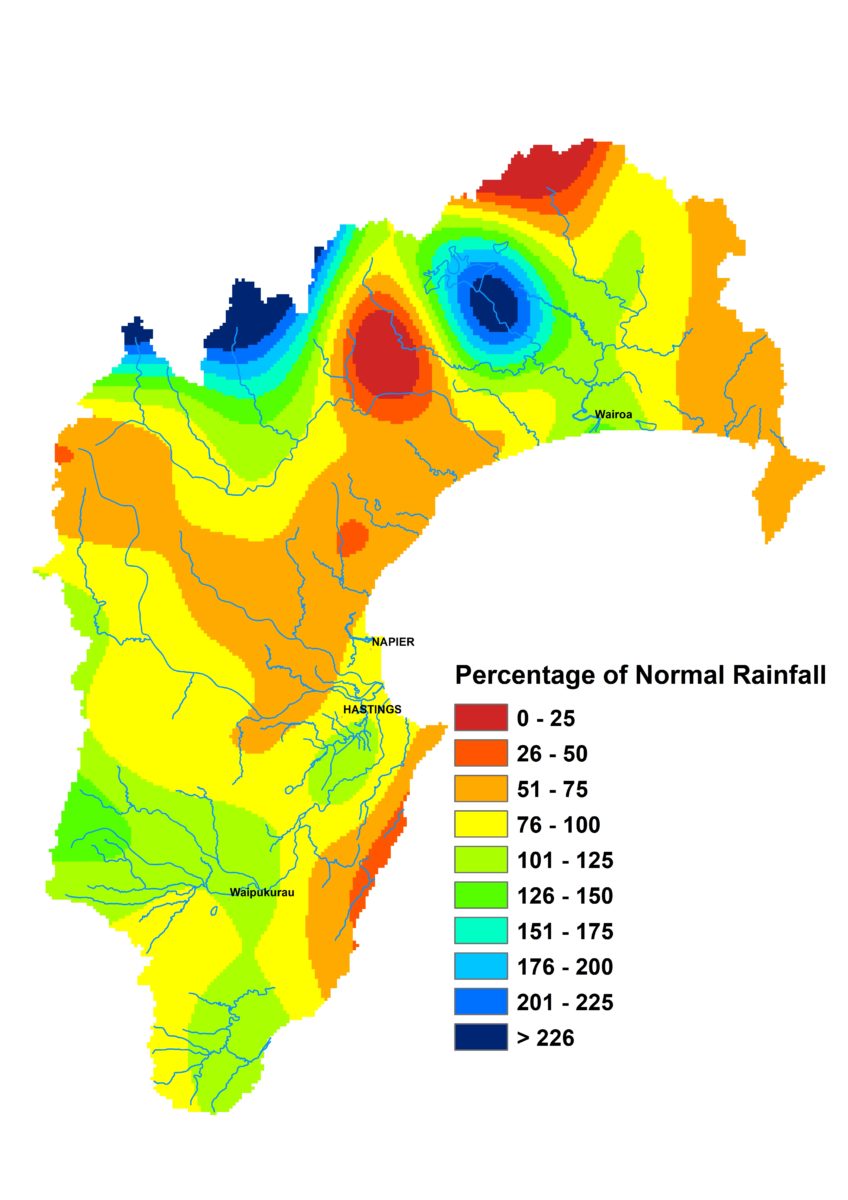
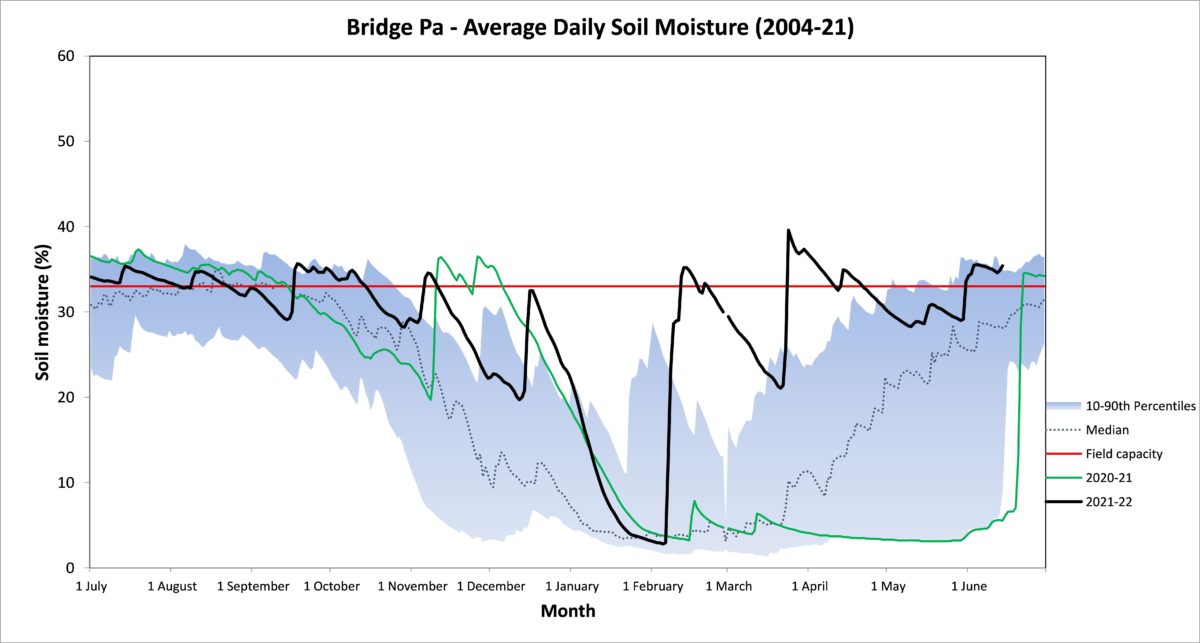
Autumn was a season of swings and roundabouts. March was extremely wet, April extremely dry, then May was just right. The region’s rainfall hit exactly 100% of our average May total, though Tangoio was one part of the region where the month’s rainfall fell well short. That area therefore clocks up two dry months in succession.
Soil moisture across the region ended May at above normal levels and was likely maintained at the expense of river flows, which dipped below normal after looking very healthy during March and April. The glow hasn’t come off groundwater levels, which looked in very good heart in our May testing. May was positively balmy with air temperatures a degree above the month’s average.
The La Niña event is potentially with us for the year, though waxing and waning in strength. June has started with a solid bout of westerlies but La Niña’s influence is expected to bring a generous dose of northerlies and easterlies through winter. Temperatures should stay balmy for the time of year, particularly as we still have warm seas around us. Alongside La Niña conditions, the Indian Ocean Dipole is likely to be negative during winter and spring, enhancing the prospect of rainfall during both seasons being near or above normal. Overall the picture isn’t too different from what we’ve had of late and even the ride could continue in autumn’s bumpy fashion.
Percentage of Normal Rainfall
Charlotte Drury, View Consult, Consultant Planner on behalf of Horticulture New Zealand
National Update
Exposure drafts on several national planning documents have recently been released – changes to the National Policy Statement for Freshwater Management, the Resource Management (National Environmental Standards for Freshwater) Regulations, as well as an exposure draft of the National Policy Statement for Indigenous Biodiversity (we don’t currently have one of these – this will be the first). HortNZ is looking at and will be preparing submissions on all of these. If anyone has a chance to look at them (they are all available on the Ministry for the Environment Website) and has any comments, please feel free to contact me.
Hawke’s Bay Updates
TANK
We are still waiting on this decision (we had expected it by the end of May). Obviously it has been delayed but the regional council has not yet advised when it can be expected.
Central Hawke’s Bay District Plan Hearings
HortNZ is attending the hearings on rural topics (Wednesday and Thursday 15 & 16 June). Generally HortNZ felt the councils recommendations were pretty good and provide a pretty good policy framework that supports primary production. The main changes the horticulture sector are still seeking, relate to aligning the permitted activity threshold for seasonal worker accommodation with the Hastings Plan (which it almost is but not quite), making sure there are sensible rules relating to agricultural aviation movements/noise standards, and clarification of the standards relating to shading/effects management from continuous tree planting (i.e shelterbelts).
Kotahi (whole of region plan change)
The Council has started work on Kotahi which is a region wide plan change and is going to look at the air quality rules (amongst other things). The outdoor burning rules are going to be reviewed (the national standards for air quality are also in the process of being reviewed) and Plant and Food have been engaged by the Council to do some work around what might be viable alternatives for outdoor burning – which orchardists are still allowed to do as part of orchard redevelopment work, and for biosecurity purposes. HortNZ have requested to review a copy of the report that Plant and Food produce, because they are aware that it is critically important that any alternatives to outdoor burning are financially viable, and also really practical. We understand the report is to be delivered within the next month or so.
Water Conservation Order (WCO)
Still awaiting the decision (requests to the Environment Court for an indication of when it might be released have been politely declined).
Plan Change 7 – Outstanding Water Bodies
This is still in mediation and a date for a further mediation meeting is trying to be arranged. It seems likely that at least some issues will need to be decided on by the Environment Court, some matters have been resolved at mediation though which is positive.
If you have any RMA questions, please do not hesitate to get in touch with me directly via email at Charlotte.Drury@hortnz.co.nz or on 027 3225595.
Richard Mills, Summerfruit NZ Technical Advisor
Last season was difficult, whatever we were growing in Hawke’s Bay. Spare a thought for the likes of the onion and buttercup squash growers in what was a difficult, wet season. For all of us getting clean paddocks and orchards needs to be a priority before spring returns. The last thing we need is retailers complaining of high wastage rates due to rots that established early season, after the gains we have made this season.
The other area that is thought-provoking at this time is winter chilling. My instinct is that leaves were slow to fall, as is witnessed by some apple trees which still have reasonably full canopies. ‘It has been mild’ has been a comment heard more than once. But what are the numbers telling us? As of 14 June, at the Longlands site, we have accumulated 231 Richardson Chill Units, compared to 251 this time last year and 375 in 2018 which was the highest of the last 5 winters. The 80% of a full crop just gone was talked about as being a reaction to those lower levels of chilling. True or not I don’t know, but in theory there should have been sufficient with over 1000 RCU’s by the end of August. That should be enough for all of our crops including cherries.
Now I start thinking climate change, perhaps dormancy enhancing products, low chill varieties and different rootstocks for the longer term. That last comment is a bit alarmist but is the sort of question we do get asked as an industry organization from time to time. What are your plans?
At the wider industry level, we have had a series of SummerGreen meetings around the country in Blenheim, Alexandra and here in Havelock North a month ago. The presentations will be on the Summerfruit portal in a while and included;
Richard Mills
Summerfruit Technical Advisor
021 632559
Jens Liesebach, KGI Lower North Island Representative
Leaves are off, secateurs are out. Pruning in the Hawke’s Bay is in full swing, setting the foundation for next year’s crop. During this time it is important to keep sprays up to protect leaf scars and pruning wounds from PSA infections. Kiwifruit packhouses are starting to wind down their packing operation as nearly all kiwifruit orchards in New Zealand have been harvested.
Last week, NZKGI CEO, Colin Bond commented on the revision of the Official Supply Estimate, as it has seen the industry down some 15 million trays on previous forecasts. While forecasts are forecasts, such significant shifts in volume have financial ramifications for both growers and the wider industry. The whole supply chain is heavily reliant on these numbers to ensure we are operating as efficiently and profitably as possible. It isn’t normal for the industry to make such large revisions to forecasts. It will be important that we take time to understand why this has occurred.
The Zespri Global Supply (ZGS) business has been running successfully for decades. In order to be responsive to market trends, expansion is required in strategic places worldwide. Following consultation with the industry earlier this year, Zespri has now confirmed it will be seeking New Zealand kiwifruit grower approval for expansion of the ZGS business in a Producer Vote. Similar to the Producer Vote, NZKGI will continue to provide growers with in-depth information over the coming months. More information can be found here.
As we approach the HiCane season, Zespri and NZKGI are once again looking to work with spray contractors and grower applicators to make sure everyone understands the rules and responsibilities we have for keeping the community and each other safe. Zespri will be holding ‘Safe Spray Workshops’ to share the latest research from well-known spray consultant, David Manktelow. David is planning some interactive and practical demonstrations on ways to reduce spray drift risk in the Bay of Plenty. These meetings will also cover an EPA Reassessment update, Zespri Compliance update as well as what’s new in 2022. Dates, locations and more information can be found here.
Hannah Riley, Global Sustainability Advisor, New Zealand Apples & Pears
Sustainable products are increasingly expected by investors, regulators, customers, and consumers. This is evident by the plethora of sustainability strategies and targets, policies, and regulations that are being developed and implemented around the globe: EU Green Deal, EU Farm to Fork Strategy, UK’s Green Claims Code, Japan’s MeaDRI, China ESG Reporting. In New Zealand there has been an increase in sustainability-related reforms in the agriculture sector: He Waka Eke Noa, the Essential Freshwater Package, Te Mana o te Taiao, and Modern Slavery and Work Exploitation.
But these sustainability expectations are not just being driven by government regulation, customers and consumers are encouraging. Tesco set a science-based target for emissions reduction; this means that Tesco’s supply chain will need to reduce emissions too. Waitrose & Partners, an UK supermarket, has a section specifically for B Corp products. There has also been an increase in investors seeking climate risk analysis and Boards completing climate-related financial disclosures.
The changing face of customer requirements towards sustainability means that sustainability is important and relevant to the New Zealand apple and pear industry. Furthermore, sustainability is becoming a market access issue, and failing to prepare for sustainability requirements is a risk to the industry. I recently heard someone say that ‘the question is when, not if, sustainability will be the baseline for maintaining market access’. As such, the industry needs to be prepared for these sustainability-related expectations, so that sustainability can move from being a risk to the industry to an opportunity.
The industry is well-placed to seize sustainability opportunities. The industry has previously innovated to meet customer requirements (i.e., low pesticide use) and has been ranked number one in the world numerous times. This has been necessary because industry cannot compete with other markets in terms of cost etc. The industry can continue to be innovate and a world leader by taking sustainability action, this will help the industry maintain market access as well as retain a competitive advantage over other markets.
NZAPI will work with our members to manage sustainability risks and opportunities. This will involve preparing a sustainability strategy that identifies key areas, measuring and monitoring these key areas, and developing improvement strategies across these key areas.
Please email Hannah Riley at hannah@applesandpears.nz if you would like to chat about sustainability.
The last few weeks have been extremely busy for the Association. Our Young Fruit Grower of the Year event was held on 26/27 May, with seven strong contestants vying for the regional title- Maatu Akonga (T&G Global), Junior Vaai (Craigmore), Nga Stanley (Craigmore), William Horsefield (Rockit Management Services), Ben Jarvis (Mr Apple), Dharam Singh (Thornhill Horticulture) and Alix Te Kere (Rockit Management Services).
This year, the National Horticulture Field Days which has historically run in conjunction with our Young Grower event, was cancelled due to covid uncertainty. Even still, it was heartening to see so many people come along to support the contestants. The annual Tug of War competition had a record number of entries this year, with 13 teams working hard for the prized Tug of War shield, eventually won by Thornhill Horticulture-well done!
The Young Grower Awards Dinner was an outstanding night and provided an opportunity for the industry to come together to network and celebrate our young finalists. Congratulations to Maatu Akonga (T&G Global) who won the competition, Alix Te Kere (Rockit Management Services) runner-up and winner of the speech competition, and third place Ben Jarvis (Mr Apple).
I also want to say a huge thank you to our family of sponsors – without your support we simply could not run this event to recognise emerging talent in our region!
The Joe Bell Trophy, awarded to an indivudual for outstanding services to the industry, was awarded to Leon Stallard. Congratulations Leon – you are an innovator and visionary in our industry.
Following hard on the heels of the Youg Fruit Grower Competition, was our Industry Awards Night on the 9 June.
People are the heartbeat of our industry and we proudly celebrated the achievements of Eastern Institute of Technology and Primary ITO students, innovators and emerging leaders. Congratulations to all the graduates- these graduates are the future leaders of our industry!
Well done to Emma Sherwood, the inaugural recipient of the HBFA Emerging Achiever Award and Brendan Hamilton, H2ortigator who was awarded the Fourneau Trophy for innovation.
I want to thank all those who attended our recent events, our dignitaries and guest speakers. Thank you to all the HBFA executive committee who gave their time and energy to making these events so successful and to Jo Pentreath who continually pushes for excellence in running our events.
Brydon Nisbet
HBFA President


