
FMG, Federated Farmers and NZ Police are holding a workshop focused on preventing rural crime Hawke’s Bay. This will be followed by a panel discussion where you can get your questions answered. For more information click the following link: Napier Rural Crime Invite (003)
Reducing injuries and preventing deaths in our industry is the objective of an ACC-funded project that HortNZ is leading.
For this project to be successful, we need to better understand how and why harm occurs in the sector, what people see as critical issues, and how people collect information about harm. By gaining this fuller picture, we can begin creating practical tools for the industry, with the industry.
We are gaining a better understanding through workshops, site visits, conversations and a survey, which we would like as many of you to complete as possible.
The survey will take 10 minutes to complete and please share it amongst your team and networks. The more people who complete it, the better our understanding will be of the issues you are facing. As an added bonus, there is the chance to win one of four $250 Prezzy cards by completing the survey.
If you would prefer to complete the survey on paper, or you have any further questions please contact Emily Lake – emily.lake@hortnz.co.nz or 027 582 6655.
While HortNZ is leading this project, collaboration across the horticulture industry is key to ensuring success so we thank you for taking the time to share your thoughts.
I’m currently in the States for a well-earned break away. I recently visited Hudson River Fruit Distributors (HRFD), a vertically integrated orchard company located near the Hudson River in the New York State, currently producing approximately 162 hectares of apples. This area still has a significant number of small family orchard growers and 99% of their apples are grown for local consumption.
HRFD do import some apples from NZ (Freshco), I saw a pallet of RG (Tenroy) in their cool store. Labour supply is not a problem for them, they have been sourcing their workforce from Jamaica for the last 30 years – this is how long their labour scheme has been in place, so way before our own RSE scheme. They are now employing the children of their first employees. HRFD are slowly re-developing their orchards into high density planting (3.5 – 1.3 – M9’s). Density planting systems such as 2D, Fops, or any other new planting systems is unknown to them. Most of the small family-owned orchard operations have multiple apple varieties planted. I encourage you to check out their website www.hudsonriverfruit.com if you’d like to learn more about their operation.
I recently went to see National MP for Taranaki, Barbara Kruiger speak in Hastings to hear about their policy on the issues our industry is facing. As you will be aware, our current govt are introducing major policy changes such as Three Waters, The Fair Pay Agreements Bill (FPA) and He Waka Eka Noa (the industry, iwi & govt Partnership to address climate change), our labour issues and RSE programme. It was good to hear that National would repeal Three Waters and the FPA (or at least as the bill stands now), and are totally understanding of the industry’s labour plights and would make sure we have enough RSE to harvest our fruit.
I would like to introduce Dean Smith, who has recently been appointed HBFA’s Business & Grower Engagement Manager. This is a diverse role which involves both the day-to-day management of the association and the coordination of a soon-to-commence pan-sector grower engagement project with cornerstone funding from MPI. We look forward to sharing more information about this project over the coming weeks/months.
Dean comes to us with senior leadership and broad commercial and business development experience. He has held management roles at both ends of the value chain with extensive export experience coupled with three years spent in mainland China where he managed procurement for a Chinese owned importer/distributor/retailer. He has worked in a variety of business models from family-owned start-ups to established private, public and listed companies. Since leaving university in the 2001, he’s worked across a range of industries including financial services, wine, wool, and aviation.
Dean holds a bachelor’s degrees in Commerce & Science from the University of Auckland and a Post Graduate Diploma in Viticulture and Oenology from Lincoln. Alongside his role with HBFA, he is currently completing a Masters in Sustainable Business through Otago University. Dean is a proud Hawke’s Bay local with strong connections to fruit growing in the region. His father was a third-generation orchardist, who was born and raised in Twyford before developing his own orchards and vineyards in Puketapu. Dean was raised on the family orchard and spent the bulk of his school and university holidays driving tractors, thinning apples, and pruning grapes.
In Deans words – “I’m excited about the scope of my role with HBFA and look forward to engaging with our growers to learn more about how the association can add value and build positively on its 123-year history”
Finally, please put aside Thursday 15th September in your diaries as this is our 123rd AGM. There will be more information on this shortly.
That’s it for me – I’ll be back at the end of the month.
Happy pruning.
Brydon Nisbet
HBFA President
Kia ora Koutou,
Our EIT fruit production team is hitting peak capacity with Chris starting the Post Harvest Diploma this month – please email him directly if you have any staff wishing to embark on this program, or do individual courses. Our first year trainees are busy chain sawing – please get them practicing this skill if possible. They will have their practical books for fruit supports and tractors as well that managers can over-write as their skills improve. Clare will be visiting all year ones through July.
Our year twos are studying soils with Steven – the practical aspect of this course is to be involved in any type of soil modification. They also have a two day propagation workshop for the block development course, where they will get a broad introduction to how most anything grows. If you are doing any grafting this year, do include them for some more experience. Year threes are working through Crop Protection, with Chris, and should have completed three courses – HR, pruning and complying with market needs, by the end of the month. We will be asking students who have not managed to do this, to re-consider starting new courses.
My apologies for timetable changes – we have had holidays to contend with, and now broken air conditioning putting classrooms out of action to add to my timetabling woes. After feedback from our survey, we are setting up a monthly newsletter to trainers summarising what students are working on, and any changes to the timetable.
Best regards,
Clare Buckner – EIT
Who can believe it’s time to start thinking about the new season! As always, the start of the season sees a flurry of planning and organisation to get set up for the next few months and the NZAPI team are keen to help growers along the way. There are a few things coming up over the next couple of months to keep in mind.
Registration for the season
Grower registration for this season opens on the 1st of August and must be completed by 1st of September. During this time, Sam Mills from NZAPI will be available to help anyone work through the registration process. Either give her a call on 022 190 0993 or email her at sam@applesandpears.nz to organise a time to pop into the Hastings office to catch up in person.
Season Start Up meetings
The NZAPI team will be meeting with grower supply groups across Hawke’s Bay over the next eight weeks. This is an opportunity for growers, technical managers, orchard managers, and anyone involved in the orchard to get together with the NZAPI team to debrief on last season and provide a heads up on what’s important for the season ahead from a market access, crop protection and labour viewpoint. Dates for the Season Start Up meetings can be viewed on the NZAPI website.
Skill Up – Education Days
Education Days are awesome days in Hawke’s Bay. It is a great short training day for orchard staff and their managers to come together to freshen up on some key topics for the upcoming season. This year’s Hawke’s Bay pre-season ‘Skill Up – Education Day’ will be on the 11th August 2022, so put the date in your diary and bring your team along. Details will be sent out via the weekly email, and available on the NZAPI website.
All the best for the coming season, and remember we are here to help, just give us a call.
Now that travel is available again the Summerfruit team took the opportunity to visit the Auckland marketers and retailers, something that we had done regularly pre-covid. This is always a good chance to review the last season and preview what is coming. With this slightly longer time scale it was a chance to see what changes have occurred.
And there have been a few personal changes and a few old contacts that have come back into the system. A bit like spray reps and orchard managers on the merry-go-round.
There was some history retold relating to peach and nectarine exported from NZ. One of our road blocks is that now Australia grows increased volumes of improved quality fruit and are closer to the Asian and North American markets than we are, and we are dealing with a perishable fruit. The opportunities are still there when the economics and logistics are right to do so. The flip side of the scenario is dealing in a profitable way with fruit that does not make grade one – especially fruit that is rejected at the packhouse. I guess the message is that there are people that are willing to work with us as fruit growers to improve orchard bottom lines. As we know it’s a hard industry to get out of once you are in it, there is plenty of passion and plenty of experience to be found when you go looking.
I had surmised that there might have been some comment on fruit quality after rain during the pre-Christmas and start of February periods. While these periods were acknowledged the higher prices seemed to make for a generally happy wholesale and retail industry. It was a good season overall, with the acknowledgement that the crops were generally lighter. My guess, but we had 80% of a full crop which translated to the correct volume in market in this year just gone. This was highlighted by plums receiving better returns, but the market is still wary of this fruit!
The comment on cherry volumes and therefore prices, was that for most of the season it was just fine. There are still buyers that will not purchase Hawkes Bay cherries as the quality is perceived as not good enough and the risk is too high due to our wetter climate. There is also real concern as to what will occur once the increased plantings in Hawkes Bay and Central Otago kick in.
There are plenty of gate sales and non-supermarket fruit sales outlets in Hawkes Bay; two in Bayview, a couple in Clive, Pakowhai Road, two or three on Hastings-Havelock Road, in Havelock North, Railway Road south among others. This is what you would expect in a fruit growing region. But are you aware that 50-60% of the fruit sales in the greater Auckland region are via the non-supermarket sector, quite possibly more with cherries? There is growth in the on-line sales platforms and some of these outlets are buying directly off the market floor – think the old school T&G trading floor in Holt Place Hastings. Interesting that these outlets are looking for big fruit with excellent quality. Other tertiary traders are happy to sell the second grade and supermarket rejected produce.
And oh, how the supermarket sector is changing. Countdown had a week ago opened their new flash DC (distribution centre) in Wiri. We had the privilege of a guided tour from the stone fruit buyer who told us that this DC will be the only one in the North Island in a wee while for the group, showed us the input and tracking system and the different cool storage options that will be used. Exciting and a bit scary as well. There’s obvious questions of extra trucking and carbon miles, of resilience when there is only one DC for the Island. The really exciting bit for me was the potential of being able to pick fruit riper, get the field heat out at our end, have it stay in excellent cool chain all the way through to the final retailer and be that fantastic sight, smell and eating experience as the first display inside the supermarket door. As fruit growers who are selling to Countdown directly or via the market floor there is potential here to increase sales. I am looking forward to tracking the next season already.
And by the way – the season has begun. There are flowers on the Mayglo nectarine trees with fruit thinning to start soon.
My thanks to the people that took the time to meet with us. We got a lot out of the visit; I hope that there was value for you as well. We are all part of the greater fruit industry but its people that make it happen. Relationships are just so important.
Richard Mills
Summerfruit Technical Advisor
021 632559
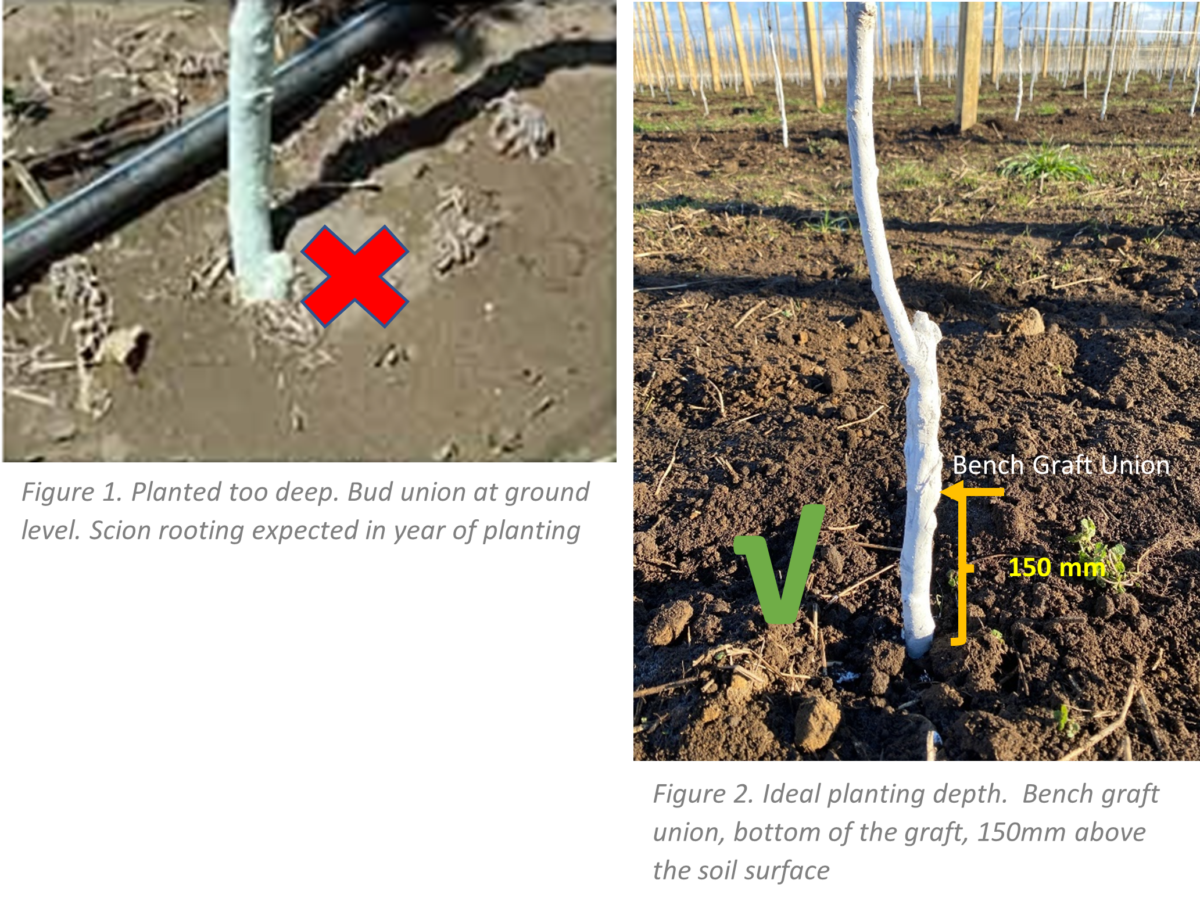
With new plantings underway it is a timely reminder to ensure the bud union, or the bench graft union is 150mm above the soil surface. Consider also that the tree inevitably sinks after planting and irrigating/rainfall. If the bud/graft union is at or below the soil level, adventitious roots will grow from scion. This will negate any dwarfing effect of the rootstock. Your trees will become vigorous, outgrowing their allotted space.
There is no easy way to address the problem once the trees have established, except pulling them out and re-planting again. I would say scion rooting is a serious problem in our orchards, significantly contributing to variability and lowering orchard profitability.
Planting at the right depth, having this attention to detail at the start, will save you a world of pain & $$ later – Do it once, do it right.
Dean Rainham
Agfirst Horticultural Consultant
While kiwifruit growers are busy sharpening pruning gear to get as many bays pruned on a dry day, our government is striking a great deal with the EU. New Zealand’s free trade agreement with the European Union was announced two weeks ago and includes the removal of tariffs on New Zealand kiwifruit exports to the European Union, possibly in time for the 2024 season. Zespri paid around $46.5m in tariffs on sales of more than $1 billion into the European Union last season, which is our largest export market. More here.
NZKGI will be running a series of podcasts with experts who will be talking about the Zespri ZGS Producer Vote, due to close at the Zespri AGM on Wednesday 24 August 2022. The aim of these podcasts is to present growers with a range of different perspectives, which may challenge current assumptions and give growers a deeper insight to allow them to make a more informed decision. The first podcast introduces the topic. NZKGI talks to Zespri Chief Global Supply Officer Alastair Hulbert and Italy-based Nikki Johnson, who is Zespri’s Strategic Projects Manager for northern hemisphere supply but is well-known to many growers as the former NZKGI CEO, click here.
In another interesting podcast, NZKGI chair Mark Mayston talks to ZGS Advisory Board chair Craig Thompson about questions on growers’ minds in the lead-up to the vote. Craig owns orchards in the Bay of Plenty and East Coast, as well as Italy where he was based for four years as European Supply Manager for ZGS Europe, click here.
The Kiwifruit New Zealand Board consists of six directors, of which three are elected by producers for a three-year term. This means every year one producer-elected director is due for re-election. Peter Ombler’s first 3-year term expires on 30 September 2022, and he will be standing for re-election for a second term. Nominations open for the Director Election on Monday, 25 July and close Monday, 8 August. For nomination forms or additional information please contact KNZ on 07-572 3685 or email here.
Spraying budbreaker is just around the corner. Please don’t forget to inform your neighbour.
Bye for now,
Jens
Jens Liesebach
KGI Lower North Island Representative
Dr Kathleen Kozyniak
Principal Scientist Air
Hawke’s Bay Regional Council
Bouts of winter westerlies had a large bearing on the region’s June rainfall and temperatures. Although we had near normal rainfall for the month, the western ranges caught the lion’s share while eastern areas, such as the Heretaunga Plains, saw just two thirds of average June amounts.
Plenty of rain in the ranges is a good thing. It means the headwaters of many of our rivers are receiving that rain and maintaining good flows. All of which helps recharge our aquifers. Both river flows and groundwater levels were at healthy levels for June. Soil moisture levels too were near or above normal for the first month of winter. Not that temperatures were particularly wintry. Daytime temperatures were a solid 1°C about average and overnight temperatures an even heartier 2°C. Soil temperatures unsurprisingly spent most of the month above average.
The tentacles of the La Niña look like they’ll keep some level of grip all year. During the next few months sea level pressures are expected to be higher than normal to the east of the country and lower to the west, especially over the north Tasman Sea. It’s an area that recently spawned a few rainmakers that headed our way. The seasonal forecasts include a reasonable dose of northeasterlies based on that pressure setup, which should keep our temperatures biased to warmer than usual and rainfall favouring normal or above normal levels.
Percentage of Normal Rainfall


As advised last month, HortNZ is/has lodged submissions on changes to the National Policy Statement for Freshwater Management, the Resource Management (National Environmental Standards for Freshwater) Regulations, as well as an exposure draft of the National Policy Statement for Indigenous Biodiversity. Submissions closed on 10 July for the freshwater stuff, and on 21 July for the NPSIB. The Ministry for the Environment will consider all the submissions, and then provide advice to the Minister for the Environment about whether to make the proposed changes, and exactly what those changes should be. There isn’t a set timeframe around this.
TANK – We are still waiting on this decision. We understand it is now going to be released at the end of August (2022).
Central Hawke’s Bay District Plan Hearings – These hearings are continuing, and will do so for several more months. At this stage decisions are expected in early 2023.
Kotahi (whole of region plan change) – The Council has started work on Kotahi which is a region wide plan change. They are just starting to engage with the community, and there is an opportunity to provide feedback through the regional council website. There is some information available here about what the plan will include. HortNZ has already had a meeting with the council to indicate we are keen to work with the council where we can, and further down the track (probably mid-late next year) we will be organising grower meetings to make sure that you are all kept up to date with what the proposed planning framework is, and to provide you with opportunity to give us feedback about it. However, please don’t wait until then though if you have any burning issues you want to talk about – feel free to give me a call at any time.
Water Conservation Order (WCO) – Still awaiting the decision.
Plan Change 7, Outstanding Water Bodies – This is still in mediation, and we have a further mediation meeting on Friday 15 July.
If you have any RMA questions, please do not hesitate to get in touch with me directly via email at Charlotte.Drury@hortnz.co.nz or on 027 3225595.
Dr Charlotte Drury,
View Consult, Consultant Planner on behalf of Horticulture New Zealand


