
Last month, NZAPI CEO Terry Meikle and I lead a visit to the eastern edge of Asia, Japan. A country composed of nearly 7,000 islands, with over 127 million people sharing the Pacific Ocean with us. The visit was alongside NZ stakeholders Plant and Food Research and Lincoln University, with the company and guidance of the High Commission team based in Tokyo.
Arriving in Narita, taking the metro to our hotel in the centre of Tokyo, we could already sense the polite and friendly people, fascinating economy, technical wizardry, rich culture, active religions, and strong traditions. A country of ambiguous communities and contradictions. Indigenous culture mixed with contemporary modern culture that has strongly influenced young populations.
The aim of the NZAPI visit was to continue supporting partnerships with the Japanese apple industry, allowing our industries to go further together. The strategic and beneficial location that makes us counter-season countries, enables the opportunity to offer our high-quality produce in times when the Japanese offer is low or nil. This satisfies a busy and demanding market, while at the same time creating a beneficial and continuous supply of good apples, increasing the demand from a happy consumer who is experiencing the taste and texture of a fresh, crispy, and sweet apple with sustainable access all year round.
NZAPI went with a clear view of developing cooperation between those who carry the “know how” of our industry to help our neighbour industry thrive, as well as to explore the industry-to-industry relationships for future businesses.
In Tokyo, we had the opportunity to engage with the international division of MAFF (Ministry of Agriculture, Forestry and Fisheries) who are dealing with the lack of young workforce – aggravated by an ageing population – and the excessive cost of farmland. They are struggling to attract young forces into the primary industry when there are so many other work options to choose from in buzzing cities.
We met with the Field for Knowledge Integration and Innovation team (KFII), a new form of industry-academia-government collaboration that aligns with the way we see research combined with academia industry and government.
In the new and advanced technologies, we met with Nihon Agri, a six-year-old company with a vision on exports of Japanese fruits. The team is adopting the 2D canopy system and looking forward to connecting with NZ soon. We arrived at NARO Apple Research Station Morioka City, Iwate Prefecture Institute of Fruit tree and Tea Science, where we visited some of their apple research blocks and commercial orchards ready to be harvested. We had the opportunity to visit JA Iwate Central Fruit packing house and storage site in full action.

On our visit to Aomori (700 km from Tokyo) we experienced the spectacular landscapes during a three-and-a-half-hour trip on the bullet train to the apple capital. We visited the historic Japanese Hirosaki University, founded in 1949, with an enrolment of approximately 6,500 students. The university is situated at the northern end of Honshu Island, and we met with researchers and PhD students focused on climate change and sustainability. From the outskirts of the train station to the middle of the city, Aomori talks apples! The diversity of apple sub-products was countless, including lollies, cakes, pastries, pancakes, cider, whiskey, vodka … to gadgets, home decor, toys, art (museums of apples, sculptures, paintings, street art, billboards and neon advertisements amongst many others).
A recommended visit and experience for any apple grower.
NZAPI Int Engagement Mgr. Dr Elena Duter
Thank you to all our sponsors and local businesses for your support and participation in our annual HBFA Fishing Competition that was held on Tuesday.
The cateogry winners:
Snapper: Paul Van, 5.585kg
KingFish: Gill Wilson, 7.705kg
Gurnard: Shat T, 1.33kg
Groper: Jack Wilson, 14.70kg
Kahawai: Brendan Downey, 2.54kg
Tarakihi: Carl Fairey, 1.865kg
Blue Cod: Dylan Woolhouse, 1.385kg
Trevally: Malcolm Ingpen, 2.13kg
Red Cod: Steven Brookes, 3.12kg
Gemfish: Abe, 7.235kg
Mackerel: Larry Olive, 2.54kg
Skate/Ray: Russell Wall, 3.955kg
Other Species: Toby Goodmen, 7.37kg
Maatu Akonga is no stranger to industry competitions. In 2020 he won the inaugural Ahuwhenua Young Maori Grower Award, the 2022 Hawke’s Bay Young Fruit Grower of the Year competition and more recently he proudly represented Hawke’s Bay at the national final of the Young Grower of the Year and took home the Best Speech Award against five other exceptionally strong young horticulturists.
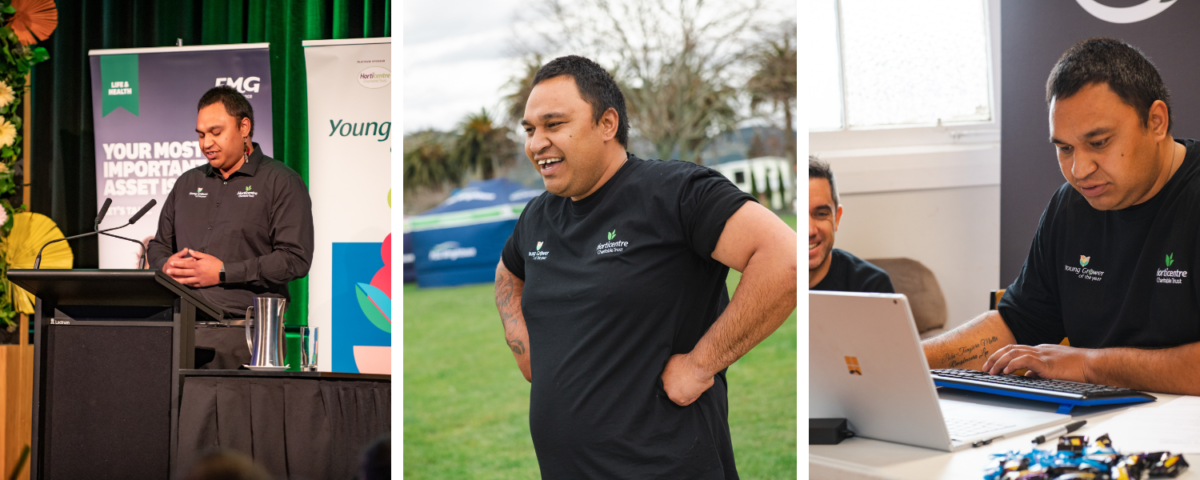
The national final was held in Nelson on 21 and 22 September and over two days the six competitors vied for the grand title in a series of practical and theoretical modules. The national competition has been running since 2007 and is a platform to encourage young people to challenge their horticultural knowledge against other liked- minded peers.
“The opportunities and networking that came from both our regional competition and the national final has been amazing,” says Akonga, reflecting on a whirlwind six months.
“It exposes you as an individual to the industry, to show the talent you have and how much talent there really is in the industry. Everyone goes into the competition nervous but you come out with a great bond with all the other competitors”.
Akonga is Assistant Manager in the Twyford Sector for T&G Global, responsible for over 80 hectares of apples. “It was awesome to have so much willing support from T&G, local businesses and sector organisations in the lead up to the event. Everyone is happy to help out at a drop of a hat and its really made me appreciate how close-knit our industry is. Taking part in the regional and national competition has reaffirmed my passion for the industry and it is such a great platform to extend and test your knowledge. “My advice would be to give the competition a go and after the event you ‘ll realise just how much potential you have to offer. For every young grower out there looking for a bright future in the industry, this event should be on your bucket list!”
The 2023 Hawke’s Bay Young Fruit Grower of the Competition will be held on the 30th June. Entries will open early January at www.hbfa.co.nz
This months RMA update focuses on two topics – the TANK Plan Change, and also the governments announcements and consultation about He Waka Ika Noa.
TANK
As mentioned in last months update the hearing panel issued its decision on the TANK Plan Change at the end of September. At 225 pages long the decision report took a while to get through, but we have now read and digested it. From a horticulture perspective there were a few wins – the key one being that the hearing panel has held the interim groundwater limit for the Heretaunga Plains Water Quantity Unit at 90 million m3/yr. Although this will still require some reductions in allocation, a number of iwi submitters were arguing for a reduction to 70 million m3/yr, which would have necessitated significant reductions in allocation, so the panels decision is a good result.
In terms of what the council will consider when applying to replace existing water permits, we were not successful in our argument to have reference to ‘actual’ deleted – we were seeking this because of concerns about lack of water meter data in some cases, and in other cases the accuracy of data that was available. This means that when applications for replacement water permits are made, the council will be looking at actual water use over the 2010-2020 year period. This ten year period has changed – in the notified plan change it was 2017. Changing it to 2020 means that it now includes two very dry water years (2012/13 and 2019/20), so this should mean that the actual water use of some growers is higher than it would have been otherwise so this is another win. However, growers who have never used their full allocation remain likely to face reductions – there are some provisions that allow periods of redevelopment to be taken into account, however there are a few tests that need to be met. Ultimately the council does need to reduce the existing level of allocation, and they will try to do that by reducing the allocation of water permit holders who haven’t used their full allocations for a number of years.
In terms of land use change, the framework has changed quite a lot. Arguably it is simpler, although we believe there are some parts of it that may need to be clarified further. The key thing to be aware of is if you are changing land use on 5ha+ of horticultural land, then you may require a resource consent from the regional council. Usual crop rotations are not considered to be land use change (this is something we succeeded in having recognised which is sensible).
The process from here is that anyone who lodged a submission on the plan change can lodge an appeal on the decision with the Environment Court. This has to be done by October 26 2022. We (Horticulture NZ) are considering this. Anyone wanting to read the decision themselves can access it here on the HBRC website: TANK Decision | Hawke’s Bay Regional Council (hbrc.govt.nz)
He Waka Eka Noa
Many of you will have seen media in relation to the governments recent announcements about He Waka Eka Noa – the government’s plans to price agricultural greenhouse gas emissions. Horticulture NZ is wanting to hear your views about the governments recommendations and are holding Zoom meetings on Monday 31 October 12:00 – 1:00 pm, and Thursday 10 November 12:00 – 1:00 pm that any grower is welcome to join. Links to the meetings will be released in the weekly HortNZ newsletter. More information is available on the HortNZ website here: He Waka Eke Noa | Horticulture New Zealand — Ahumāra Kai Aotearoa (hortnz.co.nz)
Next month I will finally be able to advise you all of the Environment Court’s decision on the Water Conservation Order for the Ngaruroro River – the decision is going to be released by October 25 and has been over 18 months in the making! Until then, please don’t hesitate to get in touch with me if you have any RMA questions, and I hope that we might see some more sunshine than we have over the last month!
As always, if you have any RMA questions, please do not hesitate to get in touch with me directly via email at Charlotte.Drury@hortnz.co.nz or on 027 3225595.
Dr Charlotte Drury,
View Consult, Consultant Planner on behalf of Horticulture New Zealand
I write this as more rain is falling, just when we thought it was all over – we certainly are in trying times.
It is imperative that fungicides are applied at the right times to prevent black spot from occurring, in conditions like this I feel for the organic growers who do not have access to the same chemicals that conventional growers use. In my view Organic growers and managers do an amazing job of crop protection considering the limitations they all face.
On the 21st of September we had a nasty hailstorm that came through areas of Hastings and Havelock Nth. There has been fruit damage, especially in summer fruit and I’d imagine that more damage in apples will show once they are in the fruiting stage. In addition to this we’ve also experienced some frost scares, however it seems that we have dodged what could have been another significant blow to the industry – we have certainly fared better than our friends in the Bay of Plenty. There has been extensive damage on many kiwifruit orchards further up the island – I spoke with one grower who has lost 70% of his crop. As growers these are the risks we all face each year, so our thoughts go out to everyone who has been affected.
After some long negotiations with Minister Woods (Immigration) and our Product Group and HortNZ CE’s, an announcement regarding the RSE cap has finally been made with an agreement to raise it to 19,000. This is good news for everyone in horticulture and will take some pressure off our labour concerns for the up-coming season. Housing remains an issue of course but this has been the case for some years now. I believe the CE’s have done an excellent job throughout these negotiations, especially given the additional complexities that emerged with the last-minute involvement of the Trade Unions. Sick pay to our RSE workers will now be required under this new deal, I’m told that some growers were already doing this.
There was more good news for horticulture the other week with the introduction of the “National Policy Statement for Highly Productive Land” (NPS-HPL) aimed at ensuring such land can be used for growing vegetables, fruit, and other produce. Councils will now need to identify, map, and manage productive land to protect it from inappropriate use and development. This document is not airtight so it will be a priority for HBFA and the “Save the Plains Group” to keep all councils accountable. Here is a video link for a local HB viewpoint on the policy.
In a previous newsletter I mentioned I had attended a meeting with Barbara Kuriger, National Party MP for King Country and acting spokesperson for Horticulture. Last week I went to hear ACT’s David Seymour to hear what his policies are on issues that are important to our growers. I asked him 2 questions and here are his responses.
1 – “Where does ACT position itself on horticulture’s labour needs and what is their policy for our RSE scheme”.
His response was extremely positive. ACT would not put any cap on the scheme “bring in as many as what’s needed to fill our labour requirements”
2 – “What is ACT’s view of the new National Policy Statement for Highly productive Land?”
He was very clear on this in that he does not agree with the (NPS-HPL) and believes there should be no interference or mandates from Central or local Govt on land use. The ACT Party have no interest in the preservation of our precious fertile soils throughout HB and NZ. He stands by landowners’ rights do what they want with their property, if that means building houses or developing lifestyle blocks then fill your boots. To me this is extremely short sighted, as our soils are amongst our Nation’s most precious commodity’s. I’ll leave you to decide your own vote at the GE next year.
The next few weeks will be an extremely busy period for the Association, with several events coming up. Our annual Fishing Contest is scheduled for October 31st, and I understand the prize table will be fully loaded, I’d like to thank all our generous sponsors and encourage as many of you as possible to get involved. HBFA are also leading this year’s “Pick the Bay” job expo on November 3rd and the activation efforts for this will include a presence at the Hawkes Bay A&P show, where Dean (our Business & Grower Engagement Manager) and Jacqui Davis from MPi will be driving awareness for Pick the Bay.
Regrettably our inaugural Industry Family Day that was scheduled for October 16th was postponed due to the wet weather. The new date will be November 13th November – I look forward to seeing you down there.
Let’s hope we see some sunshine soon!
Brydon Nisbet
HBFA President
Grab a few mates, get a catch (or two!) and measure up to win some fantastic prizes at the annual HBFA Fishing Competition. The 2021 event had well over 100 participants out hooking on to this opportunity to fish for amazing prizes, thanks to a large number of local businesses who support this fun event.
To download the Fishing competiton flyer and rules, visit our events page.
Kia ora koutou,
Its been a big year! We feel for you all, combatting the challenges of the season, and are doing our best to support students to keep up with their classwork whilst not adding too much pressure. Our ‘year’ ends in December and we need to know before 17th November if students are not going to complete everything, so we can withdraw them for those courses and re-enrol for next year. There is no problem with students taking two years to complete any of our courses, or longer for Diplomas, we just need to know. Please talk to your student about this. We can keep accepting assessment work beyond the 17th.
Our early intake of year one students have almost completed their courses, with our second hydralada session at the end of this week, we also have forklifts, tractors and chainsaws this month.
Level 3 fruit production students are half way through crop health – this is a big subject, covering pests, diseases, disorders and their controls in three days. They also have a short cass on thinning/crop load later in the month.
Level 4 students have been applying the knowledge of analysing the soil and environment in the Growing Environment subject to design and plant a productive orchard. It’s been great to see the different perspectives on orchard functionality.
Level 5 fruit production are involved in the timely subject of labour management. With the thinning and harvest tasks approaching they are discussing strategies to encourage and manage labour. There is a hearty cohort of 22 on the post Harvest diploma at various stages of completing their qualification.
We will be supporting all students to apply for HBFA scholarships in their next tutorials. The timetables for next year will be out by the end of the month, with a slightly different look and structure. We have tried to build in more flexibility for both students and staffing, and as always your feedback is greatly appreciated.
We are still awaiting news on fees from Te Pukenga for 2023, and will inform you as soon as we know ourselves.
Noho ora mai, from EIT
Last month I signed off wondering how the cherry season might develop and while its early days so far so good. Hail has had an impact to the netting covers in some cases, but on the assumption that repairs are made before harvest that scenario is mitigated.
Checking my home garden tree, a Lapins (with a ‘s’, named after Karlis O. Lapins when it was released in 1984) there is a little bit of frost damage, plenty of flowers and some small fruitlets to be seen when the sepals are removed. As long as they set there will be heaps of fruit.
That indicates that there has been sufficient chilling even in a season that has the lowest accumulation of the last five years. The 2018 season had the best accumulation of the last five.
1st May to 1st September Richardson units:
| Location | Winter 2022 | Winter 2018 |
| Bay View | 985 | 1283 |
| Twyford | 990 | 1344 |
| Longlands | 951 | 1330 |
The pollination field day that was hosted by NZAPI recently highlighted what we know about pollination and what we don’t as well. The Summerfruit NZ portal has some resources that are always worth re-reading and there are a couple of recent webinars that speak to pollination. In theory only one bee visit per flower is all that is necessary as there is only one seed, but industry experience would suggest 3 visits per flower is a better target, even with self-fertile varieties such as Lapins. Hive rates of 2.5 – 4 per hectare were other go-to numbers that were suggested. The higher rate is probably better for the other stone fruit species, such as apricot that flower in late winter or early spring. There was also discussion around the effect of nets, whether fully or partially covering and the impact on bees. This is something Hawkes Bay cherry growers have coped with for a long time while apple growers are starting to learn just now. The take home message is that bees are not that keen on nets disturbing their patterns.
As we look to the start of the harvest season in 6 or 7 weeks time, the fruit drop, or November drop, will be worth watching, with a wary eye on the stress from wet soil and poor heat unit accumulation. Still if a few fall, then the size will be larger. So far, it’s not our best start ever, but not dreadful either. Just some more sunshine please.
Growing degree day accumulation (base 10°C) compared to the best of the last five seasons from 1 September to 10 October:
| Location | Spring 2022 | Spring 2020 |
| Bay View | 101 | 153 |
| Twyford | 93 | 119 |
| Longlands | 101 | 123 |
| Renwick (Marlborough) | 69 | 90 |
| Cromwell | 35 | 58 |
When comparing the other cherry districts, the patterns seem similar, wetter than desired and with some horrible cold events.
Weather aside there is another factor for Hawkes Bay cherry growers to consider. All the fruit presently grown here is destined for the NZ market – almost exclusively aimed pre-Christmas. While there are more trees going in the ground here, there is hundreds more hectares going in the ground in Central Otago, with some about to start producing. I understand that while the aim is export there will be plenty that arrives on the NZ market as well, and some of this is coming out of covered, as in greenhouse, production, so it will be early.
The major supermarkets don’t take a lot, if any, Hawkes Bay cherries as they prefer to wait for the better-quality Marlborough and Central Otago product. My personal view is that it’s not the growing conditions but a mindset that has only needed to consider getting product to a ‘good enough’ situation. The concern is with increasing Hawkes Bay planted area, and with increased completion on the way from Central Otago we need to learn how to grow export quality fruit with a view to changing the attitude of the supermarket buyers and potentially exporting cherries. The earlier harvest season would be complimentary for exporters if the quality is good enough.
And what defines good enough; colour, brix and size are easily achievable but it’s the crunch that needs to be worked on. One of the tools is variety selection the other is the use of gibberellins as the fruit starts to ripen.
Hawkes Bay has some natural advantages, there is enough winter chilling, good growing degree days and earlier production. We export apples so know the necessary procedures. There is going to be increased competition from here and the South Island, maybe even this season. Is now the time to look to export in the medium term and in the interim teach ourselves how to grow crunchy fruit that the supermarkets will want to buy?
Richard Mills
Summerfruit Technical Advisor
021 632559
Being on saturation watch rather than drought watch is new to me. We’ve had a lot of rain so far this year, with September making a sizeable contribution. The month’s rainfall was well above average, especially on the Heretaunga Plains, where almost triple the month’s average fell. October hasn’t mucked around either. At the time of writing, near the month’s halfway mark, both the Heretaunga and Ruataniwha Plains have already hit 100% of average October rainfall. We have record accumulations at a number of our sites for the year to date.
At the Council’s climate site at Bridge Pa, the soil moisture level is the highest it has been for mid-October since monitoring started there in 2003. Soil moisture is at field capacity or reached saturation across much of the region. River levels were above normal in September and groundwater levels tracked well compared to long term averages. Cloudy conditions muted daytime temperatures in September, but overnight temperatures were a degree above normal and soil temperatures were warmer than usual, finishing the month on approximately 14°C on the Plains.
I’d like to say things will change over the next few months but a notable shift in pattern isn’t predicted. La Niña and negative Indian Ocean Dipole events continue to rumble on. We’re expecting higher than usual sea level pressure over central and southern New Zealand and lower than usual to the north of the country. The pattern favours easterly wind flows, with their potential to bring the region cloud and moisture. Rainfall predictions lean towards normal or above normal totals while temperatures are expected to be warmer than usual, though don’t be surprised if those daytime temperatures are blunted by clouds again. Usually we’d be reasonably happy with the rain forecast but right now I think a breather and some sun would bring more cheer.
Percentage of Normal Rainfall


Dr Kathleen Kozyniak
Principal Scientist Air
Hawke’s Bay Regional Council
The start of Spring has been rather tumultuous with frost, hail and plenty of rain events. Some apple orchards have used helicopters to apply crop protection sprays as the ground is very wet. To my knowledge this technique is not applied here in the Hawke’s Bay on kiwifruit orchards and could be worth considering. Activities on the orchard focus on adjusting G3 shoot numbers and removing lateral flowers. One observation is that the numbers of flowers per shoot could be challenging.
Our fellow kiwifruit growers in the Bay of Plenty have seen some unseasonal frosts, including areas which don’t traditionally require frost protection. While some frost damage will have the potential to reduce spring growth, some unfortunate growers may have lost up to 40% canopy due to leaf burn. Adverse events, such as frost, can be very stressful for growers and my thoughts are with them.
The announcement of the increase in Recognised Seasonal Employer Scheme (RSE) workers to a total of 19,000 workers and the return of open borders will hopefully give us more confidence that the shortage of labour will not be as dire as the 2022 season. In addition, NZKGI will continue to run programmes to train and attract New Zealanders to the kiwifruit industry, such as our Labour Attraction Campaign.
Applications for the two 2022 Kellogg Rural Leaders Programmes are being accepted. The closing date for applications for the 2023 Lincoln Programme One is 30 October 2022 (programme starts on January 24). Lincoln Programme Two starts on June 13 and these applications close 16 April next year. Register here.
I am moving on after 15 years in the kiwifruit industry. During my time, attempts were made to undermine the Single Point of Entry (SPE), the bacterial disease PSA brought the growing community to its knees and there was a pandemic that put our country into lockdown. I have valued the collaborative approach between growers and experts to tackle these challenges and build resilience into the system such as Kiwifruit Vine Health (KVH). If the same approach is used to resolve the fruit loss issue experienced last season, then I have no doubt that the industry will continue to thrive.
I wish you all the best for the future.
Jens Liesebach
KGI Lower North Island Representative


