

Please find the following links to resources that have been developed by HortNZ:
HortNZ Grower meeting pres. AR-info Mar 2024

HortNZ Grower meeting pres. A & R.15 Feb 2024
Commodity Levy Order Referendum starts April
As part of the consultative process for the renewal of the Commodity Levies (Apples and Pears) Order, NZAPI has been engaging with growers around the country. If you missed out on the in-person meetings, you can still attend the online meeting next Monday 25 March at midday. Click here to request the link.
Voting commences on Monday 8 April, with both postal and e-vote options available.
EVERY VOTE COUNTS! For NZAPI’s application to be viewed favourably, they need to have maximum participation in the vote, so whether you’re a big or small grower, your input is vital.
The commodity levy collected by NZAPI is primarily used to support and deliver services to growers in the following areas:
More information on the Commodity Levy Order is available on the NZAPI website.
If you have any questions about the Commodity Levy Order, please email Karen Morrish, NZAPI CEO.
Apples – Crop load observations.
Crop load still appears to be the main factor influencing fruit size and quality. We know that there is a linear relationship between total harvested yield and light inception but striking the optimum balance between tree/shoot and fruit has a major influence on marketable yield (pack-out).
The Agfirst team has just completed walking hundreds of blocks this pre-harvest. Irrespective of variety, optimizing the crop load and minimizing the variability has a significant influence on the outturn of the product which ultimately impacts on returns. We noted a range of crop loads, both within and between orchards.
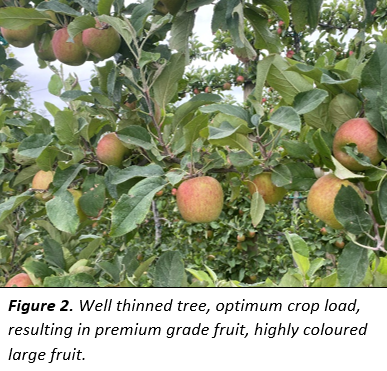
Well thinned trees were superb, with good colour and size (Fig 2). These trees will be much easier to harvest and pack-outs will be high. Leaf quality was also higher on these well thinned trees. However, within the same row we also found over-cropped trees, because of poor hand thinning, fruit held in the shade, limbs almost at breaking point (Fig. 1). Colour and size were being heavily compromised on these trees which will lower the overall pack-out for the block.
Dean Rainham

Kia ora koutou,
With harvest being well underway, this month is a time for us to spend clearing up our internal reporting, updating assessments and getting ready for the busy time from May – December. We are meeting up with our Tairawhiti colleagues, who teach the same courses, to a wider variety of industries, and finishing resulting from 2023. Students who completed qualifications last year will be receiving their certificates in the post soon.
Level 4 students should be collating some harvest documentation for the compliance course, level 3s maybe asking about the weather, or interesting weeds they are seeing, but we do not expect much to happen during this busy time.
Please see the recent NZAPI newsletter with lots of information regarding further training like the Kelloggs leadership course, and encourage workers under 30 to step up for the Young Fruit Grower of the Year.
Best of wishes for your harvest
Clare, Steven and Chris
A dry February rounded out a summer that flipped flopped between wet and dry months. Only 50% of average February rainfall fell across the region but on the Heretaunga and Ruataniwha Plains it was only a third of the average. The one outlier in the region was the Ruahine Range, where rainfall was within the normal range.
Soil moisture, that had been boosted by January’s ample rainfall, dropped closer to median levels for the time of year. River flows also responded to February’s lack of rain, being near or below average whereas groundwater levels for the month were the opposite and ranged from near to above normal.
Daytime temperatures were impressive for the last month of summer, reaching more than a degree warmer than average but overnight temperatures were largely typical of late summer. Sea temperatures remained elevated in our part of the world, though cooled to more normal levels in the area immediately surrounding the country. That likely helped put the brakes on rainfall. At the time of writing (two thirds through March), we’ve had just 25% of March rainfall with little in prospect for the remainder of the month.
The El Niño is expected to weaken to neutral conditions during autumn, after which a La Niña (sigh) could develop in winter or spring. The outlook for the next three months has hallmarks of the former rather than latter, with westerlies still the expected dominant wind flow, arising from higher than normal pressure over the North Island and lower south of New Zealand. Rainfall is predicted to be near or below normal and temperatures still tracking in a warmer vein. Hopefully that equates to a balmy, pleasant lead into winter.
February 2024 rainfall

Dr Kathleen Kozyniak
Principal Scientist Air
Hawke’s Bay Regional Council
Advertorial –
What is Safety SNAP?
SAFETY SNAP is a science based tool that helps businesses to understand the psychosocial issues affecting their team. It measures risk factors that are proven to increase accident and injury risk, and also proven to impact a person’s likelihood of surviving and thriving in their job.
We would like to offer all HBFA members 3 months trial using the Safety Snap Psychosocial Tool. For more information please click here.
We are also offering SaferMe’s Safety system to any HBFA members with a special introductory offer – 10% discount off the first 3 months of their subscription. Everyone will also benefit from a 30 day free trial of the system.


Changes to Soil and Water and Climate
There have been a few field walks, meetings and presentations in the past month, which have not directly targeted stonefruit growers and are general enough to be worthy of comment.
Summerfruit is not the easiest of crops to grow. There is some susceptibility to wet feet and silt covering, adequate levels of winter chill could be getting closer to the necessary thresholds, and sufficient water to irrigate crops is being challenged.
Making good, longer-term decisions will affect the next generation’s ability to grow fruit and vegetables. It may well have an impact on the present generation’s ability to make a profit. The past season is a fantastic illustration. While there was adequate chill and a relatively benign growing season, balance sheets have still been challenged.
James Palmer, the relatively new Secretary for the Environment, presented to the local Future Farming Trust. He strongly suggests that climate driven change has arrived, and that technology driven fixes are already too late. Storms such as Cyclone Gabrielle will be more intense and are likely to be more frequent. Bola was in 1988 with the big one before that in 1938. There is good information coming from the Future Farming Trust. While this information is often from other crops and animal farming, we are all living and growing in the same environment.
Will there be sufficient chilling soon? It’s good enough at the moment and could be made to work with the aid of dormancy breakers/enhancers. But do we encourage the importing of more low chill varieties and start getting some experience of growing them commercially?
Plant & Food Research held a hosted a field day this week highlighting some work that they are doing in the recovery from silt space. They were looking at what crops work in silted ground in relation to seed size. Bigger seemed better, but what struck everyone was that the sites from where silt was removed performed worse than the areas that were left alone. For tree crops, would replanting with higher graft unions in flooding susceptible areas be worth considering? Particularly as it is cheaper to leave the silt where it is, if possible.
The all-of-horticulture plus agriculture meeting in Havelock North, hosted by HortNZ, shared information from HBRC staff, Regional Councilors and HortNZ’s response to date. There was a good and robust exchange between growers and HBRC staff highlighting the complexity of what is trying to be achieved. Again, a good understanding of this issue will influence what is planted in the future. The variation in individual circumstances is staggering.
What some of the answers might be is not my place to guess at. I can imagine dams on individual orchards as is seen in Central Otago, and irrigating low chill peaches via solar power generated from the shed roof that also powers the electric tractor. But as I said, these are only my guesses.
Richard Mills
Summerfruit Technical Advisor
021 632559
Please find the following links to resources that have been developed by HortNZ:
HortNZ Grower meeting pres. A & R.15 Feb 2024
HBRC presentation. HP water permits Feb 24
Advertorial –
In the dynamic and competitive business of fruit tree nurseries, the journey to becoming a world-leading grower demands more than raising quality trees. It requires a strategic approach, comprehensive knowledge and a dedicated team of specialised employees.
The recent additions to Genesis Nurseries team, Dean Smith, Dave Greer and Jamie Hall, who join existing CEO Hayden Green, bring a wealth of experience and a shared vision of supporting growers in their journey to becoming world-leading.
With the expansion of the management team, Hayden believes Genesis is well-equipped to contribute to orchard success. “We want to be more than just a nursery, we want to be a dynamic force that stays ahead of industry trends. A team that constantly explores new technologies, sustainable practices and cutting-edge horticultural methods. By embracing innovation, we not only enhance the quality of our trees but strengthen our links with IP owners and breeders, providing our growers with the knowledge to stay at the forefront of the fruit production industry”.
Taking on the role of Business Development and IP Manager is seasoned specialist, Dean Smith. Previously leading Hawke’s Bay Fruitgrowers’ Association, Dean understands the importance of collaboration and communication in achieving successful and sustainable commercial outcomes.
“During my time advocating for growers, I gained a deep appreciation for the challenges they face, from accessing capital to navigating workforce constraints, regulatory hurdles, market fluctuations and extreme weather events” shares Dean.
“I’m also very aware of the long planning horizons and the significant investment with planting, and plan to bring this grower perspective to support our service delivery.”
Similarly, Dave Greer, the newly appointed General Manager Operations brings a multifaceted skill set to Genesis, combining his expertise in pest disease and risk management planning, (acquired through global experience in vineyards), 9 years of irrigation engineering with his experience in managing labour supply, assisting the Hortus management team to establish the company in the North Island.
While growing top-quality trees is paramount for Dave “building a great culture and team that can develop up the ranks” will be a strong priority.
Completing the team as Safety, People and Capability Manager is Jamie Hall. With his strong roots in the field and understanding of the regional dynamics, Jamie is equipped to be a crucial player within the Genesis team.
His ability to assess the team’s current skills and identify gaps will mean “staff will not only remain safe at work but will allow me to provide further training and skilled labour when required. Overall, I want to ensure all labour is working towards producing the best product for our growers”, says Jamie.
As the 2024 season ramps up, the strategic additions to the Genesis Nursery team will strengthen their commitment to staying ahead of industry trends and supporting growers on their journey to becoming world-leading.


NZAPI will be engaging with growers around the country in March as part of the consultative process for the renewal of the Commodity Levies (Apples and Pears) Order.
Every six years, NZAPI is required to renew their legal status as the levy collector for apples and pears in New Zealand. It was last renewed in 2018 and is therefore due for renewal in 2024. The commodity levy order sets the role of NZAPI and the maximum levy amount. All growers are required to pay the levy, which is primarily used by NZAPI to fund the support and services it provides as the industry body.
While the Commodity Levy Order is a piece of very important legislation for the industry, more importantly it is what brings us together as an industry, formalising how we work together, and how we provide services and support to growers. Because of this, it is critical that growers are part of the renewal process.
Meetings with growers will be held in early March to engage and consult on the Levy Order. Acknowledging this is a busy time of year for growers, NZAPI are combining their levy order consultation meetings with an update on the recent strategic review, and an online meeting will also be held.
GISBORNE: Monday 11 March, 5-6pm, Bushmere Arms.
HAWKE’S BAY: Tuesday 12 March, 5-6.30pm, No. 5 Café & Larder, Hastings
HAWKE’S BAY: Wednesday 13 March, 5-6.30pm, Havelock North Function Centre
NELSON: Monday 18 March, 5-6pm, Moutere Hills Community Centre, Upper Moutere
NELSON: Tuesday 19 March, 5-6pm, Headingly Centre, 2 Headingly Lane, Richmond
CENTRAL OTAGO: Wednesday 20 March, 5-6pm, 103 The Store, Roxburgh
TIMARU: Thursday 21 March, 5-6pm, Grosvenor Hotel, 26 Cains Terrace, Timaru REGISTER HERE to attend any of the grower meetings.
More information on the Commodity Levy Order is available on the NZAPI website.


