HBFGA April 2025

Change is Coming –TANK Actual and Reasonable Assessments Forging Ahead
Hawke’s Bay Regional Council are starting to process on hold resource consents in the TANK Catchments. HBRC have requested further information by 31 May 2025 and view to process the bulk of these consents by 31 August 2025. What do Grower’s do now? If you have accepted the ‘Actual & Reasonable Use’ assessments made by HBRC or already provided further information, nothing is needed and HBRC will be in touch in due course.

If you have yet to respond, have a close look at the HBRC assessment and determine whether the volume is sufficient. If it isn’t, further justification to argue an increase utilising the seven matters of discretion HBRC have outlined must be provided to HBRC by 31 May 2025. These include accuracy of data, water sharing, crop rotation / redevelopment, and low flow bans. Cyclone recovery, and investment post 2 May 2020 can also be considered, but this will trigger a change in activity status. If you need assistance, speak to your rural professional.
Change is coming, and in the immediate term this appears to be reductions in allocation. However, with change also comes opportunity to improve.

At the individual scale; how efficient is your irrigation system? Can a better understanding of demand and site-specific conditions lower use and lower costs? Can those same improvements control vigour? Drive colour?
At the regional scale; how can you collaborate to drive the success of the primary sector? Does water sharing have a role to play? How efficient is the region and its produce and does this give a market access strength?
There is no doubt that the regulatory framework is going to deliver challenges with immediate effect to the Heretaunga Plains. Industry is going to need collaboration, communication, and resilience while this challenge is navigated.

Carl

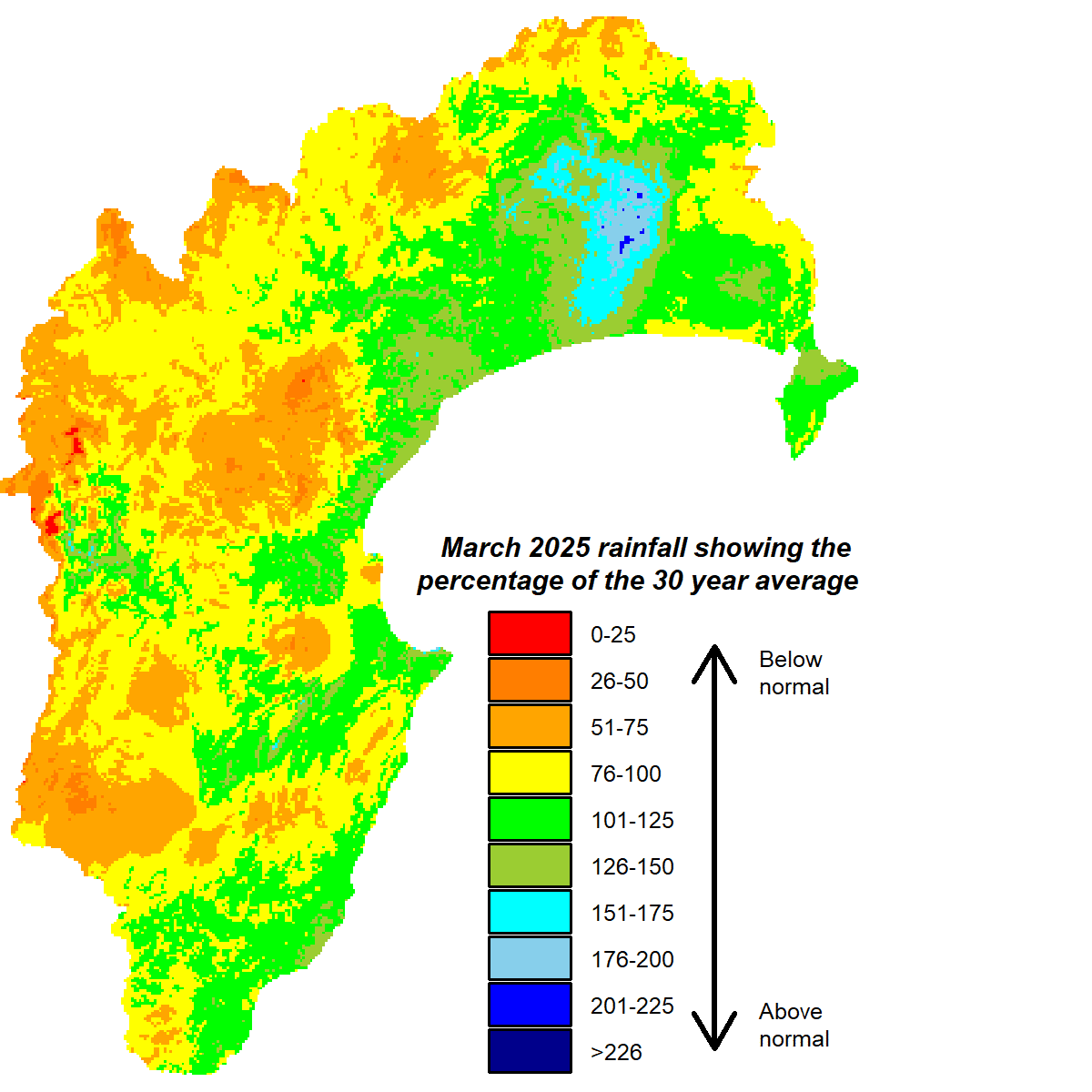
Our March rainfall snuck into the “near normal” category, although it wasn’t evenly distributed across the region.  Northern Hawke’s Bay saw the bulk of it, getting 140% of the month’s long-term average, while most areas received approximately two thirds of their March average.  No wonder then that soil moisture in the north has been looking mostly okay but the likes of Bridge Pa, on the Heretaunga Plains, Te Haroto and Porangahau have been running at or near wilting point.   March river flows were below normal and ground water levels were dipping into below normal status too.  Daytime temperatures were about 0.5°C warmer than average but overnight temperatures were close to the March average.

Ex-tropical cyclone Tam is influencing New Zealand’s weather as I write.  Parts of the region could definitely do with some rain and at this stage it looks like we may get helpful rather than worrying amounts.  Hopefully, that remains the case.  The La Niña is history and we are in neutral conditions, although a bias to easterly flows is still likely.  This is due to seasonal forecast models favouring higher than normal pressure centred southeast of the country and lower than normal pressure to the northwest of New Zealand.  Sea temperatures around us are warmer than average and expected to largely remain that way.

Easterlies plus warm seas suggest rain might be forthcoming for our region, but they will be battling high pressure systems that have been reasonably effective in steering bad weather away.  We’ll soon know whether Cyclone Tam made inroads, otherwise the forecast for the next three months reflects a balance in the battle, giving us near normal rainfall and near or above average temperatures.

All the best,

Kathleen

Kia ora koutou,

I wish I could tell you what the future of EIT looks like . . . currently we are still in limbo as we work to show financial viability so we can regain our status as a ‘stand-alone’ organisation that runs its own budget and makes its own decisions.    If we become part of a centralised service, the regional autonomy will be lost, and benefits such as reduced fees for our fruit production program, and the actual continuation of the L5 diplomas may be at risk.  We also have the future of the work-based learning model in the melting pot – hopefully we will soon have some direction as to how the ITO and EIT work together in the future.  It’s all a bit of a worry to be honest!  We will be keeping you informed as the future becomes clearer.

We look forward to welcoming back students through May and can take new students at any level.  For more specific information contact Clare or Steven.

All the best

Claire, Steven and Chris

NZAPI Newsletter – March

By now, you will have surely seen and heard about exceptional apple harvest current underway in Hawke’s Bay.
Not only are numbers up, but so is size, and flavour and storability are proving to be the best in years.
It’s just what the Hawke’s Bay’s apple and pear industry needs – not only as an economic injection into our sector, but also as a morale boost for growers who have weathered a number of challenging seasons. But, don’t just take my word for it. TVNZ’s Seven Sharp was in town this week and put this year’s harvest to the test.

See the clip here:

https://www.tvnz.co.nz/shows/seven-sharp/episodes/s2025-e31

Hawke’s Bay Fruit Growers Association update
Explore, Grow & Thrive – The month is almost over!

A strong finish, it’s all about timing!

As we move further into March, the changing weather patterns have brought a mix of challenges and opportunities for the horticulture industry. Across orchards, growers have had a good run with exceptional fruit quality, a testament to the favourable growing conditions that have supported healthy crop development. A combination of somewhat normal rainfall, optimal temperatures, and well-timed sunshine has contributed to enhanced fruit size, flavour, and overall yield. These conditions have not only benefited current harvests but also reinforced New Zealand’s reputation as a global leader in premium horticultural production. With international markets increasingly demanding high-quality produce, the industry’s ability to maintain excellence despite economic environmental shifts highlights the dedication and expertise of local growers. As the season progresses, continued monitoring and adaptability will be key to sustaining this success and maximizing market opportunities.

With that in mind, New Zealand’s economy showed slight growth in the final quarter of 2024, with a 0.7% increase in GDP, technically lifting the country out of recession. However, the economy contracted by 0.5% for the full year, weighed down by struggling sectors such as construction (-7.3%) and mining (-10.3%). In contrast, agriculture, forestry, and fishing grew by 4.4%, alongside gains in education, tourism, and healthcare. For Hawke’s Bay fruit growers, this resilience in primary industries is encouraging, though rising costs, compliance pressures, and market fluctuations remain key concerns. A positive sign was the first increase in GDP per capita (+0.4%) in two years, indicating improving productivity, even though annual figures remained down. Banks also seem to be playing catchup and, in some cases, interest rates decreasing five times from this year alone.

Despite economic challenges, New Zealand’s 0.7% quarterly growth outperformed key trading partners such as Australia, Canada, Japan, and Europe, sitting above the OECD average of 0.5%. While China led with a 1.6% increase, New Zealand’s positioning suggests relative strength in global markets. As the economy stabilizes, Hawke’s Bay growers must remain adaptable to shifting market conditions. HBFA continues to support members through advocacy, industry updates, and events, ensuring they remain informed and prepared for the evolving economic landscape.

A recent report from Boston Consulting Group which I’m really excited about called, “Future of NZ Inc: What Will New Zealand Be Known for in 2050?”, identifies sustainable food production as one of five key opportunities for New Zealand’s economy. The report emphasizes that New Zealand’s agriculture sector, which contributes approximately NZD 40 billion in annual exports, can enhance its global leadership by adopting sustainable farming practices.
To achieve this, the report suggests capitalizing on the growing demand for premium, environmentally friendly food products by improving sustainability and transparency in supply chains. Additionally, it recommends investing in research and development to reduce agricultural emissions, thereby maintaining competitiveness amid the rise of alternative proteins. By focusing on these strategies, New Zealand’s horticulture sector can strengthen its position in the global market and contribute significantly to the country’s sustainable economic future.
This report is the first stage of BCG’s investigation into the future of NZ Inc. Drawing on the robust expertise of BCG’s New Zealand team and the wealth of resources and access enabled by its global network, the study identifies five ecosystems for further exploration and many in our back yard here in Hawkes Bay:

• Agriculture 4.0
• Space and satellites
• Green tech
• Future of medicine
• Creative industries

See more here

Supporting horticulture:

The Aotearoa Horticulture Action Plan (AHAP) – a vehicle for collective progress

The AHAP was launched in 2023 to provide a framework for sector transformation. It acts as a guiding compass to achieve the ambitious goal of doubling the farmgate value of horticultural production by 2035 in a way that improves prosperity for our people and protects our environment. The plan was developed collectively, with input from industry, government, Māori and research providers. It belongs to everyone involved in the New Zealand horticulture sector. The plan enables organizations and individuals associated with the industry to align their efforts and investment towards a series of united actions to grow the horticulture sector sustainably.

Benefits from the framework are being seen already – many partners and stakeholders are actively aligning their strategic plans and work programes to deliver on the collective aspirations of the AHAP.

Launch of the AHAP progress update

The first progress update was launched at the Horticulture conference last month, and can be found here. The progress update contains a range of information including:
• the AHAP journey so far and next steps
• achievements to date
• insights from the stocktake and gap analysis
• the evaluation framework
• case studies

Further information on the AHAP (including the plan itself, FAQs, and projects completed) can be found here.

Looking ahead: FDS & TANK

Advocacy updates
• Napier-Hastings Future Development Strategy (FDS)
o The hearings on the Future Development Strategy are being held next week (Monday 24 March until Wednesday 26 March) in the Hastings District Council Chamber.
o Submitters who have asked to be heard will already know the time that they are going to appear, but if anyone else wishes to attend to listen, you are welcome too, as the hearings are public. Submissions from HortNZ, HB Vege Growers and HB Winegrowers are being heard around midday on Tuesday 25 March.
o Further information re the timetable and the Council’s reports is available here: Hastings and Napier Future Development Strategy | Hastings District Council

• Update from HortNZ re TANK water permit application process
HortNZ meet with HBRC earlier this week regarding the TANK water permit application process and can provide the following updates:
o The regional council confirmed they are not intending to push the date that you have to provide information by again, so if you don’t agree with you’re A& R volume (and you haven’t already provided information), you will need to do that by 31 May 2025.
o We are working with HBRC to organise an information session for growers to get clearer direction about what information you do need to provide. It is likely to be a webinar. The date has not been confirmed yet, but will be in the first half of April. Please watch your emails for details of this which we will share once confirmed. As always, if anyone has any resource management type questions please do not hesitate to reach out to either Charlotte Drury 027 3225595, Charlotte.Drury@hortnz.co.nz or Leanne Roberts, 027 546 1655, leanne.roberts@hortnz.co.nz

Again, a heartfelt thank you to our members, partners, and sponsors for your continued support. As you know contributions enable HBFA to champion growers’ interests, host meaningful events, and drive initiatives that strengthen our industry.

Wishing you a prosperous season,

Warm regards, 

Callum Ross 

Chief Executive Officer HBFA 


Presidents Report

No doubt everyone is in the thick of harvest and what a great season we are having. The weather is playing ball, colour seems to be good for all varieties, kiwis, back-packers and our RSE workers are here in abundance and doing a fantastic job of harvesting our summer fruit, kiwifruit and apples and pears. Theres something about growing produce that you know will go out into the world and allow millions of people to taste and enjoy our wonderful HB fruit.

Most will know that the HBRC have proposed a new dam and proceeding with a water storage proposal. Using pre-feasibility funding provided by MBIE, this dam would store around 27 million cubic metres at a site off the main stem of the Ngaruroro River. Pre-feasibility work has identified the site as technically, environmentally and commercially feasible. The dam would cost $225 million to build, with $6 million in annual operating costs. We also have the revised Ruataniwha Dam which has also received fast-track status, as well as receiving up to $3 million in Government funding to come up with a new feasibility study and detailed business case. Proponents – the Tukituki Water Security Project led by both farming and horticulture representatives. This dam would be built to store 100 million cubic metres of water. One thing we know is that there is growth in horticulture, and we will all need more sources of water for our crops.

You may have read in the paper the Future development strategy committee have had a submission from the “Heretaunga connection project” re to build 2000 homes (approx. 470ha) on our fertile lands between Hastings and Flaxmere. HBFA stands apposed to this along with HORTNZ. We will be submitting against this and represent our members at a special meeting held next week. We need to do what we can to save our fertile soils.

Our HBFA young grower applications went live end of February so please encourage any excelling staff you have (under 30) to give it a go.
All the best for the remaining harvest season – we all need this.

Kia kaha
Brydon Nisbet

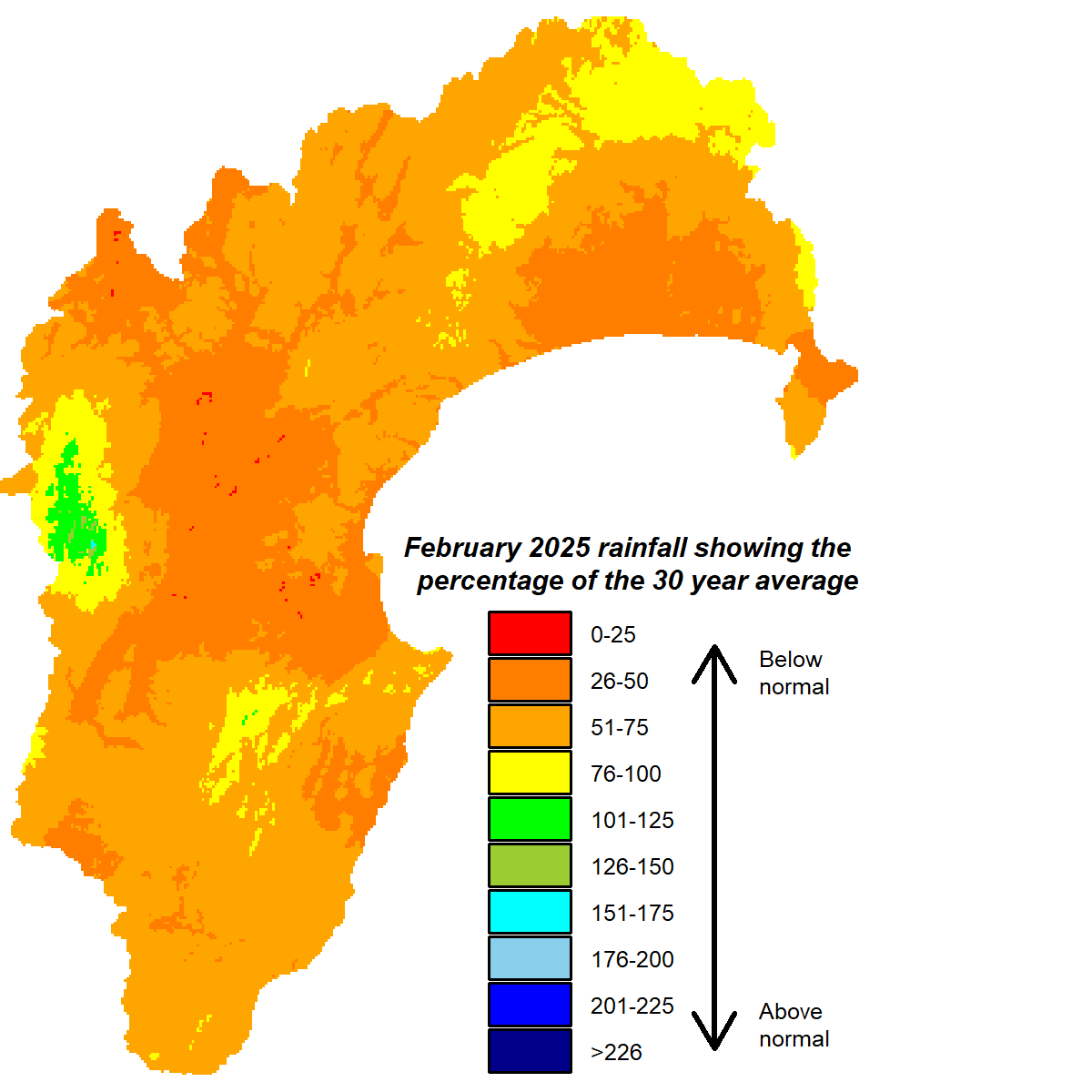
Fortunately February, being the last month of summer, actually felt like summer. Unlike January, which had an identity crisis and made like winter.  February was drier than average, with the region getting only 58% of average rainfall and the Heretaunga Plains a lowly 38%.  It rounded out a summer that ended up with near normal rainfall courtesy of a wet start, an average middle and a dry end. 

River flows in February were below average for the time of year, while groundwater levels were near normal.  Soil moisture held up well in northern parts of the region and Central Hawke’s Bay but on the Heretaunga Plains were below median levels for the end of summer.  February’s daytime temperatures were near normal and pleasantly summery.  Overnight temperatures were 1°C above average.

ENSO-neutral conditions are expected to dominate through this year.  There are currently equal odds of neutral or La Niña conditions for next summer but it’s still a long way out.  Sea surface temperatures have been higher than average around the South Island and west coast of the North Island but closer to normal off the North Island’s east coast.

Over the three months ahead, the picture looks dominated by higher than normal pressure centred east of New Zealand, which gradually weakens and possibly shifts more to the south of the country with time.  Seasonal forecast models differ a bit though, which makes the outlook even more uncertain than usual.  Higher pressure in the east means we’ll still often see winds from an easterly direction, potentially bringing us moisture.  The strength of the highs, at least at first, could act as a barrier to lows hitting us significantly.  Near normal rainfall and near to above average temperatures over the period could be the result and near to above average temperatures.

All the best,

Kathleen

Progress towards improved access to new crop protection tools:

Insect pests and fungal and bacterial diseases love to feast on the fantastic produce that Hawke’s Bay grows – but we can’t share our fruits and vegetables with every organism. Crop protection products remain an integral part of good agricultural practice to ensure high quality, clean fruit. Over the past decade, the availability of new crop protection products has been hindered by slow approval process through government agencies responsible for approving new use claims and novel compounds. Although robust scrutiny is important, it has been taking more than five years for approvals to be granted – and that is after several years of field and lab testing for efficacy, safety, and residues.
In February the Ministry of Regulation released their report on agricultural and horticultural products regulatory review that aimed to improve the approval process for crop protection products in New Zealand by enhancing efficiency within the agencies and manage associated risks appropriately. The review found that the current system is effective at managing risks to human animal, and plant health, trade, biosecurity, and the environment. However, the current system does not allow for efficient and timely assessment of new products and results in excessive delays and uncertainty. These delays and uncertainty increases regulatory costs for new product approvals which are ultimately absorbed by growers. At the core, there is room for improvement through improved resourcing and strategic alignment between the two main agencies – Agricultural compounds and veterinary medicines (ACVM) and the environmental protection agencies.

Overall, the review’s recommendations aim to create a more efficient, transparent, and responsive regulatory system, which will ultimately support the growth and sustainability of New Zealand’s fruit-growing industry. Growers are expected to benefit in several ways.

1. Timely access to new products. Improvements to the efficiency of the approval process should result in faster access to new products. This can improve management of pests and diseases, leading to better quality and yield.
2. Enhanced global competitiveness. As an export nation, faster access to new products will help NZ fruit growers stay competitive on the world stage.
3. Improved Risk Management. Through better use of international data, risks associated with crop protection products will be efficiently managed without imposing excessive burdens on growers.
4. Strategic guidance and engagement. By establishing a sector leaders forum, engagement between regulatory agencies and stakeholders should be improved so that industry concerns are addressed strategically.

In summary, there are plans afoot to improve the efficiency of the regulatory system for new crop protection products and new use claims for existing products. Hopefully growers will see the benefit in the near future once the recommendations are adopted. If you want a long read, you can access the full 119 page report or the 16 page summary at www.regulation.govt.nz

Author: Dr. Sean Gresham, AgFirst Consultants Hawke’s Bay. Ph. 0274736015,
e. sean.gresham@agfirst.co.nz

Well, its been a great start to what sounds like a very high quality harvest, here’s hoping the marketers work their magic for everyone this year.   Please remind your workers to apply for the Hort NZ scholarship, which closes on 30th March.  This is worth $500 and is paid direct to the worker.  In 2024, we had 23 scholarship recipients in Hawkes Bay.

Also, the Young Fruit Grower of the Year competition is open – please encourage your younger workers to have a go . . .  we have had plenty of past entrants in class, and across the board it has been a positive experience for them, which is designed to support and develop future leaders, not pitch organisations against each other 😊Leave that for the tug o’ war!

Classes are back in May, if you have identified potential students to start Level 3 after harvest, that’s definitely an option, and we can come and meet face to face to answer and questions.  There are also options for Primary Industry Operation Skills, such safe tractor and chainsaw use.

Our Fruit Production Diploma course has started for 2025 and Post Harvest starts July. We are keen to take a dive at the great crop we have had this year and how we continue the success. We can enrol students at any point during the year, so please get in touch to develop those future foreman and managers at shartley@eit.ac.nz.

All the best

Claire, Steven and Chris

Hawke’s Bay Fruit Growers Association Update  

Explore, Grow & Thrive – Finding solutions, focus on the future 

As August draws to a close, can you believe how fast the year has flown by? We’re sprinting toward the finish line with a packed calendar! Our team at HBFA is gearing up for several key events, including our AGM on the 19th of September and, drumroll please, 125th anniversary celebration of our association on the 2nd of November. Who knew we’d age so gracefully?

Amidst all the party planning, our central focus remains on ensuring growers have the support they need and group representation (because, let’s face it, we can’t let the cake overshadow the cause). Outgoing HortNZ CEO Nadine Tunley recently highlighted the ongoing challenges facing our sector, emphasizing the importance of water, climate change adaptation, and food security and supply as top priorities. Nadine’s words struck a chord, especially as I’ve experienced first hand climate adaptation risk assessments and it’s made it crystal clear that water isn’t just for making a great cup of tea—it’s absolutely essential. That’s why we’re rolling up our sleeves and actively collaborating with our partners to address these challenges and work towards solutions that will keep our growers thriving, now and well into the future.

Grow – Supporting RSE Scheme  

The Government has recently announced an important update following the policy review of the Recognised Seasonal Employer (RSE) scheme conducted in 2023. As a result of this review, the RSE cap will be increased, along with initial improvements to the scheme. These changes are scheduled to take effect from 2 September 2024, with further adjustments planned later in the year. To help you navigate these updates and understand their implications, we’ve outlined the key changes and actions required from RSE employers: 

The RSE cap will be raised to 20,750 workers for the 2024/2025 season, representing an increase of 1,250 additional workers. This adjustment reflects the Government’s recognition of the growing demand for seasonal workers in our industry and its commitment to supporting employers in meeting their labour needs. 

No Immediate Action Required: Employers are not required to take any immediate steps in response to the cap increase. The changes will be automatically applied. Engagement from RSE Partners: RSE Engagement Partners will proactively reach out to those employers who indicated a need for additional workers in the May 2024 RSE employer allocation survey. This contact will ensure that your specific needs are addressed under the new cap. These changes mark the beginning of a series of improvements aimed at enhancing the RSE scheme. The Government will continue its work later in 2024, focusing on further refining the scheme to better serve both employers and workers. We encourage you to stay informed and connected with your RSE Engagement Partners as these developments unfold. Should you have any questions or require further clarification, please do not hesitate to reach out. 

Thrive – Water allocation concerns in Hawke’s Bay 

Great news – HBRC are no longer wanting further information justifying proposed allocations to be provided by 1st September 2024. They have extended the timeframe until 30 December 2024 (you should have received an email from waterpermits@hbrc.govt.nz late last week telling you this).  This extension will allow more mediation to occur, and it is likely to continue for the rest of this year.  

Two final things to confirm: 

HortNZ will organise a grower meeting in October to provide more information about global/collective water consents like Twyford. Managing water collectively, rather than through individual consents, provides greater flexibility and the opportunity to shift water around, making sure people have the water they need when then need it, but they are a bit different. The purpose of the meeting will be to learn from those involved with the Twyford consent how it operates, and what joining these schemes means for individual growers, so that you can start to think about whether or not it might be an option for you.  We will be in touch with further details closer to the time. 

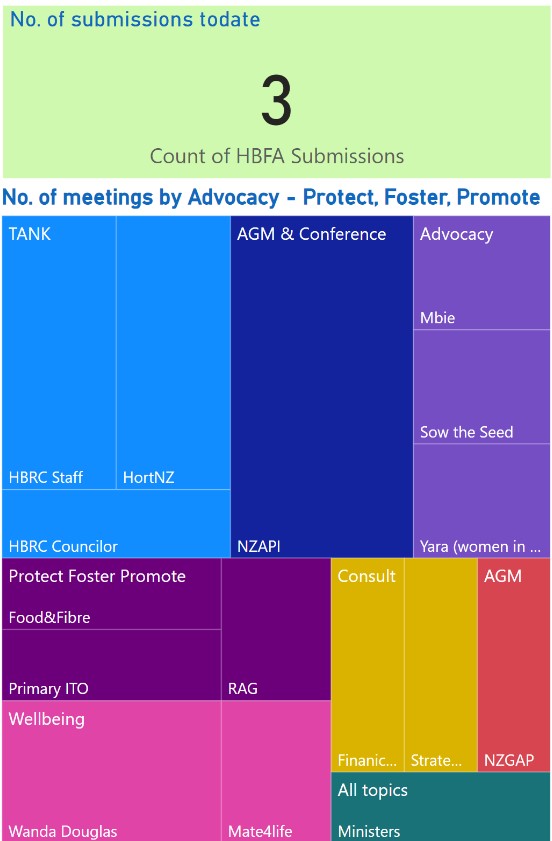
HBFA Protect Foster and Promote dashboard below: 
Key events for the remaining of the year: 

Month  Date  Event  Location   
September  14th  HAG Grower dinner  Old Church    
  19th  HBFA AGM   Toitoi 
  28th  HAG Wellbeing event  McLean Park 
October  18th  Hackathon Grower Ellwood Function Centre rsvp here 
November  2nd  HBFA 125 Years  Pask Winery  
  11th   Fishing event  HB Sport Fishing club (Ahuriri)  


HAG – Post Cyclone Gabrielle Recovery Fund! 

The HAG (Horticulture Advisory Group) is seeking applications from Hawkes Bay growers effected by Cyclone Gabrielle for a new recovery fund!  

We are aware that post Cyclone Gabrielle has impacted people in different ways and to assist us in refining how we deliver this fund, we would like to better understand your individual circumstances, specifically the needs where expert advice has been required to re-build reliance infrastructure, land use and plant variety. If you would like to apply we require you to answer the below questions. 

The applications and insights provided will also assist us in understanding the Post Cyclone impact on growers. We will individually assess each applicant that meet the criteria. All individual responses will remain confidential to the core HAG group and will not be shared to outside parties.  

If you have any questions in relation to this fund apply here, or would like to access support, please contact us on manager@hbfa.co.nz 

Mental Health and Resilience:  

We are thrilled to announce an event series sponsored by HAG, in partnership with our Core partners, featuring the renowned speaker Elen Nathan. Elen Nathan is a Sensory Integration Occupational Therapist, founder, and director of The Playful Place – a neuro-diverse affirming paediatric practice in Aotearoa New Zealand. Elen is a passionate therapist whose practice centers around building and protecting young persons’ self-esteem and the whole family’s well-being. We have a limited number of tickets available for our Grower family. Please see the event details below: 

Event: Connecting with Kids Through LEGO 

Date: September 19th 

Time: 6:30 PM – 9:00 PM 

Venue: Taradale Town Hall 

Building emotional resilience, self-esteem, social skills, and strong family relationships has become harder in this busy, fast-paced world. Anxiety, big feelings, and technology-fueled stressors are impacting our kids’ development and resilience. Join Elen Nathan, Pediatric Occupational Therapist, to learn what the latest neuroscience tells us about emotional regulation development, and ways to use your child’s love of LEGO to support the development of these skills at home. This hands-on workshop includes building with LEGO throughout the evening as we learn and build together – no building skills required! Each ticket holder will receive a complimentary LEGO set. Please note that ticket numbers for this event are extremely limited. For further information on these events, please visit www.healhb.co.nz. 

To reserve your ticket for one of these events, please fill out the form below. We will get in touch with you shortly to confirm your attendance.https://forms.gle/x8g7Q46AUWBcS1KF9 

Yara New Zealand is pleased to announce that the Yara NZ Women in Horticulture Scholarship is open for 2024.

The Scholarship aims to recognise leadership qualities in a woman working in the horticulture industry.

The primary purpose of the scholarship is to provide recognition and financial assistance to an outstanding female within the horticulture sector. It also achieves the secondary purpose of highlighting careers for women across the industry.

The winner will be announced at the ‘Yara Women in Hort’ lunch at the Hawke’s Bay A&P Show on Thursday 24th October.

Prizes

•   The Yara Women in Horticulture Scholarship recipient will receive a grant of $2,000 (incl. GST) which will be paid towards your selected course fees.

•   Second prize is $500 (incl GST) which will be paid towards your selected course fees.

Below is the link for the entries on the website:

https://www.hbap.co.nz/hawkes-bay-a-and-p-show/competition-entries/Yara-Women-In-Hort-Scholarship-1 .

Entries close on 27th September.

Please feel free to share this with your network, staff, clients.

The successful applicant may be someone working in the service industry e.g. as a field advisor. In other words, it is not restricted to someone working directly on farm in an Orchard, Vineyard, Market Garden, etc situation.

Please feel free to reach out to me for more information if required.

Regards

Glen Baylis

Country Manager

Mobile phone: +64 21 555 214

Email: glen.baylis@yara.com


Reach out for support: 

If you or someone you know is struggling, don’t hesitate to reach out. Contact me, Callum Ross, at HBFA, or directly connect with Wanda Douglas at 021 1700 506 or wandspsychology@gmail.com. Remember, seeking help is a sign of strength, and we’re here to support each other. 

Warm regards, 

Callum Ross 

Chief Executive Officer & Chairman HAG (Horticulture Advisory Group)