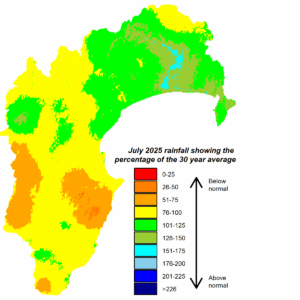
Some areas of Hawke’s Bay have now had three consecutive months (May, June and July) of below normal rainfall.  They are the Ruahine Range, the Heretaunga Plains and southern Hawke’s Bay.  It’s not a great situation heading into spring.  July’s rainfall found its way to northern Hawke’s Bay okay, the area receiving 138% of it’s July average.  So it’s a mixed picture across the region. July’s river flows were within the normal range for the month but again that was top heavy with northern areas near or above average and southern areas below average.  Groundwater levels are below average for the time of year.  Soil moisture is below median levels for the time of year on the Heretaunga Plains and far south of the region but near or above average in northern parts. The odds of a brief La Niña in spring or summer is edging slightly high than those of neutral conditions but it is still uncertain.  A negative Indian Ocean Dipole seems likely for spring though, which is another circulation pattern that raises the chances of wet rather than dry weather.  Seas are also warmer than average all around New Zealand which supports more rainfall if rain-bearing weather systems come our way.  Add to this a pressure pattern that favours more onshore easterly winds, whereby lower than average pressure extends towards northern New Zealand from across the Coral Sea and higher than normal pressure lies to the south of us.  It spells near or above rainfall for the region during spring while temperatures should be near or above average.

Kind regards,

Kathleen

Kia ora koutou,

We recently hosted a local advisory meeting here at EIT, where industry leaders had an opportunity to hear directly from the EIT executive team.  We had 16 attendees representing 12 different businesses, as well as industry bodies. We asked for  expressions of interest in supporting our program development, and have been gratified to have several offers of direct support.  Our qualifications exist to support the Industry, and we are very keen to ensure we engage pro-actively with you.

Our post-harvest diploma students are close to completing the safe horticulture business course and will be starting fruit physiology and storage this month, sharing the class with the fruit production diploma students, which is enabling great dialogue and cross pollination of ideas.

Our Level 4s have started the Growing Environment looking at extreme weather events, whilst the Level 3s have just completed the propagation workshops and are starting on Crop Health.

We also have hearty cohorts completing the Certificate in Primary Industry program, and another orchard group upskilling on Excel.

Wishing you a great start to the season from the EIT team.

Sarah McArley

No matter the variety or growing system, the profitability success of a block over its lifetime is driven by the cumulative yield achieved. Early yield is therefore critical to ensure the cumulative yield trajectory enables a good internal rate of return and a profitable outcome for the grower.

Cumulative yield driven by early yield accumulation is an important factor to keep in mind when setting this season’s canopy growth and fruit targets for young blocks on your orchard. However, growers also need to make sure that the chosen crop load isn’t too much of a draw on the carbohydrate resource therefore inhibiting canopy growth.

There are a number of ways to set the crop load target on a young tree, to ensure this balance. Measuring the Trunk cross sectional area (TCA) gives an indication of how many fruit the tree can sustain. Using a 4 fruit per TCA or 5 fruit per TCA target alongside the consideration of the percentage of current canopy fill will help to determine a suitable cropload which won’t hinder the growth and development of the young canopy. In addition, a focus on getting the cropload down to target early alongside maintaining enough vigour in the system and the execution of well timed tree training will help to drive growth and fill the tree’s space.

Therefore, be sure to keep the balance of productivity and canopy in line as you finish pruning your young blocks this winter and begin to set your croploads for spring. Early yield pays dividends over the lifetime of the block, but you must also have the canopy to hold that crop in the first place!

Hawke’s Bay Fruit Growers Association Update  

Explore, Grow & Thrive – Welcome to July 

As July brings its cold snap, we’re reminded once again of the ever-changing climate and the challenges it presents to our industry. Our thoughts are firmly with our Tasman growers and their communities, who have endured not just one, but two weather events in quick succession, and we stand alongside them during this difficult time.  

Closer to home, HBFA is looking ahead to some key events that bring our grower community together. We’re excited to confirm dates for a few favorites including, one of our most anticipated events is back! HBFA Golf Day Friday, 19th of September. This year’s event will include a special focus on mentoring and connection, supporting the next generation of industry leaders in a relaxed, social setting. As well as HBFA Fishing Competition Tuesday the 4th of November. Stay tuned for more details, registrations will open soon. These events are more than just a day out, they’re about strengthening our industry ties, supporting wellbeing, and creating space for growers to connect beyond the orchard. We look forward to seeing you there! 

Advocating for Growers: Water policy & compliance 

HBFA remains active at the policy table, particularly in the complex space of water regulation and compliance. Over the past month, we’ve contributed to critical discussions, supporting industry-wide positions to protect growers’ rights to manage their own water supplies in ways that are practical, affordable, and orchard-fit. 

Our message to decision-makers is clear: regulations must be risk-based, proportionate, and realistic. We are committed to ensuring any new policies work with growers not against them. HBFA will continue to represent your voice and work toward fair and sustainable outcomes for our sector. 

Wellbeing support: Continuing care for our Growers

We’re pleased to share that HBFA has extended our partnership with Wanda Douglas, continuing her wellbeing support services for another year. Wanda is here for our grower community who needs a confidential ear or guidance, whether it’s personal or work-related stress. Please don’t hesitate to reach out. Her support is available, free of charge, please see below contact details if you need help.  

Consultation Reminder 

Reminder that consultation on the proposed changes in national direction remains open until midnight on Sunday 27 July 2025.  Growers are encouraged share their thoughts on the proposals – either by providing comments to HortNZ or the district associations for inclusion in their submissions, or making their own submissions. Further information is available here: Package 2: Primary sector – Discussion document | Ministry for the EnvironmentPackage 3: Freshwater – Discussion document | Ministry for the Environment 

What can you do? 

The best thing you can do is join HSW. You can do this by scanning the following QR Code or via the following link:  Click here → 


Advocacy updates:    

Upcoming event: Staff Management Seminar – 23 July 

FMG is hosting a Staff Management Seminar to help employers better understand and manage employee-related risks in horticulture and agriculture. 

Event Details:
📅 Wednesday, 23 July 2025
🕚 11:00 AM
📍 Foodeast Haumako, 4 Hanuī Road, Hastings 

Topics include: 

  • Loss prevention and claims trends – FMG 
  • Fundamentals of staff management – No8 HR 
  • Employment disputes and legal compliance – Kirsty Wallace (Employment Lawyer) 

Enjoy a morning tea on arrival, followed by lunch after the session. 

Spaces are limited, so please RSVP to advice.services@fmg.co.nz or use the registration link provided. This is a great opportunity to build your knowledge in staff care, documentation, dispute resolution, and workplace compliance. 


Thinking about entering the East Coast Ballance Farm Environment Awards? Or just keen to learn more? 

We’d love to invite you to one of our upcoming networking functions. These relaxed events are a chance to: 

  • Hear directly from past entrants and Regional Supreme Winners 
  • Learn how the programme works (and what it’s really like to take part) 
  • Connect with sponsors, committee members, and other local farmers and growers 
  • Ask questions, connect with others, and find out how we can support your entry journey 

This programme is about the journey – not just the outcome. It’s an opportunity to reflect on your farming or growing story, celebrate what you’re already doing, and be part of a community that values progress and good practice. This year we’ve also introduced a new initiative – some of our past Regional Supreme Winners have volunteered to act as informal mentors, offering first-hand advice to anyone interested in entering. 

Event Details 

Hawke’s Bay Function 
  • WaterForce Hawke’s Bay – 2068 Pakowhai Road, Napier 
  • Wednesday 24 July 
  • Doors open at 5:00pm for a 5:30pm start 
  • Light refreshments provided 

RSVP by Monday 22 July 

Gisborne Function 
  • Venue TBC (Gisborne) 
  • Wednesday 13 August 
  • Doors open at 1:00pm for a 1:30pm start 
  • Light refreshments provided 

RSVP by Monday 12 August Please RSVP for catering purposes: https://forms.office.com/r/HqBR4QZr7Z 

All are welcome – whether you’ve entered before, supported someone who has, or are curious to see what it’s all about! If you have any questions, feel free to get in touch. 


Brunch On Us – Connecting Our Grower Community 

Take a break from the orchard and join us for a casual morning catch-up over coffee and a bacon buttie. The Brunch On Us series is running across the Heretaunga Plains this month, providing a relaxed space to connect with other growers, share stories, and support one another. 

Upcoming Dates & Locations: 

  • Twyford – Wed 23rd July
    Twyford Hall, Thompson Road 
  • Omahu – Tues 29th July
    Shamrock Park, Omarunui Settlement Road 
  • Bridge Pa – Wed 30th July
    Ash Ridge Wines, 2543 State Highway 50 

Time: 10:00am – 12:00pm 

These events are for owners and managers—no need to register, just turn up.
Questions? Contact: hbadmin@ruralsupport.org.nz 

Reach out for support:  

If you or someone you know is struggling, don’t hesitate to reach out and connect with Wanda Douglas at 021 1700 506 or wandspsychology@gmail.com. Remember, seeking help is a sign of strength, and we’re here to support each other.  

Warm regards,  

Callum Ross  

Chief Executive Officer HBFA 


Presidents Report

Our thoughts are with the Nelson growers who have experience 2 x heavy rainfall events in as many weeks, causing major flooding, silt deposits and structural damage over a number of orchard businesses. Growers here in HB who have gone through the floods themselves in cyclone Gabrielle will know firsthand what the growers will be facing. I have reached out to the President of the Motueka Fruit Growers Association Oliver Rowling and other business owners to check in on how things are going and the moral of the affected growers. By all accounts they are getting on and sorting the damage out. We have offered to connect them to experienced machine operators who helped with the floods here if needed. Government and Horticulture NZ have combined to offer financial assistance as has the NZ Fruit Growers Charitable Trust. If anyone would like to offer any type of assistance, please get in touch with me.

Last week I travelled to Gisborne to attend their Young Grower event. It is awesome to see how much attraction this event draws up in Tairawhiti considering they have only been part of the young growers for a short time. They had 9 young growers competing (one had to pull out due to sickness). HBFA Congratulates Rhiannon Morrell from Craigmore Sustainables who took out the Tairāwhiti YGOTY award. Rhiannon will join six other regional finalists (including our very own Sam Carter) in Christchurch on the 10th 11th September as they compete to win the Young Grower of the Year National title for 2025.

HortNZ is welcoming three new directors to its Board following this year’s election. The competition was extremely tough with 9 nominees for 3 director positions. The 3 new directors representing the interests of all horticulture are:
Simon Cook who grows kiwifruit and avocados in Te Puke. Dermott Malley has extensive experience in the commercial and horticultural sectors. He grows kiwifruit, kiwi berries, and hydroponic berry fruit. Shaun Vickers, a past winner of the national Young Grower of the Year competition, is currently general manager for clients’ orchards and business development at Apata Group. He also has a shareholding in a 14-hectare Kiwifruit orchard near Edgecumbe.

Horticulture NZ has their conference along with the RSE conference on August 27th-28th. I encourage you to attend. They also have their AGM on Tuesday 26th August at 4pm – Tākina, Wellington Convention and Exhibition Centre, 50 Cable Street, Wellington. Be good to see as many growers as possible from HB attend.

AGM information can be viewed on the HortNZ website here.

Click here to find out more about this year’s conferences, to register and to keep up to date with programmes and speakers.

HBFA has pencilled in September Thursday 25th September for our AGM – mark it in your calendars.

Enjoy the rest of winter – spraying time is in about 3/4 weeks’ time for most apple growers. Keep an eye out on our events calendar – we have a golf day planned for the 19th of September which follows up from last year’s inaugural event. A great way to come together and network. We have introduced different aspects to the day so keep an eye out for that.

Finally, will be great to see HB growers next week down in Nelson at the NZAPI conference. Their AGM is on Wednesday 30th July from 3:30pm with conference day and the awards dinner on the 31st July. I am always available to growers if they have any concerns or just want to chat.

Kia Kaha

Brydon Nisbet

President HBFA

June was the second consecutive month we’ve had below normal rainfall and roughly 70% of the month’s average.  June’s rainfall wasn’t evenly distributed though and both the Heretaunga and Ruataniwha Plains had only about 40% of their average for the month.  River flows were lower than normal as a result and groundwater levels in June were near or below normal.  

Soil moisture tracked near or above median levels for the time of year across most of the region, apart from sites on the Heretaunga and Ruataniwha Plains and Porangahau, where levels remained stubbornly below normal.  Air temperatures were above average, especially during the day, when they were a balmy 1°C warmer for June.  Sea surface temperatures have been likewise above average around the coast of the North Island and extending up past Australia to Indonesia.

The El Niño-Southern Oscillation is wallowing in neutral mode. Neutral mode is a likely contender to win for the rest of the year, La Niña being the main other contender.  Seasonal forecast models aren’t entirely in agreement on the outlook for the next three months, but their general picture of sea level pressure has lower than normal pressure extending across from Australia over northern New Zealand, while higher than normal pressure is likely to the south and southeast of the country.

It leaves an easterly component featuring yet again in our winds and increases the chance moisture will come onshore as winds cross the warmer than average seas.  On that basis, near or above average rainfall over the period is a reasonable bet, along with near or above average temperatures.

Kind regards,

Kathleen

Kia ora koutou,

This is our busiest time here at EIT, with many students half way through programs and new cohorts starting as well.  As students complete courses, our piles of marking grow as we try and get quality feedback on their progress to them.

Warren Hales has been flat out delivering the Certificate in Primary Industry skills – it looks as though we will have over 50 students complete this entry level program, which is a mammoth logistical exercise.  Some of the early completers of that qualification are starting into Level 3 Fruit Production this month and will work in with existing Level 3 students that started in January to complete block development and maintenance.  They will be requiring practical skills of tree planting and maintaining irrigation.

Our level 4 cohort have completed three of the six courses, being complying with market needs, pruning and crop protection. For the pruning course Steven coordinated a fun packed learning adventure with good discussion and a few field trips thrown in to the mix. We would like to thank T&G Twyford for showing us the range of training systems and Ngai Tukairangi Trust for a Kiwifruit update and a very cool pruning demonstration.

We were able to venture into the new EIT Training Orchard and really see the systems take shape and discuss how we should engage a team to work well with a mind to consistent quality of work.

The Post Harvest Diploma will start mid-July. We are still taking enrolments to add to our good numbers and cant wait to get started.

All the best

Claire, Steven and Chris

Winter chill – that is pretty cool!

Meg Becker

AgFirst Consultants

Winter chill sets the precedence for the season ahead, contributing to budbreak timing, floral capacity of the tree, flowering length and strength, and quality/quantity of potential yield outcomes.

The Metwatch chill unit calculators on the NZAPI website are the Richardson Chill units, Hours below base temperature and Chill Hours (sum).  All three measure chill units slightly differently resulting in different seasonal trends. For instance, at the start of July 2025, the hourly chill model is showing 2025 chill as only slightly behind the exceptional 2024 season, as the Richardson chill is showing the 2025 season to be ‘average’ when compared to previous chill accumulation.

Chill units are the number of hours the plant experiences below the base temperature but above freezing.  The Richardson chill model provides good insight into chill accumulation in temperate climates.   It accounts for the high temperatures which result in negative chilling and excludes below freezing temperatures (which do not contribute to chill accumulation).

Lawn rd (1st May to 31st August) Richardson chill Allow negative chilling Exclude negative chilling
2022 998 1238
2023 1133.5 1367
2024 1298.5 1442.5


It’s important to understand what parameters are selected when reviewing the models. As in the table above, ‘allowing for negative chill’ makes a big difference to the accumulation of chill units – which can have a significant bearing in determining the timing of your dormancy breaker applications.

For all models, consideration needs to be had regarding  when chill units actually start accumulating.  Physiologically, accumulation begins when the trees go into the Endodormancy period,  triggered by  colder temperatures and short photoperiods.  This can be before leaf fall begins and is simply the point at which the tree is unable to resume growth until winter chill requirements have been met, even if favourable conditions occur.

For comparing regional averages, 1st May is a good general standpoint, and although areas and some varieties vary this provides a point in the sand comparison between seasons.

To accurately determine block/variety specific winter chill, growers must pay close attention to the tree’s physical characteristics over autumn.  At what point did senescence begin, as this is a sign the plant is responding to temperature and day length.

Regardless of the model used, consider  each season relative to previous seasons,  how you have historically managed your blocks and what the outcomes were with relation to critical timings on your orchard.

NZAPI Newsletter – June

Tickets are selling fast to the NZAPI annual conference, EXPO 2025.

Designed with enhanced networking opportunities and more trade stands than ever before, EXPO 2025 provides ample opportunity for growers and industry members to form meaningful and invaluable connections.

Throughout the day, attendees can also attend six specialist breakout sessions, which will deliver in-depth discussions and analysis on market access, economic geo-political landscapes, post-harvest technology and sustainability.

Reaching $1 billion in orchard gate revenue for the first time at the end of 2024 was a major milestone for our sector, however we are now looking to a sustainable future, which is where our six breakout sessions come in.

Each session has been selected with an eye to the future but feet firmly on the ground.

Session topics include:

  • Water: Essential for growth, with Waimea Group.
  • Market Panel: Understanding the value of international delegations, with Mike Petersen, Scales, Mark Piper, PFR, and Shane Kingston.
  • Navigating trade barriers, with Hon. Tim Groser, former Minister for Trade
  • The release of a new Market Insights report from KPMG
  • Can electric sustainability deliver productivity gains, with Mike Casey
  • Post-harvest technology meeting future needs of Market Access with Craig Petersen

What’s more a variety of optional tours have been planned for delegates so they can make the most of the fantastic opportunity to discover more of the Tasman region.

You can learn more or register at https://info.applesandpears.nz/news-events/nzapi-expo-2025/

Hawke’s Bay Fruit Growers Association update
Explore, Grow & Thrive – Welcome to June!

As we close out June and reflect on the first half of the year, one thing is clear, our resilience and the unwavering drive of our growers continue to provide confidence in the future of our industry. 

A true highlight this month was the 2025 Young Fruit Grower of the Year competition, held on 5–6 June. This year’s event was an outstanding success, showcasing the technical skill, leadership potential, and determination of eight exceptional contestants. A huge congratulations to Sam Carter, our 2025 winner. Your performance was both inspiring and impressive, setting a high bar for the national finals ahead. We also can’t forget the Awards Dinner, full of laughter and energy thanks to the brilliant MC Jeremy Corbett, whose humour and showmanship helped make it a night to remember. 

A special thank you to our sponsors and particularly Mates4Life, who were present throughout the event, providing wellbeing support and promoting mental health awareness. Their involvement was a powerful reminder that mental wellbeing is essential, not only for individual health but for the long-term sustainability and performance of our industry. 

Behind the scenes, HBFA has been working hard on behalf of our members, actively participating in key water policy meetings and submissions. Most recently, we supported HortNZ’s position on drinking water compliance, opposing the mandatory implementation of the “Acceptable Solution” for mixed rural water supplies. We believe growers and rural families should retain autonomy over their water sources and have the flexibility to adopt fit-for-purpose solutions. Regulatory focus should remain on larger, shared systems, not small-scale domestic or staff supplies. 

We continue to advocate for out growers that reflects the unique realities of growing fruit in Hawkes Bay. Your voices are being heard, and HBFA will remain firmly engaged in shaping fair and practical outcomes for our growers. 

Heretaunga Sustainable Water Group launches draft 100-Year water management strategy   

Following on from the packed event last month, the June AGM had no less attendees. The Heretaunga Sustainable Water Group (HSW) has accelerated work on its 100-year sustainable water strategy. The group has been engaging with iwi, local councils, and industry to develop a collaborative plan that includes options such as aquifer recharge, new storage solutions, water recycling, and better allocation mechanisms. A membership drive is ongoing, aiming to represent all commercial water users across Heretaunga and the Ngaruroro zones. “If we want to avoid regulatory gridlock, we must speak with one voice and show we are proactively investing in solutions,” said spokesperson Greg Taylor.” 

The group is now formally incorporated and playing a lead role in governance discussions for storage project, projected to support up to 27 million cubic metres of water capacity. 

Reminder -Why is it necessary to form a representative group (HSW)? 

To be successful in governing our future, it is important that water users can speak as one group, providing effective and efficient pathways directly to major decision makers in water allocation – especially HBRC and if necessary, central government. This is a huge challenge to tackle alone and a united group carries more weight. What will HSW do? 

  • Be the spokesperson for water users and lobby on their behalf 
  • Undertake and implement the strategic planning necessary to develop a fair allocation model. (The “founders” of HSW have already committed $50,000 to a strategic plan, compiled by AgFirst) 
  • Represent users in exploration of water security initiatives including water storage, aquifer recharge, recycling, efficiency and other demand/supply levers 
  • Raise funds and engage personnel (executive officer) to implement the strategy 
  • Be the administrative centre of HSW’s activities including management of the group database and communication with water users 

What can you do? 

The best thing you can do is join HSW. You can do this by scanning the following QR Code or via the following link:  Click here → 

As we turn our focus to the months ahead, 2025 presents significant opportunities, from the potential for regulatory reforms to improved access to water. HBFA will continue to advocate for our growers, facilitate meaningful industry discussions, and provide the support needed to help you succeed. Please see below what’s happening in the region: 

Advocacy updates:   

RMA update 

A quick update about a few things RMA related that are happening at both the national, and local level 

  • Consultation is open on proposed changes to a number of bits of resource management legislation    
  • Central government is looking at making changes to national direction for infrastructure and development, the primary sector and freshwater. There is a lot packed into the proposed reforms that will potentially have quite an impact on the hort sector, including the proposed removal of Class 3 land from the protection of the National Policy Statement for Highly Productive Land; and proposed new policy that would specifically enable commercial vegetable growing. 
  • Submissions close on 27 July 2025. HortNZ is preparing submissions (opportunities to get involved with this are communicated through the HortNZ weekly newsletter), but anyone else (either individuals or organisations) is encouraged to make a submission – it’s really important that central government understand which parts of the proposed changes do, or don’t, work for the horticulture sector 
  • Napier Proposed Distirct Plan Hearings 
  • HortNZ appeared at the latest round of hearings for the Proposed Napier District Plan. The focus of HortNZ’s submissions were the policy provisions related to the rural lifestyle and rural production zones. 
  • There is one more day of hearings in late July, before the hearing process will be finished. A decision date for the proposed district plan is not known, but unlikely to be before late 2025. 
  • Heretaunga Sustainable Water Group Special General Meeting 
  • A Special General Meeting was held in Havelock North last Wednesday (18 June)  which provided updates on the awesome work the group is doing 
  • Anyone with an interest in water on the Heretaunga Plains, but particularly irrigators, are encouraged to join the group, and new members are definitely welcome. Visit the website to join: https://hsw.org.nz/ 

As always, please don’t hesitate to reach out if you have any questions about anything RMA related – you can reach me via phone 027 3225595 or email Charlotte.Drury@hortnz.co.nz 

Reach out for support:  

If you or someone you know is struggling, don’t hesitate to reach out and connect with Wanda Douglas at 021 1700 506 or wandspsychology@gmail.com. Remember, seeking help is a sign of strength, and we’re here to support each other.  

Warm regards,  

Callum Ross 

Chief Executive Officer HBFA