Tree Row Volume (TRV) – Optimising spray application

And just like that Spring is here.  Buds are breaking, covers are going on and flowering is just a short month away when chemical thinning decisions will need to be made.  Optimising spray application that ensures adequate coverage at the correct dose to get the right result is crucial to produce high volumes of export quality apples & pears.

A useful measure to help optimise the spray program is the Tree Row Volume (TRV).   TRV measures the theoretical volume occupied by a tree’s canopy and the space between the trees in a row.  It is calculated using the formula: TRV = Tree Height (m) x Tree Width (m) x Between-row Distance (m).

TRV is to serve as a guide, so you are not applying more chemical than is needed to achieve acceptable pest control.  TRV is especially important on higher tree density production systems. Without this measure of canopy volume, it is far too easy to over spray and overdose the trees.

TRV helps to optimise spray applications and chemical dosage, improve spray efficiency, whilst controlling costs, and mitigating the impact on the environment.

Remember, however that the TRV is used to calculate the theoretical application rates and that the most accurate TRV measurement will not compensate for poor sprayer set-up, un-calibrated units, poor coverage, timing, choice of chemical, weather etc…

TRV measurements do provide objective insights of your canopy which can only lead to better management decisions and productivity outcomes.

Dean Rainham

Horticultural Consultant


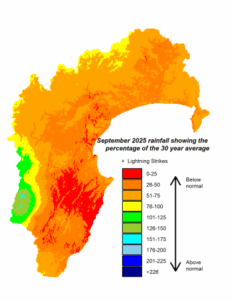
September turned out to be another dry month, with the region receiving only around 60% of its normal rainfall.
Rainfall was well below normal across most areas, with the Heretaunga Plains and Southern Hawke’s Bay receiving only
35% and 38% of average rainfall, while the Ruahine Range was the only area to record above average numbers at 130%
of normal September rainfall. The regional hydrology also mirrored these rainfall patterns, with river flows across most
catchments dropping to less than half of their typical September levels. Groundwater conditions, which had shown
slight recovery in August, deteriorated again this month, particularly across the Heretaunga Plains, with some sites in
both the Heretaunga and Ruataniwha Plains recording lowest ever levels for the time of the year. Soil moisture levels
also echoed the dry conditions, sitting near or below average across the region.
On a positive note, air quality remained good, with no exceedances of PM10 standards recorded in any of the airsheds
this month. Temperatures brought a more spring like feel, with warmer than average days and slightly above average
nights for most of the region- hinting at warmer times ahead!

As was the situation last season, there was plenty of winter chilling, although with a later start to accumulation than in 2024. The timing of bud break and bloom have been normal, there has been fruit set on all of the five fruit types, although there is a question around some plums. So, enough chilling, soil moisture levels were OK at this time, the bees flew when needed, and there have been few rainfall events to cause disease issues.

The earliest cherry variety was picked during the first week of November, with other varieties being harvested as the month progresses. The eating quality of the later picked varieties will improve as the month goes on, and for the first time ever the industry is thinking of exporting cherries from Hawkes Bay. I’ll be watching this space with interest with respect to quality and how well it dovetails into the export fruit from Central Otago. There are plenty of export registered packing sheds that might benefit from some work pre-Christmas.

Nectarine harvest started in the second week of November and by the end of the month all fruit types will be available in good volumes.

To quote Bruce McKay again, our best years are drought years, as long as there is water for irrigation. My son-in-law on a local dairy farm says that this calendar year has seen the lowest rainfall total since he has been keeping records with a significant number of February like highs, and three weeks of wind, soil moisture levels need a top up. We will be watching to see if the predicted La Nina conditions appear and when, and then what the impacts might be. For stonefruit growers, lower sunshine levels will be one of the key indicators influencing fruit quality, again assuming water can be applied.

The lower intake of Golden Queen and Tatura Star canning peaches by Heinz-Wattie may cause some winkles in the market in February this season and possibly next season as well. The mitigations that Watties have been put in place for contract growers of these peaches would seem to be a good market facing initiative. From here supply and demand will sort out how many of these trees survive in the ground.

In recent weeks Summerfruit NZ has successfully run a levy renewal process that was supported by a good majority of growers and gone through a reasonably non-contentious AGM. So all-in-all stonefruit is lining up, at his stage, for a good season. The icing on the cake might be an economy that is feeling more buoyant than it is at the moment.


Presidents Report

It’s been a while since we last sent out our newsletter – August was our last one so a lot has happened in the Association since then.                                          So far, we have had an outstanding spring with the likelihood of another early harvest season. I’m sure everyone will be getting over the winds we have been having recently and what we really need is some rain – (I wouldn’t have been saying that 3 or 4 years ago but that’s growing – it’s either to dry or to wet. Stone fruit thinning is underway and apples wont be far behind.

We held our AGM back in September at our new premises Food East situated down Elwood Rd. Thank you to all those who came along.   Here is a brief from the night.

  • HBFA acknowledged the passing of John Scott, Ross Duncan & John Moffit
  • HBFA’s New constitution was presented and passed with a majority. If anyone would like a copy of the new constitution, please reach out to us and we will make sure you receive a copy.
  • There were also two new executive nominations: Jayne Shearer and Greg Evans, both growers in their own right – they were automatically elected to the executive as there were no other nominees requiring us to have a vote. Since then, the executive’s have also nominated Hannah Grieves (Fruit Fed Supplies) as an independent executive for one year. We welcome them to the team here at HBFA.
  • Tom Dams has been re-elected as vice president for another 2 years.
  • The role of CE has recently been disestablished. We thank Callum for his contribution over the last 18 months.
  • We also gave a special recognition to Richard Pentreath who has decided to finish his tenure with HBFA. Richard has been with us for around 10 years, during this time he has served as both vice president and president. Richard will carry on supporting us in various roles such as chairing the HAG (Horticulture Advisory Group) and representing us at on-going water meetings. He will also continue as a trustee of the HBFACT.

On September the 19th we held our second HBFA golf tournament. This is a great way for growers and suppliers to re-connect outside the orchard gate. We will be building on this event next year with the date being bought forward to sometime in May. So, keep an eye out for the date

Next Tuesday on the 4th of November – (weather permitting) we will be holding our annual fishing competition. Another great day on HBFA’s event Calander.

We will soon be asking for nominations for HBFA’s Emerging Achiever award. I encourage all our growers to look out when its advertised and consider who in your organisation may fit the awards criteria.

Please see article from HORTNZ re the current RSE court case decision that will likely have some effect on RSE employers going forward. Let us know if we can help in anyway.

I attended the National Young Grower down in Christchurch back in September. All contestants performed extremely well, and it was great to cheer Sam Carter on from HB. The eventual winner was Phoebe Scherer representing the Bay of Plenty.

Brydon Nisbet

President

Don’t delay, get replacement consent applications lodged by 30 November (this year)!

If you have a regional council resource consent that expires next year (on 31 May 2026) you need to apply to replace it by the end of this November (ie. 30 November 2025) to ensure that you can continue to keep doing the activity it authorises (like irrigating) while the regional council process your application. You should have received a letter from the regional council letting you know that you need to do this, but if you are unsure please get in touch, as we can easily check consent expiry dates for you.


Water permits in Haumoana/Tukituki Road area

A number of growers who have recently expired water permits in the Black Bridge/Haumoana area have received first a s92 letter, and then more recently an email from the regional council about these applications.  Both have been quite confusing. HortNZ’s advice is to reply to the regional council email and clearly say two things: 1) that you want processing of your application/s put on hold until a decision is made by the Environment Court on PC9/TANK; and 2) that you will likely join the group assessment but need more information from the council about the scope and likely cost of the work before you could confirm that.


Make sure your water use is being accurately recorded

Having accurate water take records is becoming more and more important. Make sure your water meter and telemetry unit (if you have one) are both functioning correctly and accurately recording and reporting all water that you are taking under any water permit/s you have


TANK Plan Change

Nothing substantive to report other than that the Environment Court hearing will be in Autumn/Winter next year (exact dates yet to be confirmed) and we (HortNZ) are currently working hard to pull together evidence from a number of technical experts to support our case.


Any questions,  please do not hesitate to get in touch with Charlotte Drury on 0273225595 or Charlotte.Drury@hortnz.co.nz


Hort NZ Update for RSE Employers

Horticulture New Zealand is leading the response to the Employment Court’s judgement on Soapi v Pick Hawke’s Bay and have an update for growers below.

While NZAPI is working closely with HortNZ through on the implications of this case, we cannot offer legal advice. It is important you seek your own legal advice.

HortNZ updates:

  • We continue to seek meetings with a range of Ministers and Government officials to impress upon them the seriousness of the situation and the need for an urgent solution.
  • Last week we met with Minister Hoggard and Minister Grigg, they appreciated the issues that this case has created. We asked them to advocate to Minister van Velden (who is responsible for the relevant legislation) and ask her to reconsider her refusal to meet with us.
  • We have written to Minister Peters and Minister Jones to request a meeting, though they do not have direct responsibility for the RSE Scheme, they have been strong allies for horticulture, and we hope to gain their support for resolving this situation in a timely manner. Especially considering the implications for our relationship with the Pacific and Minister Peters’ role as Foreign Affairs Minister.
  • Unfortunately, Minister Seymour has declined to meet with us, and we are still awaiting a response from Minister Stanford.
  • We encourage you to reach out to your electorate MPs as they may be able to advocate to Ministers on your behalf. HortNZ is happy to provide a template or a guide for engagement, please email phoebe.murphy@hortnz.co.nz
  • We continue to work with our lawyers around a solution, and they have drafted suggested changes to the Minimum Wage Act 1983 and the Wage Protection Act 1983. We have shared these with MBIE’s Chief Executive and Ministers as a way to address the primary issue of deductions.

Please continue to send Phoebe.murphy@hortnz.co.nz any questions so HortNZ can express to MBIE the depth of concern from RSE Employers regarding how they continue to operate within the law.


The warmer days and relentless wind mean that water loss through evapotranspiration (ET) has exceeded rainfall the past month. That means irrigation season is upon us to ensure the trees have sufficient water to grow an excellent crop.

Irrigation monitoring is important for knowing how much water is available to the trees so that just the right amount of irrigation can be applied at the right time. There are a multitude of monitoring systems out there, but all soil moisture monitoring systems measure the water status within a very small zone around the probe. Plant water status systems similarly measure the water stress status of a single plant per sensor. Therefore, it is important that monitoring probes are installed in representative areas and the information interpreted correctly.

This season AgFirst is offering real-time monitoring using the Crop-X system – the sensor provides constant soil moisture status that can be viewed on a platform that integrates with a number of other systems including weather forecasting and weather stations. The soil moisture data is further enhanced through satellite vegetation index maps (updated multiple times a week). These maps show relative stress status of the block in relation to sensor placement so you can better predict water needs across the block.

Our existing manual soil probe service will continue to provide highly accurate snapshots of the soil moisture throughout the profile and allows for multiple sample points for the same cost as a single real-time sensor. In essence – the traditional monitoring system can provide a snapshot with better spatial resolution (across the orchard and down through the profile) whereas real-time sensors provide high temporal resolution of a single point in the orchard but are limited in how much information about what is happening throughout the soil profile.

Author info: Dr. Sean Gresham, Horticultural Consultant, AgFirst Consultants Hawke’s Bay Ltd. ph. 0274736015, email: sean.gresham@agfirst.co.nz


September turned out to be another dry month, with the region receiving only around 60% of its normal rainfall.
Rainfall was well below normal across most areas, with the Heretaunga Plains and Southern Hawke’s Bay receiving only
35% and 38% of average rainfall, while the Ruahine Range was the only area to record above average numbers at 130%
of normal September rainfall. The regional hydrology also mirrored these rainfall patterns, with river flows across most
catchments dropping to less than half of their typical September levels. Groundwater conditions, which had shown
slight recovery in August, deteriorated again this month, particularly across the Heretaunga Plains, with some sites in
both the Heretaunga and Ruataniwha Plains recording lowest ever levels for the time of the year. Soil moisture levels
also echoed the dry conditions, sitting near or below average across the region.
On a positive note, air quality remained good, with no exceedances of PM10 standards recorded in any of the airsheds
this month. Temperatures brought a more spring like feel, with warmer than average days and slightly above average
nights for most of the region- hinting at warmer times ahead!

Presidents Report

We are once again on the cusp of another spring (although you wouldn’t think so it’s 11 degrees as I write this report) Green tip is just around the corner – Lets believe for another excellent growing year as was 2024/25. I’m hearing mixed reports of how fruit sales are going – some good reports and some not so good. I have always been a great supporter of industry collaboration in all senses of the word. We will always be better and stronger if there is alignment in our common goal of selling apples to the world.

I attended the NZAPI conference and AGM back in late July. Congratulations to the team at API who out on such a great event. There was plenty of takeaways from the array for speakers and good networking opportunities throughout the event. Congratulations to Richard Hill for receiving API’s services to the industry award. Richard also received HBFA’s Joe Bell trophy a few years ago for outstanding services to our industry. So well done to Richard to be doubly honoured.

The Horticulture New Zealand and RSE conference is set to begin next Tuesday and Wednesday at the new Takina Convention & Exhibition Centre in Wellington. HORTNZ’s AGM will also be held on Tuesday Afternoon at 4pm. This will be live streamed.

HBFA have been working hard to get our new constitution updated with the new Incorporated Societies Act. 2022. We will endeavour to put this forward at this years HBFA AGM on Thursday 25th September. We hope to see as many of our members there as possible. Papers will be in early September. We have a new category of membership in our new constitution which will open more industry related people to join HBFA and potentially come onto the executive team. There will be more information on this coming out soon.

We have our HBFA golf day coming up on the 19th of September. Please register your team and come along for a great day of golf, prizes industry networking.

All the best for the up-coming start to the growing season.

Kia kaha

Brydon Nisbet

President HBFA

Hawke’s Bay Fruit Growers Association Update  

Explore, Grow & Thrive – Welcome to August 

August is nearly behind us, and with it another cold snap to remind us just how unpredictable the weather can be. As we look ahead, the team is turning its focus to some key events just around the corner, ones you’ll definitely want to lock into your calendar. 

The first is our HBFA Golf Day on Thursday 19 September. This year we’re adding a new twist. Along with the usual fun and friendly competition, we’re putting the spotlight on mentoring and connection. It’s the perfect chance to bring along a younger team member or someone new to the industry. Expect a relaxed day out, plenty of laughs, and an opportunity to share knowledge across generations. Golf Registration here 

Not long after, our HBFA Fishing Competition returns on Tuesday 4 November (1st attempt). Always a crowd favourite, the comp is one of our most popular events and we know plenty of you are already keen to get out on the water again. Registrations and full details will be coming soon, so keep an eye out. Both of these events are about more than just golf clubs or fishing rods they’re about taking time away from the orchard, connecting with others, and supporting wellbeing across our grower community. 

On the policy front, water use and compliance remain hot topics. HBFA has been at the table making sure growers’ voices are heard. Our message has been clear: rules need to be practical, affordable, and fit for the orchard. We’re pushing for risk-based compliance frameworks that support growers rather than working against them, and we’ll keep standing up to make sure policies reflect the realities of growing. 

There are also some national changes happening in the Resource Management Act (RMA). The Government has introduced a Bill aimed at making the current system easier to work with until a full replacement comes in 2027. One of the big changes is that Councils won’t usually be able to start new plan changes that would only be in place for a short time, but key processes already underway, such as the TANK Plan Change and the Napier Proposed District Plan will continue. At the same time, the Government is reviewing all the feedback it has received on proposed changes to freshwater and farming rules. The next step will be drafting wording, followed by another round of public input. 

For growers, the good news is there are no immediate changes to deal with right now, but there will be more shifts coming over the next couple of years. HBFA will keep across it all and make sure you know when it’s time to have your say. You can also read more detail from Charlotte below. 

RMA update: 

A couple of updates in the RMA space – these are both at the national level: 

  • Changes to the Resource Management Act (to be enacted through the Resource Management (Consenting and other System Changes) Amendment Bill) were introduced to Parliament last week where they are currently being debated. There are lots of little changes – aimed at making the RMA more workable until the RMA replacement legislation comes into force, which is expected to be by the end of 2027. One of the changes proposed is to stop Councils carrying on notifying or hearing plan changes ahead of the new RMA being introduced (as these plan changes would be in place for really short amounts of time), but there are a few situations when this wouldn’t apply.  One of those situations is when a plan change has already been notified and heard, like the TANK Plan Change and the Napier Proposed District Plan.   When the wording of the bill is finalised, we will provide a summary of main changes that are likely to affect growers. 
  • The Ministry for the Environment is now considering all of the feedback that was provided on the proposed changes to national policy for Freshwater and the Primary Sector. The next step in the process is that the actual wording of these changes will be drafted, before more public feedback is sought. Again – we will be keeping across these changes and let you know when there is a chance to have your say on these important changes.   

As always, if any growers have resource management related questions, please do not hesitate to get in touch with and I will do my best to assist you. My contact details are 027 3225595 and Charlotte.Drury@hortnz.co.nz 

What can you do? 

The best thing you can do is join HSW. You can do this by scanning the following QR Code or via the following link:  Click here → 

Advocacy updates:    

Reach out for support: If you or someone you know is struggling, don’t hesitate to reach out and connect with Wanda Douglas at 021 1700 506 or wandspsychology@gmail.com. Remember, seeking help is a sign of strength, and we’re here to support each other.  

Warm regards,  

Callum Ross 

Chief Executive Officer 


It was disappointing to see the Government approve only a minimal 2.5 per cent increase for the Recognised Seasonal Employer (RSE) accommodation cost recovery rate last week.

It is a decision that undermines the Government’s own ambition to double export values by 2034 as well as NZAPI’s goal to reach $2 billion in export revenue by 2035.

What’s more, it came despite extensive pan-sector collaboration that resulted in the funding of an independent report into what a fair and evidence-based accommodation rate could be.

We know New Zealand’s horticulture sector cannot grow without the labour to pick, pack and process our produce, and you can’t secure that labour without a fair and sustainable cost recovery for accommodation.

RSE employers don’t want to take advantage of the system, but it is equally true that accommodation charges have been frozen for six years, while construction, operational and compliance costs have soared.

Many of our growers have invested in lifting accommodation standards and are committed to ensuring their workers are housed safely. However, that commitment now comes under increased financial strain.

Along with Horticulture New Zealand, Kiwifruit New Zealand and Summer Fruit New Zealand, we recently invested in independent economic analysis from Infometrics in an effort to determine a fair and evidence-based accommodation rate.

We wanted to take into account real-world costs while also keeping costs down for workers. This report was shared directly with the Government and Minister for Immigration Erica Standford. That it has not been used to form this decision is extremely disappointing.

Along with our industry peers, we will continue to urge the Government to revisit the methodology for setting these rates and ensure that future changes are based on transparent, verifiable cost data.

New Zealand’s RSE scheme is a success story built on mutual benefit, delivering essential seasonal labour for growers and economic opportunities for Pacific communities.

It’s important we keep that and focus on delivering benefits for all.