
|
|
|
|
|
|
|
|

February 2026
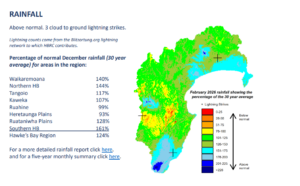
As summer came to an end, February kept the region in the continued run of wetter than average conditions seen so
far this year. By the month’s end, regional rainfall totals sat at 124% of the long term average, with Southern Hawke’s
Bay (161%), Northern Hawke’s Bay (144%), and Waikaremoana (140%) all recording well above normal rainfall totals.
River flows across most sites followed this pattern, with some northern and southern catchments registering
particularly high flows. Soil moisture levels also remained above median levels across the region, reflecting the
sustained wet conditions of the past two months. Groundwater levels across the region were assessed as “Normal” for
February, with both the Ruataniwha Plains and Heretaunga Plains recording marked improvement and continuing their
upward trajectory.
Temperatures were near normal across the region, with maximum temperatures sitting 0.3°C above normal and
minimum temperatures 0.41°C above normal. The wet conditions also influenced recreational water quality, with
several sites—particularly central locations—exceeding guideline thresholds throughout the month. Despite this, many
coastal beaches maintained good conditions even with the unsettled weather. Air quality remained excellent
throughout February, with no PM₁₀ exceedances recorded in any of the airsheds.
Nithin Bala Murali
Climate Scientisthttp://Click Here
To read the full environment report see below
Monthly Environmental Report February 2026
_________________
As we know, every season comes with its own specific factors that influence you as growers, and 2026 looks to be no different.
This season in HB started off relatively dry, sunny and warm, with not a lot of frosts or hail. While the wind challenged bees trying to pollinate, and growers trying to spray in spring, generally, it was a smooth start.
Weather windows for chemical thinning were available; trees were generally happy with active shoot growth. Spring had significantly less rainfall than normal and late November soil moisture levels saw the need for irrigation systems to be fired back into life. Sunny warm conditions had very high ET values for October, November and the first half of December.
Mid to late December saw changes to the dry, with rainfall events topping up the soil and putting the irrigation need back on hold. This has continued into the later part of the growing season with ongoing rain events creating little to no need for irrigation for the last few months. Growers that are on the edges of the rivers have seen multiple high flow events top up their soil moisture, despite some of these events not being connected to localised rainfall on the Heretaunga Plains.
The variation in received rainfall across the Heretaunga Plains during events in the 2026 growing season has been vast. Additionally, since the beginning of January there have been 27 days with a maximum temp above 25 degrees making it easy to feel that irrigation applications should be justified. Soil moisture management therefore needs to be assessed using specific data on each block of trees.
What does this all mean for the fruit in the 2026 harvest?
· The good chemical thinning and shoot growth conditions have increased tree vigour. This increases risk for apple leaf curling midge, powdery mildew and Calcium disorders in fruit.
· Carbohydrate has at times been partitioned to excess shoot growth instead of all for fruit growth, this could have a negative impact on fruit size.
· The season length is shorter than 2025 and this would likely give a smaller size than 2025.
· However, in 2026 where fruit has been thinned early and to good fruit numbers this should give a good average size.
· Sunlight and heat levels have been good, however sunburn levels are up in some blocks, especially where summer pruning has overlapped to a following high heat event.
· Fruit colouring conditions have been about normal close to harvest. Where crop loads are excessive or canopy light levels are low, there have still been colour development issues.
· Go date Brix has been a struggle in some varieties, often coupled with low fruit pressures. This is exaggerated in blocks where soil moisture has remained high for the late part of the season, caused either naturally by increased ground water conditions or by over irrigation.
· Fruit quality in 2026 looks to be a mixed bag, highly influenced by the specific seasonal situations of each of the individual blocks.
I believe 2026 season will be remembered as the year that looked good on paper but did not always deliver the final results, block specific factors are having a big bearing on the final fruit quality.
We need to identify what happened this year to each block and then understand what these results might mean for next years crop.
Jonathan Brookes AgFirst HB Ltd
Kia ora
Greetings to all our members and supporters of HBFA
The year has started off in full swing, summer has given us some excellent fine days and so I imagine everyone has had an enjoyable break.
Picking is well underway with Royal Gala strains, Rockit, Piqa®Boo pears to name a few. Early indications show good pressures and SPI’s although as we know these measures can drop very fast especially with the hotter days. Colour development has also been slower due to the heat. This last week has seen a drop in temperature at night which will be great for increased stronger colour.
The 2026 Industry Awards: A Night of Excellence
Early February HBFA in conjunction with EIT and PITO held our 2026 Industry Awards, a highlight of the HBFA calendar. Coming together at the start of the year serves as a vital reminder of the calibre of people we have in our region.
· NZ Diploma in Horticulture Production, Level 5, Fruit Production: 2 graduates
· NZ Diploma in Horticulture Production, Level 5, Post Harvest: 1 graduate.
· NZ Certificate in Horticulture, Level 4, Fruit Production: 17 graduates
· NZ Certificate in Horticulture Production – Level 4 Post Harvest: 1 graduate
The Fred Horrocks Memorial Award is awarded to the topmost outstanding graduates at level 4 – this year’s recipients were Kevin Kooijman from EIT and Laurie-Ann Newton from ITO.
Scholarships
The Hawkes Bay Fruitgrowers Charitable Trust in conjunction with the Horticentre Charitable Trust, provides scholarships to our local students. This year we gave out 19 scholarships to our years 1, 2 and 3 – studying fruit production. We awarded 8 diploma scholarships in fruit production and post-harvest.
There were also 12 HortNZ Industry Trainee Scholarship awarded.
Well, done to all our recipients
The night also consisted of HBFA’s industry awards for 2 categories. 1 – Emerging Achiever Award – This award recognises an individual who has demonstrated their ability to positively impact horticulture and who shows effective, values-driven leadership — strengthening relationships within their workplace, their teams, and across the wider industry. We were pleased to announce the winner of this award went to Malandi Fourie. Assistant manager at T&G Global
2 – Fourneau Award is an accolade that celebrates innovation in the fruit-growing sector—innovation that drives efficiency, enhances sustainability, and improves safety
within our industry – this year’s recipient of the Fourneau Innovation was awarded to Wade Taylor, the owner of Brimar Vegetation Services.
I want to thank all our sponsors and supports who made this night such a success.
We are keeping a close eye on the water allocation situation – Richard Pentreath is a member on the water group and will give us an update in next month’s newsletter. I encourage you to read Charlotte Drury’s update as she is HORTNZ’s representative in this space.
I had time with our newly appointed Mayor Wendy Schollum early in the month to share about what HBFA does, how along we have been around and our concerns namely protecting prime horticultural lands and of course water. By all accounts she seems very supportive and understands the importance that the fruit growing industry contributes to our local economy. I have invited her to speak at our HBFA young grower competition dinner on the 19th of June.
All the best to everyone who grows fruit, stay safe and have a productive and profitable harvest.
Kia kaha Brydon Nisbet
President Hawkes Bay Fruit Growers Associatio
Fundamentals of vigour management
Understanding the cause of your vigour in each block is key to establishing the most effective, cost-efficient management tool.
Back in 2018, the late John Wilton was concerned about the level of vigour seen in intensive plantings having a consequence on bud quality and fruit quality (colour and poor carbohydrate partitioning). 8 years on, and we are having the same conversations! In saying that carbohydrate balancing is key and vigour reduction can be taken too far. Ranking blocks in order of severity can help to prioritise areas for investment.
A useful way to think about vigour management is through the Liebig’s Barrel principle. It reminds us that until the most limiting issue is fixed, everything else is just plugging holes. As an example, fighting vigour using regalis does not fix the underlying issue if the growth is a result of excess Nitrogen. Identifying the cause of excess growth can be tricky with many factors influencing plant growth. To go into them all we would need a few more pages, but to list a few of the most common:
Tree structure –Fruit is the cheapest most rewarding form of vigour management. Does the canopy structure provide enough ’framework’ or ‘metres of fruiting wood’ to comfortably hold the target crop load in singles and/or even doubles (on preferred sites).
Wood texture should also be a consideration. As we have moved to more formal precision systems, the ‘fill a wire’ concept has been followed. This has been absolutely essential to fill the canopy and achieve cumulative yields; however a replacement programme must be implemented to ensure the larger, less fruitful, higher vigour units can be rotated out.
Pruning should focus on balancing carbohydrate. managing excess vigour and setting up high-quality wood for next season. Summer pruning is a highly effective tool for vigour management, but timing and execution will determine the response. E.g. for example, flush cutting when minimal regrowth is required, and stubbing when a stronger response is needed. Summer pruning off a weak/settled/terminated dart is counterintuitive to vigour management, and fruit quality.
Irrigation deficit is an ongoing balancing act that no one has truly mastered. Have your ever heard the saying, “treat ‘em mean keep ‘em keen?”. The first sign of plant stress is vegetative termination. If shoots are still growing, they are more than likely getting sufficient water. This comes back to the fundamentals of irrigation management – where is the active root zone and how is soil moisture behaving at each profile depth.
Combatting the vigour war will not happen overnight, but determining each blocks root cause will aid in making effective, cost-efficient decisions, leading to improved productivity and fruit quality.
Meg Becker


|
|
|
|

EXCEPTIONAL APPLE AND PEAR HARVEST GETS UNDERWAY
New Zealand growers deliver fantastic 2026 crop to global markets
New Zealand’s apple and pear harvest is underway, with early forecasts pointing to a standout season marked by exceptional fruit quality and high pack‑out rates.
A largely quintessential growing season across key regions has delivered a significant boost to productivity, across both traditional and new IP varieties.
It is a welcome return to form for the industry after several challenging years, that included Covid‑19 disruptions and extreme weather events, says New Zealand Apples and Pears (NZAPI) Acting General Manager Danielle Adsett.
“It’s incredibly heartening to see,” says Adsett. “The fruit looks and, most importantly, tastes fantastic. Growers are reporting excellent quality, early pack-outs are tracking really well and there’s a real sense of optimism across the industry.
“While we are still building toward previous pre-Covid peaks, this year’s improved productivity numbers are the real gamechanger for growers. After an excellent 2025 harvest, this season is also tracking in the right direction.”
A warm, dry spring with good growing degree days and high levels of solar radiation has resulted in large fruit with vibrant colour and delicious eating quality. Apples and pears from all growing regions are expected to store superbly for export markets.
“We’re delighted with the significant uplift in productivity, which can largely be attributed to the maturation of new plantings of IP varieties,” says Adsett. “It is particularly valuable given New Zealand apples and pears are in high demand, due to expansive opportunities across a number of our global markets and the premium quality of fruit.”
Productivity gains are attributed to the strong focus from growers to transitioning their orchards to more highly-productive growing systems, that are more efficient and deliver higher yields.
“The new IP varieties deliver higher yields and attract stronger returns in global markets, however some of these orchards are still relatively young,” says Adsett. “They need time in the ground before they reach full production, which suggests further growth and improved productivity is in the pipeline.”
New Zealand’s apple and pear industry is a major contributor to national export earnings as well as regional economies and supports New Zealand’s reputation as a leading producer of premium, safe and sustainably grown food.
As the 2026 harvest gathers momentum, growers are focused on delivering consistent quality to customers around the world, while continuing to invest for the future.
For further information: Please contact New Zealand Apples and Pears National Communications Manager Jessica Wauchop on jessicaw@applesandpears.nz or 021 254 0923
Just a quick update on a couple of RMA matters:
Please get in touch on 027 3225595 or via email at Charlotte.Drury@hortnz.co.nz if there is anything consent/resource management related you would like to discuss.
|
|