April rainfall was well above normal, almost double the month’s average total, but sandwiched between a very dry March and now May. April’s rain left river flows measuring above normal and soil moisture lying above median levels for the time of year. Groundwater levels for the month were mostly near or below normal but that might improve once April’s rain filters through. Daytime temperatures were near average but nights were warm for the time of year. Sea surface temperatures have been above average around most of New Zealand but cooler than average in Hawke Bay.

An El Niño event is expected to develop during the next couple of months and those events typically bring the region a west to southwest flow. Westerlies reduce the likelihood we’ll have above average rainfall because the western ranges help shelter us from storms coming from that direction. Forecasts suggest winter will bring us that west to southwest flow due to higher than normal sea level pressure lying to the west and lower than normal pressure to the east. That pattern leads to predictions of below or near normal winter rainfall and near normal temperatures, tempered by winds having a southerly aspect at times.

European Canker Best Management – Protecting Leaf Scars.

The recent rain events have created ideal conditions for EC. Soon tens of thousands of leaf scars will be created during leaf fall. It’s important you have a program to protect these wounds from infection. Do not underestimate the impact this disease can have on the economic viability of your orchard. Do not be complacent. It’s an aggressive disease which requires and equally aggressive response.

Best practice includes:

1. Canker walk your blocks NOW. Cut, remove and burn. Lowering the inoculum level in the orchard is the No.1 management tool. You can’t rely solely on spraying your way out of this disease.

2. Commence weekly Captan &/or Copper sprays between 10% and 90% leaf fall. At least 3-4 applications over the leaf fall period. Additional applications will be needed immediately following rainfall events.

3. The Copper & Captan a.i. rates are important for efficacy. Copper a.i. rate is 1.0 kg/ha, Captan a.i. rate is 2.0 kg/ha. Note: do not exceed 5.0 kg Cu/ha/year.

4. Check pH of spray solution. Captan needs buffering to <6.5 to ensure it does not hydrolyse (breakdown).

5. Adjust water rates to achieve complete coverage. Check/test sprayer set-up to ensure even spray deposition. This is crucial for maximum protection.

6. Consider assisted leaf drop sprays, e.g. EDTA Copper, in known high-risk blocks. You must wait until natural leaf has started (~5% leaf fall) before application. Shortening the period that scars from fallen leaves are susceptible to infection reduces the risk of European canker infection. Captan/Copper sprays to cover the wounds is still essential.

7. Do not apply foliar Nitrogen once leaf fall has started. This increases EC infection risk. If Urea is required for black spot clean-up, wait until all leaves have dropped and apply as a 5% solution to the ground.

Note: Sprays are supplemental to an aggressive cutting, removal and burning of inoculum from the orchard.

Dean Rainham, AgFirst Consultants

It’s great to see the harvest season coming to a close. From everything I’m hearing across the orchards, picking has gone well and the quality looks fantastic. We are now in the thick of packing and exporting, ensuring our amazing produce reaches customers all around the world.

A few weeks back, we dodged a bullet with the cyclone. While it didn’t eventuate into anything major, it was a timely reminder of how susceptible we are as growers to things we cannot control. In saying that the last couple of days have given us plenty of welcomed rain after such a dry March.

As president I sit on the committee for the Napier Port Hawkes Bay Primary Industry Awards. This event was held in early April and was an excellent night of celebrating the primary sector.   It was awesome to see Horticulture do well on the night with the following picking up awards


A Well-Deserved Honour for Chris Herries
A huge congratulations to Chris Herries for taking home the Professional of the Year award Chris has spent more than four decades as a trusted advisor to our region’s growers, bringing a wealth of knowledge that has helped many of us over the years.  Known for his leadership at Horticentre, Chris’s expertise in production systems, biosecurity responses, technical and nutritional advise is second to none, but it’s his personal commitment to supporting local growers that truly sets him apart. Congratulations on this fantastic achievement, Chris.

Orchard Success: Ngāti Pāhauwera Commercial Development Ltd
A massive congratulations to Ngāti Pāhauwera Commercial Development (NPCDL) for being named the Horticentre Horticulturalist of the Year. It is inspiring to see their 55-hectare Pākuratahi pipfruit orchard at Tangoio recognised for such high performance and forward-thinking management. Tom Keefe (Director at NPCDL) received the award on behalf of the whole team.

Industry Leader of the Year: John Bostock 

A standout highlight for me was seeing John Bostock receive the Hastings District Council Industry Leader Award. As the founder of Bostock New Zealand, John was recognised for his decades of pioneering work in commercial organic horticulture, effectively positioning Hawke’s Bay as a global leader in the sector. From transitioning to organic growing in 1996 to building the country’s largest integrated organic apple operation. He is also a large grower of squash and onions.

“Having spent a decade managing organic orchards for JB between 2002 and 2012, I know this award is a true testament to the tireless work that John and the entire Bostock NZ team put in every day – Congratulations.

We also want to give a special shout-out to orchard supervisor Te Rina Joe, from Ngāti Pāhauwera Commercial Development and Larissa Wooding-Ngata (Ngāti Porou), a foreperson at Craigmore Sustainables in Gisborne, for both becoming finalists for the Ahuwhenua Young Māori Grower Award. It’s fantastic to see such talent and dedication within our local growing community, and we look forward to seeing their continued expansion across Northern Hawke’s Bay and Tairāwhiti Gisborne

Tukituki Water Security Project (Ruataniwha Dam)
There has been significant movement on the Tukituki Water Security Project recently, with the Government announcing an $18 million loan to test its commercial viability. As the project moves toward the Fast-track Approvals process, it offers a glimmer of hope for long-term water security in our region. If it progresses, the scheme could be a gamechanger for our growers, providing the consistent water supply needed to de-risk our orchards and support future expansion.

Events

Keep an eye out on our latest industry events coming up soon

  • HBFA Golf Day – Friday 15th May
  • HBFA Young Fruit Grower Competition – 18th/19th

Kia kaha

Brydon Nisbet

President Hawkes Bay Fruit Growers Association

HAG (Horticultural Advisory Group)

The Heretaunga Sustainable Water (HSW) steering committee continues to meet on a monthly basis to review project updates and set priorities.  HSW exists as a forum to advocate and coordinate work that supports long-term (100-year) water security for the Heretaunga plains.

In April the HSW steering committee met with representatives of the Tukituki Water Security project.  This project has successfully secured funding to complete feasibility analysis, geo technical testing and design work.  Mike Scott, former CEO of Waimea Water has been appointed as CEO for Tukituki Water Security project and Mike Petersen is  Chair of the project governance group. The site of this proposed dam is the same as the former Ruataniwha dam proposal but due to changing regulation and other factors, significant changes to the original design of the dam have been undertaken.

The HSW steering committee are also receiving regular updates from the Heretaunga Water Storage project which has selected a site at Whanawhana as a preferred water storage scheme.  This project has also been successful in securing funding to advance feasibility analysis including geotechnical and engineering design work and has a governance group including representatives of local government, mana whenua and industry.

Both water storage projects are progressing well at this time and are confident that they can provide viable solutions that will greatly enhance water security on the plains.  The HSW steering committee will continue to engage with both project groups as further information becomes available on economic, environmental, technical and cultural factors over coming months.   Other project work underway includes analysis of current water abstraction along with 3D models of the aquifer to determine locations where aquifer recharge could be possible.  Members of HSW can expect a newsletter update soon including details of an AGM meeting.

Richard Pentreath
Chair of HAG


NZAPI APPOINTS DANIELLE ADSETT AS CHIEF EXECUTIVE

Decision reflects deep sector knowledge & vision for billion-dollar sector

The Board of New Zealand Apples and Pears (NZAPI) is pleased to announce the appointment of Danielle Adsett as Chief Executive, effective immediately.

Danielle’s appointment reflects her deep knowledge of the pipfruit industry and her future-focused vision for the organisation, its members and the sector.

As Market Access Manager for six years and Acting General Manager since December 2025, Danielle has provided strong and steady leadership along with clear direction and continuity for the organisation.

NZAPI Chair Andrew Gibbs said the Board was unanimous in its decision after a rigorous recruitment process.

“Danielle’s clear vision for the industry, leadership capability, and deep, long-term dedication to the sector were evident throughout the process and made her the standout candidate,” Mr Gibbs said. “We look forward to working with Danielle and the team to deliver further benefits for our members and New Zealand as a whole.”

The announcement comes at a key point in time for the industry, which achieved more than a billion dollars in exports for the first time in 2025, following several challenging seasons marred by weather events and covid-19.

Danielle said she was honoured with the appointment and has hit the ground running.

“I am committed to this sector. Our growers are passionate, innovative and resilient and they produce the world’s best apples.

“I am proud and excited to have the opportunity to support the industry, to advocate on their behalf as we seek to double exports and to work alongside a phenomenal team at NZAPI, who are all equally as committed to our members’ success.”

The Board also acknowledged the tireless work and commitment of former Chief Executive Karen Morrish, who departed at the end of 2025.

NZAPI has now begun recruitment for a Market Access Manager.

Kia ora koutou,

We are looking forward to welcoming students back to Eit in the next few weeks.  We have new cohorts starting the Cert in Primary Industry Operation Skills in May, so please get in touch if you have staff needing this entry level qualification.  It has a modest fee but also includes Growsafe and First Aid so is great value.  Our Level 3 students will be back to study the Growing Environment and Level 4s start on Crop Protection.

Diploma students are still working with their staff to harvest the last of the crop and will return in May to continue their analysis of their research topic. The topics are varied from tree reaction on pruning techniques to chemical application. Cant wait to see the results.

Our 2025 graduates attended the EIT graduation ceremony which was a great success and great way of reaffirming the work, commitment and their achievement over the last two years. Well done Danielle Sammons, Jordan James and Navneet Kaur.


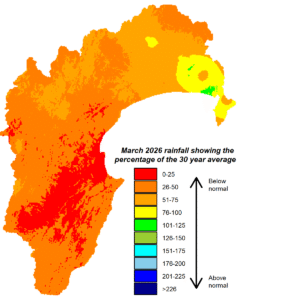
After a wet summer, much drier weather kicked off autumn.  March rainfall was well below normal, with the region getting just 38% of the month’s average and the Heretaunga Plains a mere 14%. River flows were well below average and soil moisture, which was high during summer, pared back to sit near median levels for the time of year.  Groundwater levels remained in good heart at the time of measuring. Air temperatures were average for early autumn so didn’t accelerate dry conditions with super-hot days.

 The tropical cyclone season runs until the end of April and that tropical influence, helped by warmer than average seas around New Zealand, has already left April’s rainfall looking healthy. With an El Niño event expected to develop by spring this year, good moisture stores leading into it would be ideal!   Seasonal forecast models already indicate drier conditions are on the horizon.  Over the next three months, their predicted sea-level pressure pattern is higher than average pressure west of New Zealand, near normal pressure over the country and lower than average pressure to the east.  That gives the region a west to southwest flow, bringing into play the rain shadow effect of our western ranges. Near or below normal rainfall is their favoured outcome and near normal temperatures.  We’ll be keeping a wary eye on the looming El Niño.     

Nutrition Considerations

Throughout the period from post-harvest through to leaf fall, fruit trees are accumulating nutrients and carbohydrates, storing these for use in the following spring. New Zealand’s long growing season provides a distinct advantage for growers as photosynthesis continues to occur well into autumn. This enables carbohydrate production to continue for a longer period in our trees compared to other growing regions. Growers should look to maximise this natural advantage, and make sure their trees enter dormancy with adequate nutrient reserves.

When walking blocks, growers should be sure to take note of foliage colour, tree health, areas of poor growth or any fruit colour problems. This information, coupled with a leaf sample analysis to verify the current nutrient situation will allow the post-harvest nutrition programme to be tailored to the block’s individual needs, and ensure the trees are then set up well for the next season.

Root Health Considerations

Turning the post harvest management attention underground, root health is also an important consideration at this time of the year. Dry roots are not going to be operating at optimum, therefore growers need to ensure blocks have adequate water, for root function, root renewal and nutrient uptake as they move into dormancy. We have quite a range of growing conditions across the Heretaunga Plains, with differences in rainfall, ET, soil type, subsurface hydraulic pressure, therefore a localised understanding of your rainfall and soil moisture status is key.

Flooded root systems will also not be operating at optimum. Therefore, the post harvest period is a good time carry out drainage system maintenance.  This helps ensure good root health is maintained prior to potential water logging from winter rainfall events. Poorly maintained drainage (root balls causing blockages, or collapsed tiles) is a limiting factor for root health and resilience. Good drainage allows deep root systems to develop and access underground water reserves, as well as supporting sustainable yields and nutrient uptake.

Sarah McArley, AgFirst Consultants

Harvest Update: 2026 Season in Full Swing
We are now in the thick of the 2026 harvest. Following on form the great spring we had of last year, the weather again has been on our side, providing the warm, dry window needed for harvest.

RMA and Water Issues
Water security remains a top advocacy priority as we move through 2026. On behalf of HBFA, please see Charlotte’s report

  • Resource Management Act (RMA): We continue to work closely with the Government and Council to ensure the voice of horticulture is central to the new “Fast-track” consenting frameworks. Our goal is simple: long-term certainty for our growers.
  • Water Storage: We are closely monitoring the progress of the Ngaruroro storage proposal and the revitalised Tukituki Water Security Project. Securing reliable water is the only way to future-proof the “Fruit Bowl of New Zealand.”

Upcoming Events & Industry Milestones

  • Napier Port Primary Sector Awards Dinner: Celebrating our industry leaders on Thursday, 2 April 2026, at Toitoi. This is now the 6th year that horticulture has been a part of this event so best of luck to the participants of this year’s Hort industry award
  • Young Fruit Grower of the Year 2026: Our regional competition will take place 18–19 June 2026.
  • NZAPI EXPO 2026 (Queenstown): Mark your calendars for 22–23 July 2026. This year’s expo has expanded to two full days of technical workshops, specialist sessions and the industry awards evening.
  • New Zealand Horticulture Conference (Wellington): The following week HORTNZ have their conference at Tākina, Wellington from 28–29 July 2026. This will be an integrated event combining the main Horticulture and RSE Conferences.
  • HBFA Industry Golf Day: May 15th – keep an eye out for details

Call to Action: Young Fruitgrower of the Year 2026
Applications for the 2026 Hawke’s Bay Young Fruit Grower of the Year are now officially open!

We are looking for the next generation of leaders to step up. If you have a talented young person in your team under the age of 30, encourage them to enter. This competition is about more than just winning; it’s about networking, growth, and professional development.

I want to thank our sponsors and the dedicated HBFA team for their tireless work. To all our growers: stay safe, look out for your teams, and let’s bring this 2026 harvest home.

Kia kaha

Brydon Nisbet

President Hawkes Bay Fruit Growers Association
RMA Update

You may have recently received a letter from Hawke’s Bay Regional Council (HBRC) about a change to your resource consent expiry date. The key points are outlined below.

 What has already happened

  • Your previously expired consent has been reinstated and automatically extended to 31 December 2027.
  • You do not need to do anything for this extension to apply.

 What you now need to decide

You must decide what to do with the replacement consent application you lodged before your consent was originally due to expire.

You have two options:

  • Withdraw the replacement application, or
  • Leave the application in place, in which case HBRC will continue to process it (or keep it on hold, if within the TANK Catchment).

 HortNZ guidance

HortNZ recommends the following:

  • If your consent is within the TANK Catchments:
    • Do not withdraw your application.
    • Your application will remain on hold until the Environment Court releases its decision on the TANK Plan Change (expected early–mid 2027).
    • No action is required from you at this time.
    • HBRC will contact you after the Court decision to confirm next steps.
  • If your consent is outside the TANK Catchments and your activity has not changed since the consent was granted:
    • Withdraw your replacement application.
    • You will need to email HBRC to confirm the withdrawal.

Important notes if you withdraw your application

  • Any processing costs incurred to date that exceed the deposit you paid may still be charged (there may be no additional costs).
  • You will need to lodge a new replacement consent application before your consent expires in December 2027.

 If you are unsure which option is best for your situation, please contact Charlotte Drury on 027 322 5595 to discuss.