
Presidents Report
Harvest is in full swing – the weather is giving us fine days and cool nights – near perfect conditions. A lot different than this time last year or in fact the last few years.
Harvest time is great – its when we see the fruit of our labours, the community is vibrant and full of our wonderful workers from the pacific. Our RSE scheme is recognized as best practice by ILO (International Labour Organization) & the World bank. The benefits to our workers and the communities they return home to are immense. The benefits to our industry are huge, in that it gives growers assurance that their (on orchard thinning, picking etc) will get completed (a job kiwis on the whole are not really keen on doing) This means growers can get on with growing and expanding their businesses thus creating more full time jobs for our locals. To me this is a win-win for all.
I want to draw your attention to 2 Levy Order renewals coming up. Currently NZAPI are presenting at grower meetings discussing their Levy renewal. Please attend these events and hear what they have to say about where your Levy money is going as an apple grower. The HORTNZ (Horticulture New Zealand) Levy Order renewal is to be voted on soon as well. HORTNZ are also currently travelling the country talking with growers. I am a director on the board of HORTNZ and I can tell you that the team at head office in Wellington are extremely passionate about what they do in the horticulture space and for us as growers. There is a huge amount of work that goes on down there (a lot of it is unseen) HORTNZ are proactively influencing policy, seeking the very best operating conditions in areas such as the environment, biosecurity, food safety, crop protection to name a few. They lead the RSE space working with other product groups to get the best outcomes possible. They read, review, and continually make draft policy submissions on a wide range of policy’s that affect us all. They are the face of Horticulture (growers) to the Government and are currently building strong relationships with officials and ministers of the newly formed coalition government.
We have for the first time a Minister of Horticulture Nicola Grigg, this is fantastic for all growers and can only be good for our industry. HORTNZ have been asking for a minister of Horticulture for a while now so its good to see this has got over the line. This relationship will be especially critical as HORTNZ are advocating for various policy settings especially over the certainty of water supply to growers with the investment in water storage being a front runner. This is a key issue for our growers right now especially with what HBRC is pushing ahead with in our own region.
Please look out for the proposal documents to be sent out in April with voting starting on May 14th to June 14th. If you have any questions about the upcoming levy renewal please don’t hesitate to contact me. HBFA have a strong relationship with HORZTNZ. They are experts when it comes to water regulation, and we benefit with this from Charlette Drury who is contracted to HORTNZ. Charlette writes a monthly piece in this newsletter – I encourage you to read her articles.
When Cyclone Gabrelle hit HBFA led the industry in wellness, technical support packages, grower relief / support and networking events. We engaged Wanda Douglas within days of the cyclone bringing much help to some of our impacted growers. We opened this up to all of horticulture. Hundreds of thousands of dollars were raised and gifted to HBFA over this time. We knew that this would be a long game and we would have to be prudent with the funds entrusted to us. Our team here at HBFA have made sure that we have sufficient funds to carry us for at least the next 1 to 2 years supporting our growers especially in the wellness and networking space. Callum will share more about this in his first CE report.
We have opened the registration for our 2024 Young fruit grower competition, please share this to your employees and encourage them to apply and give it a go. Our event is on the 6th&7th of June.
Take care and enjoy the rest of your harvest.
Kia kaha
Brydon Nisbet
Embracing change, overcoming challenges
In these times of rapid change and challenge, the Hawke’s Bay Fruit Growers Association remains steadfast in its commitment to the well-being and prosperity of our growers and industry. As your CEO, I’m proud to reflect on the strides we’ve made, the hurdles we’re facing, and supporting the future of the industry we’re cultivating together.
Over the past few months, the HBFA team has been deeply engaged in reinforcing our core values and enhancing our team efficiencies and focus areas. We’re excited about the coming year, some of our key initiatives include brand awareness (watch this space) and refreshing our website enriching your experience and facilitating better interaction with us. We are also having a big push on social media to help promote up and coming industry events that target our future generations. Our focus has always been and will continue to be on promoting and protecting the incredible growers of our region.
We’re thrilled about our lineup of events for the year, with the Young Fruit Grower of the Year (YFGOTY) competition being a highlight on the 6th & 7th of June. We’re also planning exciting activities to get growers out and about, involved, connected, and entertained. So please keep an eye on this space!
Addressing the core issues: Post Cyclone, cash flow, costs, and staffing
We’re acutely aware of the challenges our growers face, from cash flow difficulties and escalating costs to the struggle in finding experienced staff. The HBFA is actively engaging with several key issues our industry is facing and advocating for growers where we can. Our Post Cyclone support alongside our HAG partners (Horticulture Advisory Group) continue to support Wellbeing, Technical and Financial initiatives has been rapidly slowing but not forgotten. We are closely monitoring the TANK water permit process, alongside many of the industry stakeholders and aim to keep you informed and prepared.
Summary RMA update from Charlotte Dury:
This newsletter will be finding many people really busy with harvest, so this RMA update is focused on a brief update about the TANK water permit replacement process that many of you are currently involved in. We had a second grower meeting in early March at the Twyford Hall, and the key messages from that were:
Wellbeing: At the heart of HBFA & HAG
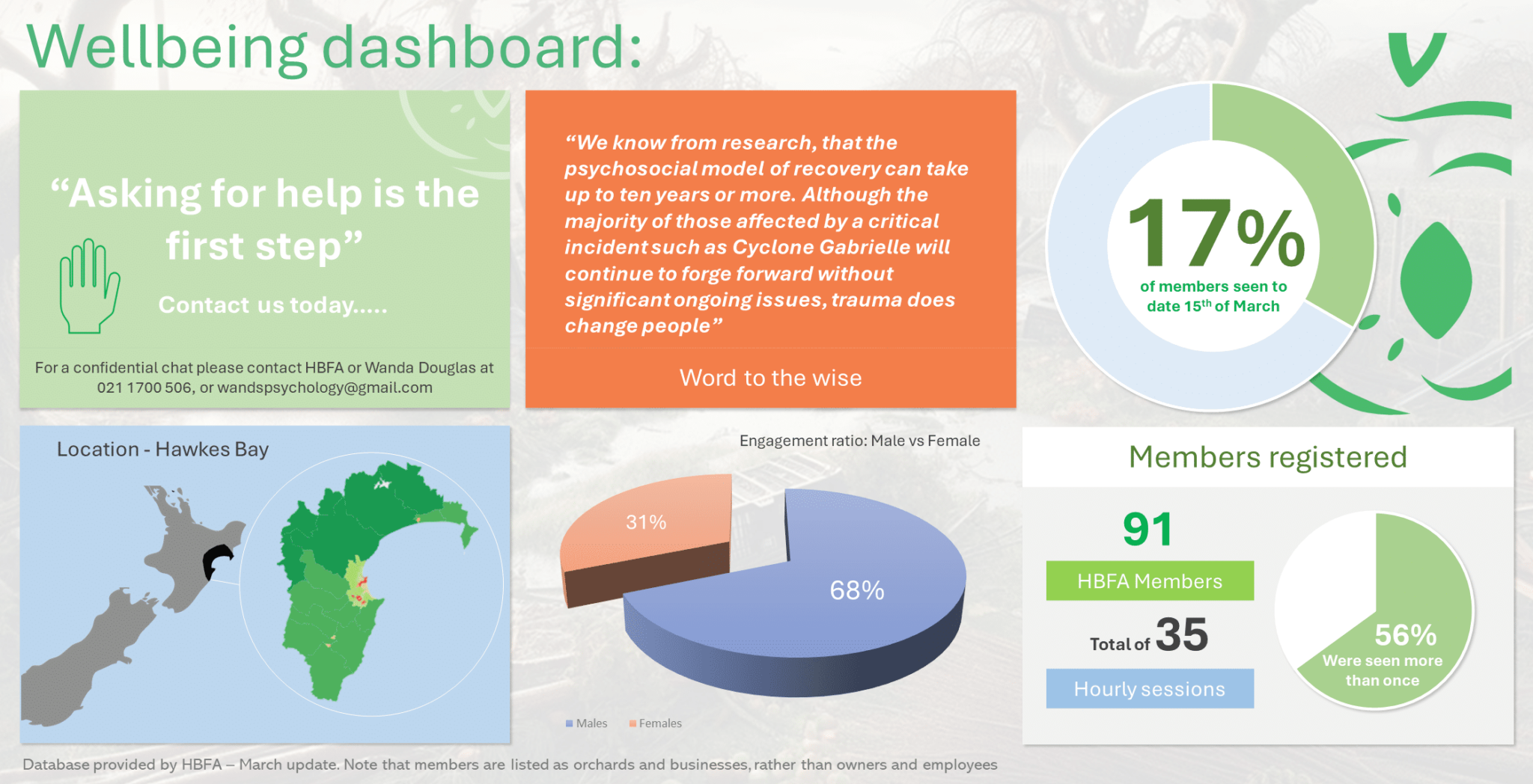
The well-being of our community remains our priority. The pressures of the industry and life’s uncertainties in the current market can weigh heavily, which is why we’ve introduced our Wellbeing support post cyclone. This initiative supports crucial services aimed at helping our growers and their families navigate these challenges. Below is our Wellbeing dashboard showing engagement up to March this year.
Moving Forward: Mental Health and Resilience
HBFA & the HAG group are commitment to mental health and resilience is stronger than ever. Thanks to the funding received, we’re able to offer confidential counselling sessions with Wanda Douglas, a respected local psychologist. Wanda’s expertise and compassionate approach provide a lifeline for those in need, offering strategies for stress management, resilience building, and much more.
Reach out for support
If you or someone you know is struggling, don’t hesitate to reach out. Contact me, Callum Ross, at HBFA, or directly connect with Wanda Douglas at 021 1700 506, or wandspsychology@gmail.com. Remember, seeking help is a sign of strength, and we’re here to support each other.
Together, we can face any challenge and emerge stronger. Let’s stay safe, stay connected, and prioritize our well-being.
Warm regards,
Callum Ross
Chief Executive Officer

Please find the following links to resources that have been developed by HortNZ:
HortNZ Grower meeting pres. AR-info Mar 2024

HortNZ Grower meeting pres. A & R.15 Feb 2024
Commodity Levy Order Referendum starts April
As part of the consultative process for the renewal of the Commodity Levies (Apples and Pears) Order, NZAPI has been engaging with growers around the country. If you missed out on the in-person meetings, you can still attend the online meeting next Monday 25 March at midday. Click here to request the link.
Voting commences on Monday 8 April, with both postal and e-vote options available.
EVERY VOTE COUNTS! For NZAPI’s application to be viewed favourably, they need to have maximum participation in the vote, so whether you’re a big or small grower, your input is vital.
The commodity levy collected by NZAPI is primarily used to support and deliver services to growers in the following areas:
More information on the Commodity Levy Order is available on the NZAPI website.
If you have any questions about the Commodity Levy Order, please email Karen Morrish, NZAPI CEO.
Apples – Crop load observations.
Crop load still appears to be the main factor influencing fruit size and quality. We know that there is a linear relationship between total harvested yield and light inception but striking the optimum balance between tree/shoot and fruit has a major influence on marketable yield (pack-out).
The Agfirst team has just completed walking hundreds of blocks this pre-harvest. Irrespective of variety, optimizing the crop load and minimizing the variability has a significant influence on the outturn of the product which ultimately impacts on returns. We noted a range of crop loads, both within and between orchards.
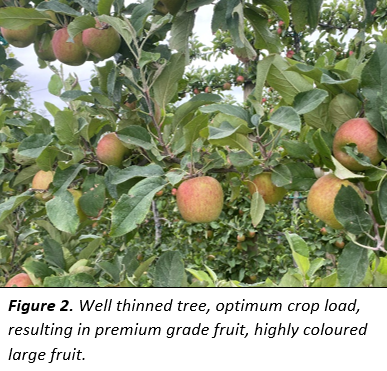
Well thinned trees were superb, with good colour and size (Fig 2). These trees will be much easier to harvest and pack-outs will be high. Leaf quality was also higher on these well thinned trees. However, within the same row we also found over-cropped trees, because of poor hand thinning, fruit held in the shade, limbs almost at breaking point (Fig. 1). Colour and size were being heavily compromised on these trees which will lower the overall pack-out for the block.
Dean Rainham

Kia ora koutou,
With harvest being well underway, this month is a time for us to spend clearing up our internal reporting, updating assessments and getting ready for the busy time from May – December. We are meeting up with our Tairawhiti colleagues, who teach the same courses, to a wider variety of industries, and finishing resulting from 2023. Students who completed qualifications last year will be receiving their certificates in the post soon.
Level 4 students should be collating some harvest documentation for the compliance course, level 3s maybe asking about the weather, or interesting weeds they are seeing, but we do not expect much to happen during this busy time.
Please see the recent NZAPI newsletter with lots of information regarding further training like the Kelloggs leadership course, and encourage workers under 30 to step up for the Young Fruit Grower of the Year.
Best of wishes for your harvest
Clare, Steven and Chris
A dry February rounded out a summer that flipped flopped between wet and dry months. Only 50% of average February rainfall fell across the region but on the Heretaunga and Ruataniwha Plains it was only a third of the average. The one outlier in the region was the Ruahine Range, where rainfall was within the normal range.
Soil moisture, that had been boosted by January’s ample rainfall, dropped closer to median levels for the time of year. River flows also responded to February’s lack of rain, being near or below average whereas groundwater levels for the month were the opposite and ranged from near to above normal.
Daytime temperatures were impressive for the last month of summer, reaching more than a degree warmer than average but overnight temperatures were largely typical of late summer. Sea temperatures remained elevated in our part of the world, though cooled to more normal levels in the area immediately surrounding the country. That likely helped put the brakes on rainfall. At the time of writing (two thirds through March), we’ve had just 25% of March rainfall with little in prospect for the remainder of the month.
The El Niño is expected to weaken to neutral conditions during autumn, after which a La Niña (sigh) could develop in winter or spring. The outlook for the next three months has hallmarks of the former rather than latter, with westerlies still the expected dominant wind flow, arising from higher than normal pressure over the North Island and lower south of New Zealand. Rainfall is predicted to be near or below normal and temperatures still tracking in a warmer vein. Hopefully that equates to a balmy, pleasant lead into winter.
February 2024 rainfall

Dr Kathleen Kozyniak
Principal Scientist Air
Hawke’s Bay Regional Council
Advertorial –
What is Safety SNAP?
SAFETY SNAP is a science based tool that helps businesses to understand the psychosocial issues affecting their team. It measures risk factors that are proven to increase accident and injury risk, and also proven to impact a person’s likelihood of surviving and thriving in their job.
We would like to offer all HBFA members 3 months trial using the Safety Snap Psychosocial Tool. For more information please click here.
We are also offering SaferMe’s Safety system to any HBFA members with a special introductory offer – 10% discount off the first 3 months of their subscription. Everyone will also benefit from a 30 day free trial of the system.


Changes to Soil and Water and Climate
There have been a few field walks, meetings and presentations in the past month, which have not directly targeted stonefruit growers and are general enough to be worthy of comment.
Summerfruit is not the easiest of crops to grow. There is some susceptibility to wet feet and silt covering, adequate levels of winter chill could be getting closer to the necessary thresholds, and sufficient water to irrigate crops is being challenged.
Making good, longer-term decisions will affect the next generation’s ability to grow fruit and vegetables. It may well have an impact on the present generation’s ability to make a profit. The past season is a fantastic illustration. While there was adequate chill and a relatively benign growing season, balance sheets have still been challenged.
James Palmer, the relatively new Secretary for the Environment, presented to the local Future Farming Trust. He strongly suggests that climate driven change has arrived, and that technology driven fixes are already too late. Storms such as Cyclone Gabrielle will be more intense and are likely to be more frequent. Bola was in 1988 with the big one before that in 1938. There is good information coming from the Future Farming Trust. While this information is often from other crops and animal farming, we are all living and growing in the same environment.
Will there be sufficient chilling soon? It’s good enough at the moment and could be made to work with the aid of dormancy breakers/enhancers. But do we encourage the importing of more low chill varieties and start getting some experience of growing them commercially?
Plant & Food Research held a hosted a field day this week highlighting some work that they are doing in the recovery from silt space. They were looking at what crops work in silted ground in relation to seed size. Bigger seemed better, but what struck everyone was that the sites from where silt was removed performed worse than the areas that were left alone. For tree crops, would replanting with higher graft unions in flooding susceptible areas be worth considering? Particularly as it is cheaper to leave the silt where it is, if possible.
The all-of-horticulture plus agriculture meeting in Havelock North, hosted by HortNZ, shared information from HBRC staff, Regional Councilors and HortNZ’s response to date. There was a good and robust exchange between growers and HBRC staff highlighting the complexity of what is trying to be achieved. Again, a good understanding of this issue will influence what is planted in the future. The variation in individual circumstances is staggering.
What some of the answers might be is not my place to guess at. I can imagine dams on individual orchards as is seen in Central Otago, and irrigating low chill peaches via solar power generated from the shed roof that also powers the electric tractor. But as I said, these are only my guesses.
Richard Mills
Summerfruit Technical Advisor
021 632559
Kia ora koutou,
It is hard to believe that one year has passed since the devastating cyclone Gabrielle hit our region. This past week saw many Commemorations take place, official gatherings and community’s all coming together to remember what happened on Feb 14th, 2023.
We remember those who lost their lives, we remember those who lost their homes and orchards especially those who can no longer build back on their land or where it has become impossible to ever grow back on their land. We remember the many orchardists and growers who combined lost thousands of hectares of trees not to mention the hundreds of thousands of tons of fruit and vegetables. As I look around the region, I’m encouraged to see how much work has been done to remediate broken orchards, where at one stage it looked a near impossibility for these orchards to ever be reinstated. I’m extremely proud of the way our growers have stood up and got on with the job at hand. This came at a great cost to our us, yes there have been government funds that have helped contribute to clearing some of the mountains of silt, which we are all grateful for, but the cost to clear trees, fix broken posts and wires, repair or replaced irrigation systems, flush wells, plant new trees, grass down and fixed ruined orchard tracks has been no easy task.
Some growers still have many years left as they wait for new trees to replant where their orchards were completely wiped out. The orchards that are up and running are looking good, trees for the most part have bounced back and are holding decent crops. We need everything to go our way now, a good dry “weather” harvest, a packing season with higher-than-average packouts and strong robust marketing and sales programmes focused on getting the best returns possible for our growers. But I believe we are on the way to “Growing back Bigger, Better and Stronger”
In early February HBFA held out annual industry awards night at Toi Toi. We had a record 250 in attendance who came along to support this event. Here is a short brief of the night. A big thankyou to Bex Tacan and her team for helping make this event such a success.
Our Emerging Achiever award went to a well-deserved Hannah Greaves – Fruit Fed supplies.
Our Fourneau award for innovation was awarded to Croptide for the sensor, designed for plants such as kiwifruit, and apple trees, which reads the hydration status directly from the plant’s stem.
Receiving certificates for completing their studies in 2023
· 4 x L5 diploma graduates for fruit production
· 5 x L5 diploma graduates for post-harvest.
· 23 x L4 graduates for Fruit production
· 1 x L4 graduate for post-harvest.
HBFA awarded a record number of scholarships this year.
· 7 x HORTNZ scholarships.
· 35 x HBFACT scholarships.
· 2 x HBFACT degree scholarships.
I want to commend all the students for continuing to commit to their studies through what was a very difficult year. A special mention to all the EIT and ITO tutors and the on-job trainers who helped these young people achieve their qualifications – the industry needs you and we value all the work you do.
I want to officially welcome Callum Ross our new chief executive who started with us at the end of January. He is extremely excited to be part of HBFA and has a real desire to make a difference in whatever way he can. You will be seeing and hearing from him as he gets around and makes himself known.
Our next event is our HB Young Fruit Grower – to be held on the 6th and 7th of June – you will be hearing more on this very soon.
HBFA has been around since 1899 so 2024 will see HBFA’s 125th anniversary – Our team will be looking at how we can celebrate this later in the year so watch this space.
HBFA are believing for 2024 to be a great and prosperous year for all our growers, All the best for your harvest.
Kia Kaha,
Brydon Nisbet
HBFA President


