
Kia ora koutou,
Its a frantic time at EIT as we drag in final assessments from students and flounder under a mountain of marking. Whilst its been fantastic having such hearty cohorts, the flip side is the assessment moderating is equally enormous! All courses are finished, and all assessment should be in . . . .
Enrolments for 2025 are rolling in – classes for L3 and 4 start 16th/17th January, the Fruit Diploma on 22nd January, so please talk to your employees and get in touch. Our office closes 20th December for three weeks, but Nat and I will be checking emails from 7th. Its a relief to say fees for 2025 remain the same as 2024.
Diploma 5 fruit production students are on the big push of finalising their assessments for the year. Some students will feel good about getting the last work in and graduating with the diploma. The other half are a year down. We are taking enrolments for the Diploma 2025 intake as the first class starts in January to avoid the harvest. This course is for individuals that want to open themselves up to management. Don’t delay, enrol today!
The level 5 Post Harvest students have completed teaching for the year and are now focusing on getting their assessments worked on. The packing season will be on us before we know it, so although the post Harvest courses officially end in June, they all know that getting the bulk of their work completed by end of January makes good sense.
Chris will be in touch with packing operations in the new Year to discuss potential PD for staff starting in July 2025.
Finally, many thanks to you all for the support for EIT and for your students – its a great industry partnership, and a privilege to be involved with helping students realise their potential.
Wishing you a fantastic holiday time for you and your family
Clare, Chris, Steven and Warren.
Irrigation is go – A dry season at last
Jonathan Brookes AgFirst HB Ltd
As I write this article, we are seeing the driest soil conditions in the last four years. It looks to be shaping up to be a season where irrigation use will once again be a necessary consideration for Hawke’s Bay fruit growers.
Years of looking at soil moisture monitoring results have taught me that in many parts of the Heretaunga plains, the basic input / output calculation of soil moisture less Evapotranspiration (Et) plus rainfall does not guarantee an accurate soil moisture status. The influence of rain in the river headwaters and how that travels into groundwater can often “freshen up” a soil even with dry local conditions. Open drains can be good indicators of what is happening at a deep level, the deeper readings of soil moisture monitoring sites are also useful for this.
The seasonal soil moisture needs of specific blocks of fruit also needs to be well understood. A significant deficit of soil moisture can affect fruit size, reduce shoot growth and increase the risk of sunburn and biennial bearing in many fruit crops. However, soil rootzone drying in the right block at the right time, can be used to control excessive vigour and improve fruit dry matter and brix levels.
Irrigation systems need to be checked to ensure they are working efficiently and effectively, with irrigation run times set to ensure correct amount of water is getting to (and stopping in) the soil zones where you require it. Check for good filtration, manage leaks, and overall application uniformity.
Keep an eye on your total use as this is necessary to keep within consent parameters but can also indicate other problems such as leaks.
Due to our relatively kind climate the need for irrigation excellence has historically not been easily justified, but it is important to consider that the best seasons for fruit in Hawke’s Bay are generally dry years with crops that have well managed irrigation applied to them.
The need to make improvements to orchard irrigation management will only continue to become more important into the future. Compliance and social license needs, fruit quality, maximizing profitability and reduction in overall management costs all point to a need to get better at managing irrigation.
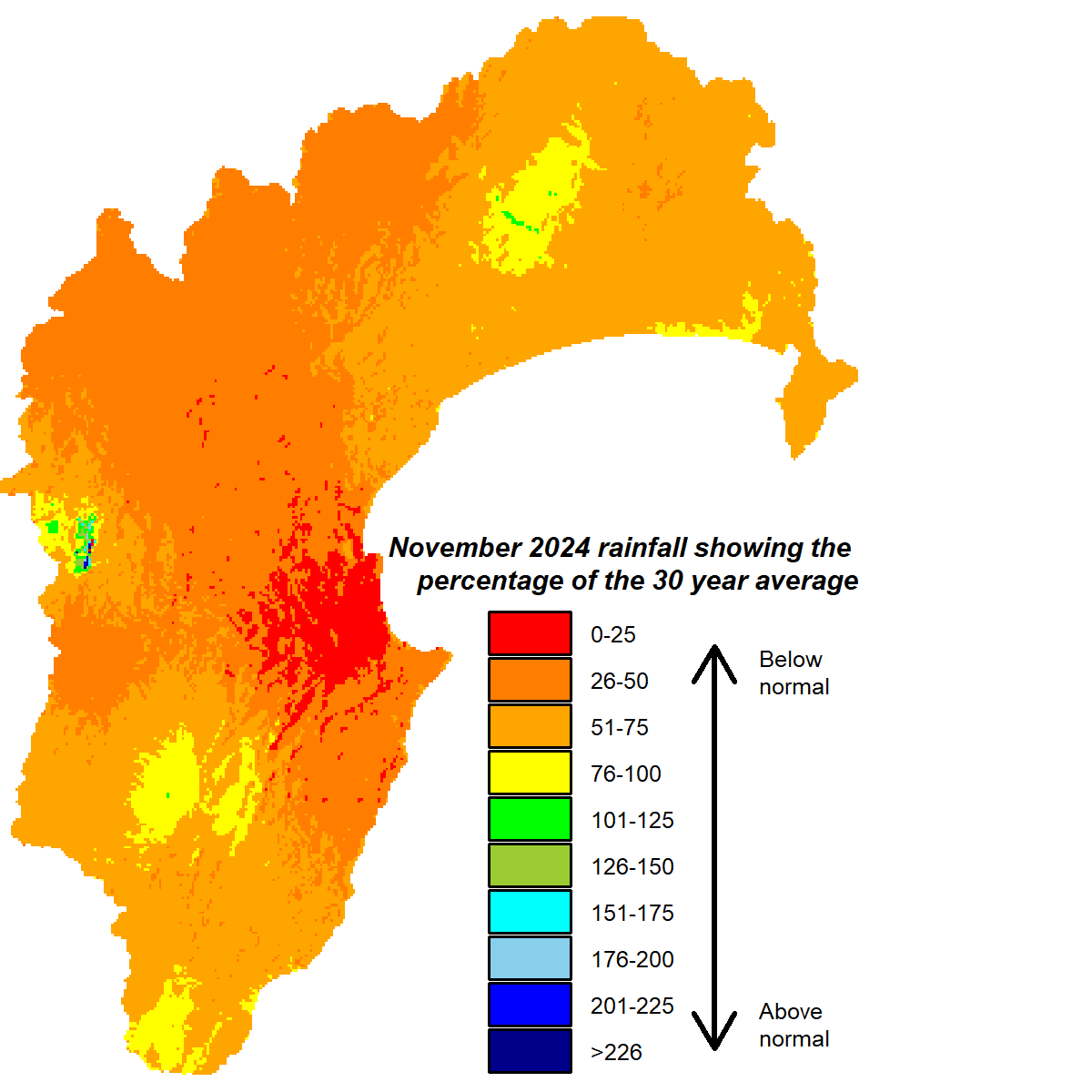
It was the driest spring the region has had for some time and rivalled the 2012-13 spring, which heralded one of the region’s worst droughts. It was the driest spring recorded at the Council’s Bridge Pa site on the Heretaunga Plains and contributed to a run of five consecutive months of below normal rainfall there. The lack of rain meant river flows, groundwater and soil moisture have all been running below average levels for the time of year. Warmer than average temperatures and, at times, windy conditions have only accelerated the drying trend.
As we run into Christmas, we’ve had some meaty showers traverse parts of the region and as I write, northern Hawke’s Bay has been doused with rain for a few days, with other areas seeing some of it. Unsettled weather continues as we make our way to the New Year. It seems we are being gifted some relief for Christmas.
Previous seasonal forecasts suggested our weather could start to turn. The pattern of higher than normal pressure extending over eastern and southern New Zealand was expected to progressively weaken and shift south, while lower than normal pressure extended eastward over the northern Tasman Sea. The current forecasts continue that theme. It gives us an easterly flow that arrives across seas that are considerably warmer than normal and enable plenty of moisture to be picked up enroute. We may not have an official La Niña but there are still hints of a La Niña influence. Summer rainfall could be near or above normal by the time the season ends and be accompanied by a good level of warmth.
All the best,
Kathleen
Presidents Report
The season to date continues to shape up nicely – Lots of activities happening on orchard with thinning well underway. Our overseas work force have started arriving with more coming in February ready for harvest time. On that note it was extremely unfortunate that a bus carrying 30 Tongan employees rolled while travelling from Auckland down to HB. We trust that everyone involved is now doing well and we are thankful there were no fatalities.
Yesterday we held HBFA’s annual fishing trip – what a fantastic day, I’m hearing there were plenty of fish caught. The boat I was on caught the 1st, 2nd ,3rd and 5th biggest kingfish (not by me) well done to the team on Stampede and to everyone who collected prizes. A big thankyou to all our sponsors and anglers who continue to support this great event. Thank you Bex, our fishing committee and all those involved in making this a special day in HBFA’s Calander.
The Hawke’s Bay Fruit Growers Association is 125 years old this year. 1899 – 2024. HBFA celebrated this a couple of weeks ago at Pask Winery. Around 75 invited guests came to celebrate this prestigious occasion. Both Mayor Sandra Hazelhurst and HORTNZ president and Chair addressed the attendees. Catherine Wedd, Tuki Tuki MP – Lesley Wilson, Chair of NZAPI – Nigel Bickle, CEO Hastings district council also attended. Many past and present executive members, life members and past presidents were amongst the guests. Guest speakers, David Mardon (past president and life member) spoke of his time involved in the Fruit growers John Paynter also spoke about his involvement in the horticulture industry and the heritage of his past family members involvement in HBFA. His grandfather was president and attended the 25th anniversary of HBFA and John himself attended the 75th and 100th anniversary. Leon Stallard also spoke of his time as president and the pioneering of the Young Fruit grower competition that originated here in HB under Leons reign. The orchardist / grower magazine will have an article in the December’s addition. This is a great milestone for HBFA, many district associations no longer exist but we have weathered the storms and remain a strong voice and support to not only our members but to the industry. I feel privileged to be president of HBFA at this special time it it’s history. Next year there will be a book released covering the last 25 years of our industry. This will follow on from the (First 100 years book written) in the earlier2000’s.
There are many reasons our association has remained strong. The willingness of HBFA’s executives both current and who have gone before us in giving of their time, energy, passion and desire to see fruit growing in HB remain successful and prosperous. There is a lot of time and resources that go into helping HBFA function successfully. For a long time now, the association has benefitted from owning three commercial properties down Omahu Rd. Two of the properties were purchased in 1967, and another one purchased in 1984. The rent received from these properties has enabled HBFA to function effectively for our growers. But we are growers and advocates for our members, not commercial property managers. Over the last 18 months / two years we have been in discussion with our tenants about the on-going work needed on these properties. It became very clear to us that the level of work needed to bring these properties up to a required commercial standard was going to be significant and extremely costly to the association. This would have meant borrowing vast sums of money. As flagged at our 2024 AGM in September, HBFA’s executives voted and decided to sell our properties. As of Friday November 8th, we no longer own these properties. We negotiated a private deal with a well-known family to our industry. Please note this decision did not come lightly amongst our team and there was plenty of robust and enquiring conversation held prior to this major decision. HBFA also engaged in professional commercial companies for advice and direction. For the interim the funds have been placed on fixed term interest. It is important to us that we remain prudent with the funds and over the next 12 months we will look at different options for longer term investment possibilities. Our members can be sure that anything we do regarding investment will be in the best interests of everyone and if needed expert advice will be sort in any major decision taken. I know it’s a long way off, but as always, our finances will be transparent and available to read in our financial report at the September 2025 AGM. I’d like to thank all our team members for their work in getting this over the line especially Callum, Tom Dams and Sheryl our accountant.
All our members will be receiving a survey shortly, please take the time to fill this in and give your thoughts. We are here to serve our growers so it’s important we here from you.
Our next event is down for February 3rd, our graduation and awards evening. Keep an eye out for more details.
Kia kaha
Brydon Nisbet
President HBFA
As November unfolds, we find ourselves balancing exciting celebrations alongside some of the most pressing challenges facing our industry. It’s a dynamic time of year, filled with opportunities to reflect on our shared achievements while also planning for what’s ahead. As the weather warms, so does the pace of the season. Orchards are buzzing with activity, and the demands on growers are increasing. Remember to take a moment to pause, breathe, and reflect on the incredible work you’re doing—not just to sustain your orchards, but to contribute to the vitality and prosperity of our entire region.
This month has been one of action and engagement. From celebrating the 125th anniversary of HBFA to our annual Fishing Competition, there’s been plenty to celebrate and enjoy. At the same time, we’ve been hard at work communicating critical updates, submissions, and events to ensure you stay informed and supported as the season heats up.
Looking ahead, there are several key submissions on the horizon, including updates related to water allocations (TANK), the Future Development Strategy (FDS), and the Joint Waste Management and Minimisation Plan and not forgetting the Governments Natural Hazards feedback (Each of these has significant implications for growers, and we’re committed to advocating strongly on your behalf. Keep an eye out for more detailed communications as these submissions progress.
Celebrating 125 Years of HBFA
On Saturday, November 2nd, we came together to celebrate the 125th anniversary of HBFA, and what a fantastic event it was! It was heartwarming to see so many growers, past and present, along with industry leaders, come together to mark this significant milestone. The stories shared, the camaraderie, and the reflections on our journey as an association made it a truly memorable evening. Thank you to everyone who attended and contributed to making this celebration such a resounding success. See below past Presidents and current.

Fishing Competition Success
The annual HBFA Fishing Competition has wrapped up, and what an incredible event it was! The weather was so perfect at times, with stretches of flat, “glass-like water,”. The turnout was fantastic, with boats filled to the brim with eager competitors ready to weight in their biggest catches (or the best fish tales, depending on who you ask). The enthusiasm was contagious—though we’re not sure if it was more for the fishing or the post-catch bragging rights back at shore.
A huge congratulations to the winners, and a heartfelt thank you to everyone who participated, sponsored and supported the event. Your efforts made this year’s competition one to remember. We’re already counting down to next year—rods ready, nets untangled, and stories slightly more believable.

Future Development Strategy (FDS):
We are actively in the FDS to ensure the voices of our growers are front and center. These discussions are vital for protecting livelihoods of our industry and ensuring long-term prosperity and securing food supplies. We ask that you contribute your thoughts to our Grower Survey on this topic, survey out now!
Joint Waste Management and Minimisation plan:
The council is seeking your feedback on how we manage resources moving forward. The next opportunity for you to provide input on the plan will be at the consultation stage, anticipated in April 2025, but now is the time to familiarize yourself with the plan and prepare to provide input. More info here
Water & the TANK Plan:
Water remains one of the most pressing issues for our region. The TANK plan and water allocation strategies are critical to our industry’s future, and we’ve been working tirelessly to communicate essential updates to growers. We’re making every effort to ensure that growers are informed, supported, and ready to meet the challenges of water management head-on. If you have questions or need more information, don’t hesitate to reach out.
Key dates for TANK:
• 29 November 2024, 4 PM:
If your water permits are expiring in May 2025, you must lodge replacement applications by this date to ensure your ability to continue taking water under your current consent while applications are processed. If you’re unsure what volume to apply for, we recommend applying for the same volume as your current consent. Look out for reminders from the regional council, and don’t delay!
• Early December 2024:
The regional council has indicated that an update on the processing of water permits will be provided in early December. Their last communication extended processing timeframes to 30 December 2024. Keep an eye out for this update, as it will provide critical information about next steps.
Natural Hazards submission: Building Resilience:
HBFA is contributing to the Building Resilience to Hazards – Long-term insights briefing, a critical discussion led by the Department of the Prime Minister and Cabinet. This initiative focuses on understanding and strengthening New Zealand’s resilience to natural hazards, including floods, droughts, earthquakes, and climate-related events. As growers, these hazards pose significant risks to our livelihoods, infrastructure, and long-term sustainability.
Key dates for Natural Hazards submission:
• Consultation Open: 1 October 2024
• Consultation Closes: 30 November 2024
• Insights Briefing Release: April 2025 (anticipated)
By actively engaging in these consultations, we ensure that growers’ perspectives are not only heard but also central to shaping policies that safeguard our industry and communities. This work reflects our ongoing commitment to protecting the long-term viability of horticulture in the face of increasing natural challenges. We encourage growers to stay informed and engage in future opportunities to influence these critical conversations.
________________________________________
The Hawke’s Bay Fruitgrowers’ Association (HBFA) is committed to aligning our efforts with the priorities and needs of our grower members. To ensure we focus our resources on the areas that matter most to you, we would greatly appreciate your input through the following survey. This survey is a valuable opportunity for you to share insights and feedback that will help us better address the challenges and opportunities within our industry. Your responses will remain completely anonymous, ensuring you can provide open and honest feedback.
Thank you for helping us shape a stronger, more responsive HBFA. Members, please watch out for the survey email and link following this newsletter.
HBFA Protect Foster and Promote dashboard below:

Reach out for support:
If you or someone you know is struggling, don’t hesitate to reach out. Contact me, Callum Ross, at HBFA, or directly connect with Wanda Douglas at 021 1700 506 or wandspsychology@gmail.com. Remember, seeking help is a sign of strength, and we’re here to support each other.
Warm regards,

Callum Ross
Chief Executive Officer HBFA & Chairman HAG (Horticulture Advisory Group)
NZAPI has begun a five-year project to find new and more effective ways to control bronze beetle after successfully securing additional funding from MPI.
The project is backed by $888,630 of funding from the Ministry for Primary Industries Sustainable Food and Fibre Futures Fund, with NZAPI investing $598,370.
The project will develop and trial new biocontrol products and develop a trap to monitor the beetle’s presence in orchards. It will also test biopesticides that are available in New Zealand and internationally that could be applied to the soil or tree, as well the use of endophyte grasses that might affect bronze beetle larvae. Bronze beetle chews through growing fruitlets leaving apples unsuitable for harvesting and eating. It can damage up to 25 percent of an organic apple crop and costs growers more than $13,000/ha per year.
NZAPI Research and Development Programme Manager Rachel Kilmister says the project seeks to develop a trap to help monitor populations of the pest and determine new bio control options. “Organic growers cultivate the soil to control the bugs, that disrupts the larvae and prevents the beetle appearing during spring. “Organic growers will often do about 11 or 12 cultivation passes during October and November, which does provide a level of control, but unfortunately not enough. It’s also less sustainable long-term as cultivation isn’t ideal for tree or soil health.
“In this research we’ll test pesticides that are available in New Zealand, and internationally, which can be applied to the soil or the tree. We’ll also look at whether endophyte grasses in and around an apple orchard emit natural chemicals into the soil that affect the bronze beetle larvae.” This latest research programme is a part of NZAPI’s research and development programme, which is currently running projects for fruit fly cold treatment, mealybug and more.
Late season Vigour management – Have you got the tiger by the tail?
By Meg Becker
Balancing shoot growth (vigour) is critical to good fruit production. Leaves supply all the energy for tree growth and fruit development, but shoots are greedy and excessive vigour will limit fruit size, yield, and quality.
Deficit irrigation. The first sign of water stress (before impacting fruit size) is the termination of vegetative shoots. This is a common practice, however, should be carefully managed so as not to impact fruit quality outcomes.
Summer pruning has multiple benefits, letting light into the canopy which improves fruit colour and sets buds up for next season. Removing shoots that generate carbohydrate that is not being partitioned into cropload reduces tree vigour.
Cropload is the most effective form of vigour management in any canopy system, however, achieving appropriate croploads in a high vigour block can prove challenging. Altering the leaf to fruit ratio helps improve vigour responses.
Plant growth regulators (PGRs) are an effective tool for managing vigour. Ethephon (Ethrel) and Prohexadione-Calcium (Regalis) are the two most broadly used in pipfruit.
Regalis suppresses growth-promoting plant hormone synthesis resulting in shorter internodes (shorter shoots) and less vigour within the plant in that growing season.
Ethrel is often used as an alternative and supports return bloom (important in a high vigour canopy).
These two products may be used in unison in excessively vigorous blocks.
Post-harvest pruning cuts can made while the tree is still in leaf. In doing this, the carbohydrate reserves are removed from the tree prior to senescence – managing the vigour response at the start of the next growing season. If you miss this window or need to spread labour, pruning at full bloom can be just as effective, this can also be beneficial in blocks where you need to ensure flower numbers prior to branch removal.
Summer girdling can decrease vigour and improve fruit size and return bloom when done correctly. Girdling can be carried out from petal fall through to the end of November/early December. The efficiency of girdling diminishes later in the season.
The depth of the girdle determines success in vigour management. The bark, phloem and cambium tissue should be removed down to the hard white xylem tissue.
Two opposing half C cuts, overlapping and, approximately 50mm apart – the closer the cuts, the harsher the girdle.
As a last resort, root pruning may be used when a block is completely out of control and everything else has failed. Root pruning is harsh, and after the last there wet seasons would be a last resort. Root pruning is also known to reduce fruit size outcomes.
Kia ora koutou,
The EIT year is ending and we are not much wiser as to what the future holds for our institution. What we have been told is that every individual program is being audited against a viability matrix, and any ‘under-performers’ will be closely scrutinized, and quickly removed from our offerings.
What this means is that EIT needs your support – we need enrolments for both our Fruit Production and Post Harvest Diploma programs and a solid steady stream into Certificate of Primary Industry Operation Skills and Level 3 and 4 fruit production courses. If we lose any of these programs, we will lose staff, and then the capacity to deliver in the future, so please continue to support us as you always have, but also, if you can organize enrolments before the end of the year, that will provide evidence to external auditors that we are working in partnership with our local industry, and are an important cog in developing capability for the primary production exports.
Steven and I are on the road and the phone encouraging students to get work in, aware of how busy they are getting at work. Our teaching is just about finished, so please reach out if your student is struggling with anything.
Noho ora mai
Clare, Steven, Chris and Warren.

The first two months of spring have been drier than normal and November is shaping up to be no different. Hawke’s Bay had 56% of average rainfall in both September and October and now sits on 33% of November’s average with two thirds of the month gone. Some areas in the region are having a particularly dry run, the worst hit being the Heretaunga Plains. It’s had four months of below normal rainfall and November will likely be its fifth. The area has received only 13% of its November average to date.
Spring has not only been dry but also warm. Daytime temperatures were more than 1°C above average in both September and October. Overnight temperatures were more subdued, but still near normal in September and above average in October. The warmth and lack of rain sent soil moisture tracking well below median levels for the time of year and likewise groundwater levels and river flows aren’t meeting monthly averages.
The rest of November may not offer much more rain but ingredients exist that should help beyond that. Sea temperatures are warmer than average around New Zealand and in areas where some of our storms originate, such as the Coral Sea and Pacific Islands. A La Niña occurring over summer is a 50:50 call but the Indian Ocean Dipole looks set for a brief negative phase which is more promising than not for our region. The Madden Julian Oscillation, which can promote tropical storm activity, might be active in the region north of New Zealand in early to mid-December.
Seasonal forecast models suggest summer winds will mainly be from the east to northeast (La Niña-like) due to higher than normal pressure over eastern and southern New Zealand and lower than normal over Australia and the Coral Sea. Stubborn anticyclones are currently keeping rainmakers at bay but the forecasts indicate that the dominance of high pressure will shift southward as we progress through summer and that the area of lower pressure will extend closer to northern New Zealand, enhancing prospects of rain. Near normal summer rainfall could be on the cards therefore… hopefully not arriving in one devastating dump. Temperatures should be toasty for the season, spurred on by the warm seas.
All the best,
Kathleen
Presidents Report
I want to start this report with congratulating Grace Fulford currently working at T & G Global for winning the 2024 National Young Grower of the year competition held on the 10th of October at Toi Toi. Grace also took out the winner of the young fruit grower section and the overall practical section of the competition. Well, done Grace we are all so proud of you. Later next year Grace will compete in the supreme “New Zealand Young Horticulturist of the year which will be held in Auckland. This competition includes other young growers from the Wine industry, NZ Arborists, Master landscapers, Amenity, Florist & Flower & NZ young plant producers. The past 2 winners of this competition have been won previously from our own National Young Grower’s competition. Our own HBYFG event is planned for early next June, so I encourage all our employers out there to encourage your standout employees and rising leaders to consider entering our comp. Details will be available early next year.
HBFA turns 125 this year – 1899 – 2024. To celebrate this, we are gathering many past presidents, executives, life members, dignitaries and key people who have been involved in our association to a cocktail event to celebrate this milestone. There is also a book getting written which will cover the last 25 years of the fruit growing industry in HB. This follows on from the first book written which covered the first 100 years of HBFA. This book will be made available to all our members once it comes out.
11th of November will see our annual Fishing competition get going. This is a standout event with over 100 keen fishermen from our industry enjoy a great day out and compete for outstanding prizes supplied by our sponsors – we so appreciate their willingness to support our industry.
As I drive around HB, I note the orchards are looking great. My blocks are currently around 20 days earlier than last year and I’m sure many other orchards are in a similar situation. This is good news, with everything pointing to early thinning and harvest windows. It’s shaping up to be a year where we will be needing to irrigate – “foreign” considering the last few years of very limited irrigation needed on most orchards.
I note the report put out by NZAPI in the media shows just how valuable the apple and pear industry are not only to our region but also to the national economy. This is great for NZ but as growers we need our orchard gate return (OGR) to significantly increase to make for happy growers. Currently our on-orchard and post orchard costs are so high that our margins for profitability are very narrow. This to me is the most important issue we are facing as growers, and we need to work together with industry and Govt to find solutions.
Take care – enjoy your time off this labour weekend.
Kia kaha
Brydon Nisbet
President HBFA


